All posts by yogafrog

The Noise of Time

THE BOOK:

9781101947241

I looked forward to the release of the latest from Julian Barnes after reading The Millions’ recommendations for books coming out in June 2016, of which this was one. This is Barnes’ stream-of-c0nsciousness imagining of Dmitri Shostakovich’s reflection on his life during a particularly dark time in 1936 when Stalin had taken an interest in his work. In Shostakovich’s case, that was not a good thing. What struck me the most about poor Shostakovich, was how Fascism ruled his art. How fear ruled his life. What might he have written had he not been ordered to represent Soviet values to the exclusion of his own musical sensibility? This book, and Barnes’s writing, more than any other of the same period, left me feeling uneasy, claustrophobic and unable to breathe as I sympathised with Shostakovich and his artistic dilemma. Without spoiling the book, I offer just one example of how he was under Stalin’s thumb, and how it pained him to have to put forward the party line. Shostakovich loved Stravinsky and considered his “Symphony of Psalms” to be one of the most brilliant works in musical history. Hoping to meet him in New York at the Cultural and Scientific Congress for World Peace in New York City in 1949, he was disappointed when Stravinsky sent his regrets, stating in a telegram that “[he would] not be able to join welcomers of Soviet artists coming [to] this country. But all my ethic and esthetic convictions oppose such [a] gesture.” Then, at a press conference where Shostakovich was required to read a prepared speech, Nicolas Nabokov, (a Russian born, U.S. citizen, composer, writer and cousin of Vladimir) aware that Shostakovich was not able to speak his own mind, publicly asked whether the composer supported the denunciation of Stravinsky’s music in the Soviet Union. Shostakovich had to answer in the affirmative. (He never forgave Nabokov for this episode of humiliation.) All of this begs the question, why didn’t he leave the Soviet Union? Apparently lacking in self-confidence, was he also a coward, or lazy? Why was he content to loathe himself privately, instead of finding a way to write the music of his heart, the music that he wanted to write? There is a lot of wisdom in this book, and being by Julian Barnes, of course it’s well-written.

One final personal connection. At one point, Shostakovich wonders whether irony might enable him to preserve what he valued. Could irony protect his music? This struck me because I had just read that Shostakovich loved Shakespeare. “How was it possible not to love Shakespeare? Shakespeare loved music.” Ironically, I was reading, concurrently with The Noise of Time, Shakespeare’s As You Like It, and NOT loving it. Ultimately, I ended up enjoying the play, once I sort through all the characters and plot lines, but at the point where I read about Shostakovich’s (and Russians’ in general) love of Shakespeare, I was feeling personally very un-Russian, yet somewhat ironic.

THE BEAUTY:

Of  course the beauty had to be Shostakovich’s music. Not being familiar with it, I took to the Internet to find music that is accessible to me. (Yes, my blog, my musical sensibility!) While there is plenty of beauty in the dissonant, mournful, and melancholy, I searched for something more upbeat, so here it is: Piano Trio No. 2 in E Minor, Opus 67, Second Movement, Allegro Non Troppo.


THE FOOD:

There was little specific mention of food that I recall. When Shostakovich made his trip to New York for the Soviet dog-and-pony show in 1949, he is surprised by American journalists who wanted to know trivial details, in his opinion, about the Soviet delegation. They went so far as to interview the stewardess who had served them on the plane, and then duly reported in the New York Times that the Soviets chatted and drank dry martinis and Scotch and soda.

According to Shostakovich, “There is only good vodka and very good vodka-there is no such thing as bad vodka. This was the wisdom from Moscow to Leningrad…But there was also American Vodka, which, he had now learnt, was ritually improved with fruit flavors, with lemon and ice and tonic water, its taste covered up in cocktails. So perhaps there might be such a thing as bad vodka.”

So, here is my challenge to that thinking. When I make raspberry jam every summer, I use the leftover pulp and seeds I extract from the crushed berries to make – (wait for it) – flavored vodka! Before you judge, make it, taste it, and then tell me it’s not delicious!

Raspberry Hooch

raspberry seeds and pulp
1.75 liters vodka

I used 5 pints of fresh raspberries, but you could probably use frozen. (If you use frozen, you’ll need less overall, because you’ll use all the juicy pulp rather than straining it for seedless jam.)  I put the whole, washed berries through the KitchenAid stand mixer attachment for fruits, using the juice and pulp for jam and reserving the seeds and leftover pulp for flavored vodka. After making the jam, I divided the leftover seed and pulp mixture among three quart mason jars, and then filled them with vodka. I shake them and store them in a cool, dark place (basement) for about 6 weeks, or longer. Strain the mixture through a fine mesh sieve, pressing out as much liquid as you can. I like my hooch very clear, so I then strain it through a coffee filter-lined strainer. Be patient. This could take some time, but it’s worth it in the end. Once you have your strained raspberry vodka, add  simple syrup to taste. You can use commercial or make your own by warming equal parts water and sugar in a saucepan over medium heat until the sugar is dissolved.

Serve in cordial glasses. Na zdorovye!


Life in a Jar: The Irena Sendler Project

THE BOOK:

9780984111312

What makes memoir/non-fiction great is that because the events described really happened, you don’t have to suspend belief, no matter how much you may want to. Some of the things in this book left me feeling astounded that people can be so cruel, so inhumane.  What makes this story even scarier is the context in which I read it now, as the race for the presidential candidates heats up in 2016. The demonizing of Jews and Poles in this WWII story was the environment in which such atrocities seemed  inevitable. Sadly, the foundation upon which such horror was built was xenophobia and nationalism. Similar rhetoric has been making the news here. Build a wall!  Restrict Muslim immigration! Make America great again! This rhetoric keeps the power and the money where it currently lies, and makes America great for the privileged few. These are not the ideals upon which our country was founded. They are not mine.

This was such a difficult and depressing read, but with an important message. Irena Sendler was a Catholic Polish social worker in Warsaw during WWII. Her goal initially was to provide food and shelter for the Jews of the ghetto who were her clients. Later, her goal was to find safe harbor for as many Jewish orphans as she could. Irena’s Jewish friend, Ewa, asked her to bear witness to the atrocities committed against their neighbors and friends. And that is what she did, many times, watching her neighbors being marched to their demise, until finally she witnessed the Nazis marching her friend, a Jewish doctor and savior of orphans, to the depot where he would be forced into a train for passage to a death camp. As students of history we are taught to believe that we have a chance to prevent things like the Holocaust from happening again if we learn from the past.What made Irena Sendler risk her life to save Jewish orphans was her upbringing. Her father had taught her when she was very young and reinforced it throughout her life: when you see someone drowning you must save them, even if you can’t swim. You must do something. When that is repeated regularly to you as a child, that becomes your moral compass. It explains, why, when asked how she found the courage to do what she did,  Irena said, “It was a need of my heart.” This brave woman, very simply, did what she had to do. She did not think she was a hero. Her only regret was that she couldn’t do more, save more children. Extraordinary story.

THE BEAUTY:

While she still had a radio, Irena found some comfort in the beauty of the music of Chopin. From another book I’m reading, I just learned about Wladyslaw Szpilman, a Polish Jew who played piano on Polish Radio until it was bombed in September of 1939 after Szpilman’s last Chopin concert aired. His remarkable story of survival at Treblinka is the subject of his biography, The Death of a City by his friend, the writer Jersy Waldorf, and the Roman Polanski film, The Pianist. That last Chopin piece was Nocturne in C sharp major, played here by Janusz Olejniczak in The Pianist.


THE FOOD:

Food was rationed in Warsaw during the war, and if you were Jewish, you were surviving on under 300 calories per day. Frequently, Irena’s main meal consisted of black bread and soup (euphemism for broth), or bread and jam, or just bread. The recipe for Polish Black Bread below comes from a YouTube video “How to make Polish Black Bread.”

POLISH BLACK BREAD

2-3 tsp. dry yeast                              3 T unsweetened cocoa
3 T vegetable oil (not olive)            1 ½ tsp. salt
2 T molasses                                        1 ½ C lukewarm water (105º)
4 C all purpose white flour

To proof the yeast, place it in a bowl with the lukewarm water. Stir gently to mix. Gently stir in molasses. Set aside for 10-15 minutes until surface is foamy. (Longer if needed) Place dry ingredients in another bowl: flour, cocoa powder, salt. Mix with spoon until the color is even throughout.

Pour the yeast mixture into the bowl with the dry ingredients. Stir to mix and add 3 T oil. Stir to mix. Knead dough on floured surface by flattening, fold over, flatten, turn dough ¼ turn. Repeat several times. Form dough into ball and place in a bowl. (You can oil the bowl to prevent sticking, but I haven’t found it necessary.)  Cover bowl with a light towel and let it rest in a warm place until dough has doubled, 45 minutes to one hour. To test for  readiness, poke the dough with your index finger. If the indent remains, the dough is ready.

Grease and lightly flour a baking sheet, or cover with parchment paper. Sprinkle dough with flour. Flatten, fold in left and right sides, then top and bottom sides. Bring the seams together and pinch to close the seams. Shape into an oblong or round loaf. Place on prepared baking sheet, cover, and let rise again, 45-60 minutes.

After 45 minutes, check to see if dough has risen. Preheat oven to 350º. Make 3 slits evenly spaced across the top of the loaf using a sharp knife. Cover dough until oven has come to 350º. Place loaf in oven and bake for 45-60 minutes.

Remove bread from oven and let cool on a rack.


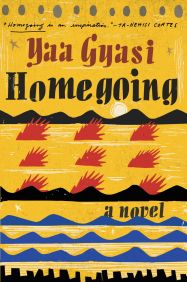
Homegoing

THE BOOK:

Homegoing-Cover-Image

This book was on many bookseller’s and bloggers most anticipated of 2016 books list, and for that reason, it has been on mine. Fortunately, I must have put in my library hold before anyone else in town heard about it, because it was released in June, and I just finished it this morning. It is rumored to have received a seven figure advance for 25 year-old Gyasi, and in my opinion, it was worth every penny. Each chapter tells a story of Ghanian half-sisters Effia and Esi, and their progeny through the generations. Effia’s side remains in Ghana, while Esi’s family winds up in America. Most of the book was difficult to read because of the brutality of the slave trade, wars between the Fante and the Asante, Jim Crow, plantation slavery, and miner’s working conditions, to name a few. Having just finished an amazing book about heroism in WWII, my spirit is weighed down by man’s inhumanity to man, and yet, I know these stories are important, and, as in Gyasi’s case, I am drawn to them because of the promise of the beauty of the prose. The scene where Yaw takes Esther to Edweso to visit his mother is achingly beautiful. He weeps, she comforts, he begins to forgive. She tells him his family history. “What I know now, my son: Evil begets evil. It grows. It transmutes so that sometimes you cannot see that the evil in the world began as the evil in your own home…When someone does wrong, whether it is you or me, whether it is mother or father, whether it is the Gold Coast man or the white man, it is like a fisherman casting a net into the water. He keeps only the one or two fish that he needs to feed himself and puts the rest in the water, thinking that their lives will go back to normal. No one forgets that they were once captive, even if they are now free.” This is so reminiscent of the Native American parable of the two wolves that live inside you, hate and evil and love and forgiveness. The one that lives is the one that you feed. (This was from the book,  Life in a Jar: The Irena Sendler Project.)

THE BEAUTY:

Trying to find the beauty for this book was hard because of the cruelty that was leveled upon, and propagated by, in some cases, generations of this family. I then turned to the last pages of the book that were very satisfying to read, and I found it there: home. Marjorie has encouraged Marcus to join her in the water, and despite his fear of it, he does, and when he does, she says, “Welcome home.” Home has so many meanings. It can be the place where you grew up, or where you currently reside, or a place that brings you joy, even if you don’t spend much time there. It can mean being in the company of those who make you feel safe and loved. For Marcus, it was finding his heritage, connecting the disparate dots of information about his ancestors in their homeland, Ghana with the woman he loved.

cape-coast-castle02
Image from http://www.traveladventures.org

This is a beach outside Cape Coast Castle to which, in the final scene in the book, Marcus flees from “The Door of No Return.” It is the beach where Marjorie’s grandmother took her on her annual visits to Ghana. It is where Marjorie welcomed Marcus home. Cape Coast Castle was where slaves were held before being shipped off to America. They were held in the very bottom of the castle, the dungeon. They were packed in so tightly, they could not move. There was no bathroom, no food, just bodies piled in a dark cramped space. When Marjorie and Marcus visited the Castle, Marcus was overcome by the horror of those conditions in the place where his ancestors were once held.

THE FOOD:

There was a lot of food mentioned in the book, but the recipe that made the most sense to represent it was groundnut, or peanut, soup, as illustrated by the simile in the passage that follows. James, Effia’s grandson, gets a lesson about politics in the Gold Coast, when he learns that the Asante king, Osei Bonsu, his grandfather, has died.
“The Asantes are saying we killed their king to avenge Governor McCarthy’s death.”
“And did you?” James asked, returning the man’s stare with force, anger beginning to boil up in his veins. The white man looked away. James knew the British had been inciting tribal wars for years, knowing that whatever captives were taken from these wars would be sold to them for trade. His mother always said that the Gold Coast was like a pot of groundnut soup.  Her people, the Asantes, were the broth, and his father’s people, the Fantes, were the groundnuts, and the many other nations that began at the edge of the Atlantic and moved up through the bushland and into the North made up the meat and pepper and vegetables. This pot was already full to the brim before the white men came and added fire. Now it was all the Gold Coast people could do to keep from boiling over again and again and again.”

Peanuts were introduced into West Africa from South America via the Portuguese and replaced the native bambara groundnuts. Meanwhile, in much of Ghana, the prevalence of the tsetse fly made cattle-rearing impossible, which led to a diet without milk or dairy products. In order to make rich, creamy soups or stews, thickeners like ground legumes, nuts, melon, sesame seeds, pureed vegetables, okra, palm butter or ground peanuts were used.

Groundnut soup is made from a basic chicken stock and is very flexible: one can use more or less peanut butter, or add a variety of vegetables from eggplant to mushrooms. Also, the recipe can be easily adapted to a vegetarian version by substituting fish stock or vegetable stock for the base. However, besides peanut butter, the holy trinity of Ghana’s cooking, tomatoes, peppers, and onions, are necessary ingredients. Serve with cooked rice or rice balls, or boiled potatoes.

Only use peanut butter that has no additives, and especially no sugar! I used Teddie because it contains only peanuts and salt.

1 onion, finely chopped
1 13 oz can of chopped tomato
1 1/2 C creamy peanut butter
4 C boiling chicken stock, vegetable stock, or water, divided
1 red pepper, chopped
2 C mushrooms, quartered
2lb cooked chicken, shredded

Liquify the tomatoes (in a blender) or with immersion blender in a large pot. Mix in the chicken with about a cup of stock, and bring to a boil.

In another bowl mix the peanut butter with 1 1/2 cups stock. Stir until you have a creamy sauce.

Put the peanut butter mix in the tomato and chicken mix. Add the rest of the ingredients and stir together. Cook over medium heat for about 20 minutes stirring frequently. Add salt and pepper to taste and serve hot.


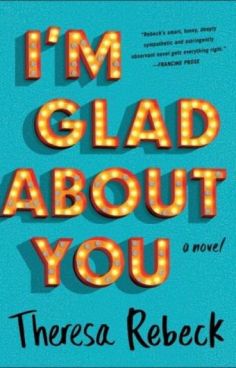
I’m Glad About You

THE BOOK:

71328669-368-k671665

When I heard about Theresa Rebeck’s new book, I was excited because I loved the TV show “Smash” about the making of a Broadway musical starring Debra Messing, Brian d’Arcy James, Anjelica Houston, and others. I was prepared to love it and raced through the book.   I was surprised by the way it ended, and had to read the last chapter a couple of times to fully take it in. Alison and Kyle, are high school sweethearts, in an on-again, off-again relationship. He dreams of opening a clinic in some remote part of the world where he can care for sick children, and she longs to be an actress. Neither one really ever gets what they were looking for, and both end up reinventing themselves by the end of the book. How different the Midwest is made out to be from New York in Alison’s musings. She couldn’t wait to get out of Cincinnati, but finds that she doesn’t really fit in in New York, in a kind of “you can take the girl out of the Midwest, but you can’t take the Midwest out of the girl” way. Kyle is a practicing Catholic, and although Alison doesn’t believe in organized religion, the two used to get into heated discussions when they were teenagers when Kyle would read aloud to Alison from whatever he happened to be studying at the time. For example, Kyle enjoyed the writing and philosophy of Thomas Merton, an American mystic and Trappist monk who lived at Gethsemani Abbey in Kentucky. (The Abbey figures prominently in the plot and in Kyle’s spiritual life.) Merton wrote his autobiography Seven Storey Mountain and about 60 other books and is considered the most influential American Catholic author of the twentieth century. Alison preferred Teilhard de Chardin, a Jesuit who was exiled to China by the Church where he played a part in excavating Peking Man.

In a scene where Alison reveals to Kyle’s wife and friends what his heart’s desire was professionally when they were teenagers, we learn  what the title of the book means. Although I was completely charmed by the revelation, subsequent googling failed to support the idea that there is no Navajo way of saying “I love you.” (Ayoo anii nishni) Nor could I find evidence that the Navajo people don’t believe in possession. I will acknowledge that a cursory search and subsequent reading of articles about Navajo culture and language was not an exhaustive process and that I might have missed something had I explored in more depth.

I love this sentence fragment from page 140: “…but an answer to their yearning for relief from the exhaustion of what it means to be human.” Some days, it truly is exhausting to be human!

Serendipitously, this book takes place primarily in Cincinnati, as does Eligible from my previous post. I’m not sure what that means, if anything, but it struck me that two randomly selected books would be about a midwestern city I knew nothing about. So what does Cincinnati, the word, mean? I conjectured that it was of Native American origin, and I was wrong. Cincinnati was originally called Losantiville when it was founded in 1789. A year later the name was changed by then governor Arthur St. Claire in honor of the Society of the Cincinnati, a fraternal veteran’s organization founded by former  Revolutionary War officers, of which St. Claire was a member. The organization was named for Lucius Quinctius  Cincinnatus, a Roman hero who saved the city and then retired to his farm rather than rule Rome. His name roughly translates to “with curly hair.” Losantiville means “the city opposite the mouth of the Licking River.” It was named by the original surveyor, using four terms, each from a different language: “ville” is French for city, “anti” is Greek for opposite, “os” is Latin for mouth, and L was included for Licking River. When I consider all of things I don’t know, it’s no wonder I’m no Jeopardy champ!

THE BEAUTY:

Since I have already written about the beauty of Cincinnati, and since Theresa Rebeck currently lives in Brooklyn and is an honored Broadway playwright, I have posted an excerpt from her play “Seminar,” starring Alan Rickman, Lily Rabe, Hamish Linklater, Jerry Connelly and  The production premiered at the Gold Theater on November 20, 2011 and closed on May 6, 2012. Four young writers in New York City have paid $5000 each for a ten-week seminar with Leonard, played by Rickman and held in Kate’s (one of the writers) Upper West Side apartment. Rickman gets to eviscerate not only their writing, but the very core of their existences. And it’s Alan Rickman. Long live Snape!

src=”https://www.youtube.com/embed/pIVCtBz1Ivo?rel=0&#8243; frameborder=”0″ allowfullscreen></iframe>

THE FOOD:

The food comes from a dinner party hosted by Susan, Kyle’s sister, during which discussion turns to Alison’s upcoming debut on a popular TV show. Van, Kyle’s wife, raises the tension around the dining table with her persistent questions about Alison. I loved how Kyle’s father brought the discussion to a close with his final remarks during “Grace” before dinner: “Look kindly on us as we gather in your name, and keep an eye on your daughter Alison, who has run off to the big city to follow her dreams. Some of us think that may have been a mistake and that she will need your guidance there, as we need it here. Amen.”

When Van compliments Susan on the chicken, she remarks that she always thought it was a Southern dish.  Bill, Kyle’s father, says that Cincinnati really is a Southern city, as it is situated across the river from Kentucky and was one of the first stops on the Underground Railroad.

SOUTHERN PECAN CRUSTED CHICKEN WITH MUSTARD SAUCE

3⁄4 C pecans                             1⁄4 tsp dry mustard
2 T cornstarch                        2 T fresh parsley, chopped
3⁄4 tsp dried thyme               1 egg
1⁄2 tsp salt                                4 boneless skinless chicken breasts
1⁄4 tsp cayenne pepper         2 T vegetable oil

In food processor, finely chop pecans, cornstarch, thyme, salt cayenne and dry mustard. Whirl in parsley. Transfer to shallow bowl; set aside.

In separate shallow bowl, beat egg. Dip each chicken breast into egg,
then into pecan mixture, coating both sides well. (Make ahead:
transfer to platter and cover loosley with plastic wrap;
refrigerate for up to 2 hours.)

In large nonstick frypan, heat oil over medium heat; cook chicken,
turning once, for 15 to 20 minutes or until no longer pink inside.

Sauce: Meanwhile, in small bowl, whisk together sour cream,
Dijon mustard, sugar and salt. Serve with chicken.


Eligible

THE BOOK:

b99701545z.1_20160415094408_000_goif96j6.1-0

Never having been on the Jane Austen bandwagon, I had to read the Sparks summary of Pride and Prejudice to familiarize myself with the book, despite having seen at least one film version. Sittenfeld appears to have remained true to Austen’s intent, and this was an enjoyable read, with memorable characters and an interesting plot. I loved learning a bit about Cincinnati, and its decline as railroad travel took a backseat to air travel. In this version of the Bennet family, older sister Jane is a yoga instructor while Liz , closest to her in age, is a magazine writer in New York city. Both women are approaching forty when they return home after their father’s heart attack to help with his care. Liz is very quick-witted with a sharp tongue and keen observational skills. Prejudice is alive and well in “Queen City” society as Mrs. Bennet looks forward to meeting “Eligible” Chip Bingley, a newly transplanted doctor, who is rather publicly looking for a wife. At the introductory barbecue at Dr. Lucas’s home in the posh Indian Hill neighborhood, Liz overhears Fitzwilliam Darcy, Bingley’s good friend, severely disparage the women of Cincinnati and thus begins their hate fest. I had never heard of hate sex before, but I am seriously afraid to google it, so I’ll just have to accept that there is such a thing in this modern era of which I am so not a part! Mr. Bennet is rather disengaged from the family, but has a reasonably close bond with Liz as she takes charge of family business. Younger sisters Kitty and Lydia are remarkably crude and jobless. Mary, the middle daughter is working on her third Master’s degree and won’t reveal to the family what she does every Tuesday night.

People who know me will understand why I particularly like the following passage from page 29:
“That her mother devoted extensive attention to housewares was not news …
So, no, it wasn’t a secret that her mother fetishized all manner of domestic decor, but the sheer quantity in Jane’s former bedroom, plus the fact of so many boxes being unopened, raised for Liz the question of whether some type of pathology might be involved.”

The book came to a satisfying end but was a puzzlement for me about why the conclusion was so focused on Mary. Having just read chapter 61 of Pride and Prejudice, I still don’t get it.

THE BEAUTY:

When I started thinking about images to represent beauty in Cincinnati, I settled on Liz’s running route: past the country club, right onto Madison Rd., right onto Observatory Ave., right onto Edwards Rd., and back to Grandin Road. Then I googled Cincinnati, and the first thing that came up was that Hillary Clinton and Elizabeth Warren were having a rally at the Cincinnati Museum Center at Union Terminal. Further googling revealed these stunning images of a beautiful public space.

rotunda-interior
View of the rotunda from the Cincinnati Museum website.

a_092808_cStation13
Segment of the history of Cincinnati mural from http://www.justabovesunset.com.

84.12.2

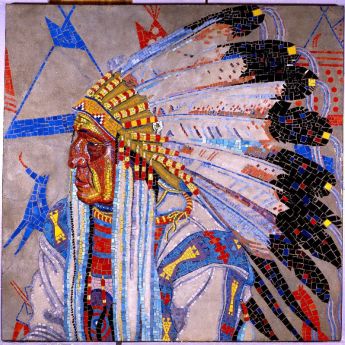
Detail of the portrait of Blackfoot Mike Little Dog from The Wolfsonian–Florida International University, Miami Beach, Florida, The Mitchell Wolfson, Jr. Collection. URL: 84.12.2.JPG

Winold Reiss created two 22 foot high by 110 foot long color mosaic murals depicting the history of Cincinnati and a timeline of U.S. history for the rotunda. In addition, he created twenty more murals for other parts of the building, and a large world map.

THE FOOD:

Members of the Bennet family continually reported seeing Darcy at Skyline Chili on Madison Rd. in Oakley. I am a hot dog lover and purist who would never defile a dog with chili, but since this was the perfect food to represent this book, defile I did, and it was good!

Copycat Skyline Chili
2 lbs ground beef (I used flap meat [steak tips], cut into 1 inch chunks, frozen for 15 minutes, ground in food processor)
2 cups chopped onions
4 cups beef stock
2 (8 ounce) cans tomato sauce
2 -3 tablespoons chili powder
2 tablespoons apple cider vinegar
2 teaspoons Worcestershire sauce
1⁄2 ounce grated unsweetened chocolate or 2 3⁄4 tablespoons cocoa
2 teaspoons instant minced garlic
1 teaspoon ground cinnamon
1 teaspoon ground cumin
1⁄2 teaspoon salt
1⁄2 teaspoon ground red pepper or 1⁄2 teaspoon cayenne pepper
1⁄4 teaspoon ground allspice
1⁄4 teaspoon ground cloves
1 bay leaves or 1⁄8 teaspoon bay leaf powder

Toppings:
chopped onion (optional)
finely shredded cheddar cheese (certainly NOT optional)
kidney bean (optional)

DIRECTIONS

Brown ground beef and onion. Drain. Add beef stock to beef mixture and simmer 10 minutes. Add remaining 13 ingredients, simmer uncovered 1 hour.
Remove bay leaf, skim off extra fat.
Serve over hot spaghetti, or hot dogs in buns for chili dogs.
Top with plenty of cheese and other optional toppings.

The Portable Veblen

The Book: 41jgJbfo7eL._SY344_

As someone who once posted a scoreboard in the kitchen with the statistics Squirrels 3, Jim 0, this book had me before I even cracked the cover. And when I did, meeting Veblen Amundsen-Hovda was a treat. How can you not love a woman who makes retching sounds like she’s being strangled on the phone to telemarketers before hanging up on them? There was so much for me to love in this book, starting with the name of Veblen’s street in Palo Alto. Tasso Street was named after a sixteenth century Italian, mentally ill poet, Torquato Tasso. And what’s more fun than a dysfunctional family?  Why, TWO dysfunctional families, of course. And the squirrels. Right after Paul proposed with a big honking diamond, (so not Veblen’s style) the squirrel that had been watching them looked at her as if to tell her, “I was cut loose from a hellish marriage, and I want to meet muckrakers, carousers, the sweet-toothed, and the lion-hearted, and you don’t know it yet, but you are all of these.”

Veblen is named after Thorstein Veblen, an American economist and sociologist who was famous as a witty critic of capitalism. Veblen coined the phrase “conspicuous consumption.” Melanie, Veblen’s mother, and a huge presence in her life, was a Veblen scholar with some secrets. Veblen (the woman, not the sociologist) had come to realize that instead of looking for a love affair all those years, what she really sought was a human safe house from her mother. Veblen writes of her love for her namesake, “because he lived true to his beliefs, and committed not a hypocritical act in his life.” About Paul, her fiancé, she wonders. “Was it possible to love the contradictions in someone? Was it all but impossible to find someone without them?”

The book is about Paul and Veblen’s journey as a couple. Throughout most of the book, I thought she and Paul were horribly mismatched, but a squirrel-induced catastrophe intervened, transforming Paul into Veblen’s soulmate. Yay. She deserves one. (We all do.) I love all the philosophical musings and the descriptions of Veblen’s natural world. Nature is very much a character in the book.

THE BEAUTY:

Veblen has a very personal and unique relationship with the natural world, that is evident in her interactions with the outdoors. When she first laid eyes upon what was to become her house, “It was a warm night in September, that night… she crunched the sycamore and magnolia and locust leaves on the sidewalk. Just before she reached the end where the street met the arroyo, she passed a small house so overgrown with vines that the windows were no longer visible. The yard was neck-high with weeds and ivy and morning glory, and in the gentle air of evening she heard the flap of a tarp on the roof, laid over the old shingle.”

Sycamore tree    magnolia-5            locust_black150

Sycamore                                  Magnolia                                                             Locust

Later, after Paul proposed and met Veblen’s mother and stepfather, “Spring had come. Bright-headed daffodils elbowed through the soil, yellow acacia fanned the rooftops, humming with trains of bees.”

Delightful Daffodils    Acacia_covenyi02
Daffodils                                                                      Acacia

THE FOOD:

When Veblen first took Paul to meet her mother and stepfather, Linus, Melanie made an artichoke casserole with Asiago and bread crusts for lunch. Here is my version with some  chicken added to make it more of a main course than a side dish.

Chicken Artichoke Casserole
serves 6

3 cups chicken, cooked                                              1 tbsp olive oil
¼ cup green onions                                                   1 ½ cups Romano cheese croutons
1 cup red bell pepper                                                   1 cup Asiago cheese
1 container Alfredo pasta sauce, 10 oz.                  1 can artichoke hearts in water
½ cup mayonnaise

Heat oven to 350º F. Spray 11 x 7 inch (2 quart) baking dish with cooking spray. In 6 inch skillet, heat olive oil over medium heat. Add bell pepper and green onions and cook 2-3 minutes, stirring occasionally until bell pepper and onions start to soften. In large bowl. mix remaining ingredients except croutons. Spoon mixture into baking dish and top with croutons.

Bake 30 to 35 minutes or until hot and bubbly. Sprinkle with additional sliced green onions before serving.


The Revolving Door of Life

THE BOOK: 

9781101971918

Alexander McCall Smith’s work is my guilty reading pleasure. Thankfully, he is a prolific writer with several series going at once. I began with The No. 1  Ladies’ Detective Agency with protagonist Mma. Ramotswe, then moved quickly into the Portuguese Irregular Verbs series, followed by the Isabel Dalhousie series, 44 Scotland Street, and finally Corduroy Mansions. Then there are the stand-alones, but I won’t go there now. Each time a new book is released, I feel like I’m taking a vacation with my fictional friends, and when I finish a book, I miss them, as though they are real. This latest installment of the 44 Scotland Street series did not disappoint. It had everything I have come to love from this author: cultural references, literary references, real places and events, ruminations, meditations, digression, philosophical discourse and moral dilemmas. The substance of this post will be an excerpt from the story that encapsulates the examination of the ordinary things of daily life that give our lives meaning. So many times when I read a McCall Smith book, I pause, and say, “Yes. I know what you mean. I feel that way too.”

A pair of occupants of 44 Scotland Street, artist Angus Lordie and his bride of only a year, Domenica MacDonald, have been invited to a reception to mark the appointment of the coming year’s Artist in Residence, to be held at the City Chambers on High St. At first Angus doesn’t want to go, and questions why they were invited in the first place. Domenica reminds Angus of his reputation as a portrait painter, suggesting that perhaps the new artist in residence has an interest in portraiture. Angus pooh-poohs that notion, asserting that nobody is interested in portraiture anymore. Nonetheless, they accept the invitation. The following excerpt, of which I have left out some detail, takes place at that reception. Domenica has left Angus to get them some wine, encouraging him to seek out someone to talk to. The excerpt begins as Angus turns to make his way through  the crowd that had thronged at the entrance, and I’m calling it “A Moment of Mystical Insight.”

“On the other side of the room, from the windows facing north, a view of the city revealed itself: spiky rooftops, stone crenellations, angled expanses of dark grey slate, all touched with gold by the evening sun. His artist’s eye caught the view and made him stop for a moment where he was, halfway across the room, and stare at what he saw. And for a moment he felt a strong sense of delight in belonging to this place, this city that vouchsafed to those who lived there, and to those who came in pilgrimage, sudden visions of such exquisite fragile beauty that the heart might feel it must stop. And it was his; it was his place, his home, and these people about him in a brotherhood of place, sharers in the mystery celebrated there, right there, in the City Chambers on that summer evening.”

[When Domenica returns with the wine, he tells her he just had an extraordinary experience, somewhat embarrassed. He says, “I felt as if I was being filled with something. I felt an extraordinary current pass through me.”]

“It can happen at any time,” [Domenica] went on. “We can be anywhere – out in the street, at home, climbing Ben Lawers, anywhere…and suddenly it comes to us, a sense of being at one with the world. Or it can be a sense of suddenly feeling a current of life that simply fills us with delight or warmth or…It can be anything, really.”

“You know that Auden had just such an experience? He uses it in his poem A Summer Night, but he described it later, in prose. It was when he was teaching at a school. He went to sit outside with a small group of colleagues, under the night sky, and suddenly he felt just what I think you felt a few moments ago. He had what amounted to a vision of agape, that pure disinterested love of one’s fellow man that so many of us would love to find, but never do. And he said that that the glow of this stayed with him for some days. Imagine that, Angus, you’re sitting in a deckchair under the night sky and you suddenly realise that you love humanity. Imagine that.”

He could. Now he could.

[Domenica] “Why are people so unkind to one another, Angus?”

“Because they don’t open themselves to the feelings that banish unkindness. Because when a vision of agape comes to their door they keep it closed.”

“Yes,” she whispered. “Exactly.”

Happily, I too, have had moments where I felt that energy that Angus described. It usually happens in a place known for its beauty or connection to the spiritual or religious. I’m blessed to have lived on a lake for the last eleven years of my life, and have felt a close connection to the world while looking at a sunrise or sunset, or at an egret, kestrel, hawk, or heron in flight. The images are usually too fleeting to capture, but leave my heart filled with great calm and peace.

THE BEAUTY:

In the excerpt above, a view of Edinburgh at sunset is the catalyst that stirs Angus to experience a feeling of love for his fellow Edinburghers. Here is a photo from myplaceinprints.com, called “Rays Over Ramparts,” that suggests the majesty that overwhelmed Angus.

Edinburgh-Castle-Photograph-0001-480x320.jpg

THE FOOD:

In Irene’s absence, Nicola, Bertie’s fraternal grandmother has come from Portugal to assist her son, Stuart, in caring for Bertie and his baby brother, Ulysses. In one of their conversations, Nicola tells Bertie about Proust and madeleines. Madeleines were mentioned in the last Isabel Dalhousie book as well, so it’s time to offer up my recipe for this literary cookie.

Gourmet Madeleine Cookies
Servings: 20

Ingredients:
• 2 large eggs
• 2/3 cup sugar
• 1 teaspoon vanilla extract
• 1/2 teaspoon grated lemon peel
• 1 pinch salt
• 1 cup all-purpose flour
• 10 tablespoons unsalted butter, melted, cooled slightly

Instructions:
Preheat oven to 375º F. Generously butter and flour pan for large madeleines (about 3×1¼ inches).

Using electric mixer, beat eggs and 2/3 cup sugar in large bowl just to blend. Beat in vanilla, lemon peel and salt. Add flour; beat just until blended. Gradually add cooled melted butter in steady stream, beating just until blended.

Spoon 1 tablespoon batter into each indentation in pan. Bake until puffed and brown, about 10-16 minutes. Cool 5 minutes. Gently remove from pan. Repeat process, buttering and flouring pan before each batch. (Can be made 1 day ahead.)

Dust cookies with powdered sugar. A spread of your favorite jam or jelly enhances these cookies. I’m partial to homemade raspberry jelly.

All Things Cease to Appear

THE BOOK:                              all-things-cease-to-appear-1

The striking thing about this book, as I reflect on the reading experience, is the author’s use of animal symbols to convey atmosphere, a sense of place, portent and all things spiritual/paranormal. On the first page, entitled “The Hale Farm,” the tone is set in the sixth sentence with the appearance of a hawk as it “winds down through the open sky.” The hawk, a bird of prey, brings surprising and sudden death to its victims, and conveys a sense of menace to the story. In Christianity the hawk symbolizes death, injustice and violence by those who prey upon the weak. Could there be a more succinct characterization of George Clare, or a more ominous introduction to the plot?

Continuing to use birds of prey in part one, in a scene during the first May after the Hale parents’ death, three falcons that the father had raised by hand since birth, returned to the farm. Cole, the youngest of the three sons, remembers his father once telling him that there’s not much you can count on in this world, but those birds come back every year. When Cole first sees them in the sky, he wonders if they’d seen his father in heaven, if they’d brought a message from him. Cole raises his arms into a T and stands like a scarecrow, waiting.  The birds hesitate on the roof of the house until the largest swoops down and lands  on his forearm. Talons piercing his flesh, Cole views this as a test, and refuses to cry out. When he and the falcon locked eyes, Cole felt that something important that he could not name had been decided. Here is a foreshadowing of the part that Cole will play as the plot unfolds. The  wild falcon in Christianity represents the unconverted soul and its attendant sin, while a tamed one stands for conversion, salvation. In the moment with the bird, symbol of his father, who was himself a “bird” of prey, Cole’s fate was sealed, but with the hope of salvation.

Continuing the bird imagery, the night that George first laid eyes on Willis at the sheep farm was in late September when it was starting to feel like fall. Arriving home while Catherine was baking a pie, George went out to the barn to split and haul in wood for a fire. When done, as he restored the ax to its resting place, a barn owl fluttered in the rafters, setting off for an evening of hunting. Here the bird of prey represents the polarizing effect an individual can have on others, where someone either likes or loathes him. There is also the suggestion of imminent death as the barn owl sets off to do what owls do in the night. The fact that the bird stirred at that moment calls attention to the object, the ax, itself. Not only is there portent here, but a very apt symbolic representation of the effect that George has on most people.

After a disturbing dinner at their friends’ Justine and Bram, where the men got stoned, Catherine beggged George to slow down his little Fiat convertible on the drive home. This of course, led to a fight, and as she gets out of the car and starts to walk, George drives off in anger, but rethinks and comes back for her. When she won’t respond to his pleas to get  in the car, he gets out and grabs her. They struggle, he hit her and tore her dress. Defeated, Catherine gets back into the car. Before getting in the car himself, George scanned his surroundings, including the woods, where he saw a pair of yellow eyes looking at him: a deer, a witness. That deer, symbolic of gentleness, grace, innocence and sensitivity, represents Catherine, especially before her association with Justine started her thinking about an alternate life path for herself, and stands in stark contrast to the behavior it just witnessed in George. The incident also serves as a portent to future violence on George’s part.

That incident happened on the way home from George and Willis’s excursion to Olana, a historic home on the Hudson, when the car struck and injured a deer. The deer was in great distress and Willis begged George to ease its pain. After George “took care” of the deer, his shoes and pant legs were covered in blood. He threw away his shoes at a gas station, grabbed some paper towels and ordered Willis to wipe off the fender. In this scene, the deer becomes the victim of violence, a portent of things to come for other “deer.”

I didn’t start thinking about the animal imagery until I went back to reread the first page about the Hale Farm. My note to myself after reading it the first time was “I don’t get “The Hale Farm”page. When I finally understood, I realized how beautiful, narratively speaking, the image of the hawk was in laying out the first intimation of what was to come. Beautiful writing.

THE BEAUTY:

1960-66-Inness_Morning-Catskill-Valley

George Inness was a 19th century American artist of the Hudson River School who was influenced by the Old Masters and studied at Barbizon in France. George Clare, our “hero” did his doctoral thesis on this painter, but never actually got his doctorate because he refused to even consider the suggestions his supervisor presented. Rather than address their differences, George ignored them and his appointment to defend his thesis, but managed to get a teaching job anyway by forging the supervisor, Warren Shelby’s name on a letter of recommendation. This painting is mentioned in the book  when George and his friend Bram accepted Giles Henderson’s  invitation to shoot skeet with him at the inn. “It was a glorious fall day, straight out of Inness’s Morning Catskill Valley, he thought, the tops of the oak trees aflame with red leaves.” Later that day, after drinks and dinner at the inn, he met up with Willis after her waitressing shift, and thus began their “relationship. I chose this image rather than The Valley of the Shadow of Death (TVSD) because it appeals more to my personal aesthetic in terms of beauty. TVSD appears in the book when George Clare returns to the lecture hall for his first class after his boss, Floyd DeBeers’s funeral. When George entered the room the slide for this painting was already displayed on the large viewing screen. Rattled, Clare asked the assembled students, “Did someone put this up?” One of his seniors responded that it had been on the screen when they got there. Even though this was not what he planned to lecture on, he seized the opportunity to delve into Inness’s spiritual beliefs, and was surprised that despite of all the advances in science since either Inness’s or Swedenborg’s day, his students were intrigued by death and the afterlife. So because George had no use for God or spiritual things, he didn’t even speculate about how that slide got up on that screen on this particular day. Apparently sociopaths aren’t haunted by guilt.

THE FOOD:

A dish that was emblematic of the 70’s was onion dip, and that’s in the book at the parties the Clares hosted. I decided against using it here because everybody knows how to throw together a quick onion dip: a package of onion soup, sour cream, mayonnaise, bingo, bango, boingo! Your dip is ready. So instead, in recognition of the first time the Clares had dinner at the Sokolov’s and Justine served her famous lasagna, I give you mine.

Fresh Vegetable Lasagna

4 medium zucchini, halved lengthwise and thinly sliced (about 1½ lbs.)
1 (8-oz.) package sliced fresh mushrooms
2 garlic cloves, minced
Vegetable cooking spray
1 medium-size red bell pepper, chopped
1 medium-size yellow bell pepper, chopped
1 yellow onion, chopped
½ teaspoon salt
1½ cups  ricotta cheese
1 large egg
2¼ cups shredded  mozzarella, divided ( 1½ cups plus 3/4 cup)
½ cup freshly grated Parmesan cheese, divided (¼ cup plus ¼ cup)
2 (24 oz.) jars Rao’s Marinara (you will have 1 C left over, or you may decide to use it all)
1  package lasagna noodles, cooked and drained

1. Preheat oven to 450°. Bake zucchini, mushrooms, and garlic on a cookie sheet coated with cooking spray 12 to 14 minutes or until vegetables are crisp-tender, stirring halfway through. Repeat procedure with bell peppers and onion. Reduce oven temperature to 350°. Toss together vegetables and salt in a bowl.

2. Stir together ricotta, egg, 1½ cups shredded mozzarella cheese, and ¼ cup grated Parmesan cheese.

3. Spread 1 cup marinara sauce in a 13- x 9-inch baking dish coated with cooking spray. Top with 3 noodles, 1 cup sauce, one-third of ricotta mixture, and one-third of vegetable mixture; repeat layers twice, beginning with 3 noodles. Top with remaining noodles and 1 cup sauce. Sprinkle with remaining 3/4 cup shredded mozzarella and 1/4 cup grated Parmesan.

4. Bake, covered, at 350° for 45 minutes. Uncover and bake 10 to 15 more minutes or until cheese is melted and golden. Let stand 10 minutes before serving.

Substitute low fat ricotta and part skim mozzarella if you want to lower the fat content. You can use any marinara recipe, but since I discovered Rao’s, I don’t make my own any more because Rao’s is so delicious. It’s the recipe from the New York restaurant you can never get a reservation to unless you’re famous or connected in some way. I drown my sorrow over the probability of never eating at the restaurant every time I eat Rao’s supermarket sauces!


My Name is Lucy Barton

THE BOOK:

                            my_name_is_lucy_barton

I had looked forward to this latest book by Elizabeth Strout since I read about its impending release in January, on “The Millions” on Twitter. There was so much in this book that resonated with me, not the least of which was the dynamic between Lucy and her mother. The relationship one has with their mother determines the kind of adult they will become, and has a great impact on one’s ability to love and be loved in return. Having met Lucy’s mother, I marveled at Lucy’s ability to reinvent herself and seemingly fit into a world that was completely foreign to her. We all need a mother’s love, but Lucy didn’t know that when she was in the hospital recovering from an appendectomy gone awry. Her husband did- or perhaps he was just looking for someone to keep his wife company during her extended hospital stay- and arranged for Lucy’s estranged  mother to visit. Even though he’s not much of a presence in the story, I liked him for that, however briefly. His absence definitely contributed to the overall aura of detachment and aloneness surrounding Lucy.

There was something about the tone of the prose that caused me to keep filling up with emotion. Of course there were specific passages that brought me to tears, but that was independent of the emotion that the prose engendered in me, and I can’t quite say what that “something” is. Lucy alludes to a similar situation as she returned home after going to Sarah Payne’s (the writer she briefly encountered in a clothing shop) panel discussion on the topic, “the idea of fiction.” After the discussion, Lucy overheard a man who knew Sarah say something nasty about her. Lucy muses, “And I took the subway home alone; it was not a night I loved the city I have lived in for so long. But I could not have said exactly why. Almost, I could have said why. But not exactly why.”  So I can almost say what that “something” is, but not exactly.

The themes of otherness and loneliness pervade the narrative. As a child, Lucy was ostracized because she was poor. I don’t quite understand why the community marginalized Lucy’s family to the degree that they did because so much of what we think we know is only intimated. We do know that something terrible happened between her father and her brother in a rather public way, and that great pain was suffered by the whole family. Maybe that’s what I’m trying to define about the tone of the narrative: in what was unsaid, or unwritten, a lot was conveyed. The one detail Lucy’s mother shares about Lucy’s 36 year-old brother who still lives at home is that he has no job, but spends the night in the Pederson’s barn (their closest neighbors) with any animal that will be killed the next day. This reminded me of something I had heard on a podcast criticizing the meat industry. Studies show that animals that are stressed produce hormones that cause their meat to taste bitter.The reason the industry doesn’t address it institutionally is that the remedy would be expensive. Most meat is so highly processed that the consumer doesn’t notice the bitter taste anyway, so there’s no financial imperative to change. There are farmers who have adopted more humane practices to address this, and their products are more expensive, but as one farmer said, it should be expensive, it’s a life. So, why did the brother sleep next to the soon-to-be slaughtered animal, on its last night alive? Did providing comfort to the animal help the brother heal himself? Can an act of compassion do that? We don’t learn enough about the brother to know how damaged he was before the incident with his father, but I feel pretty confident that there was always an unspoken animosity, especially on the part of the father that the son certainly could feel. I think about this part of the story a lot. Lucy’s mother did say that the brother loves those children’s books about the family on the prairie. Who wouldn’t?  What better way to escape from a loveless home than to spend time in a book with such a loving family.

As to loneliness, in the hospital Lucy attempted to engage the busy nurses in conversation because of it. Growing up, even though she had a sister equally reviled by other children, Lucy was not close to her, viewing her with the same detached suspicion with which she viewed the rest of the world. Her parents were emotionally distant. There was no television, no newspapers or magazines in her childhood home and the closest neighbors were far away, so Lucy literally had no connection to the greater world around her, especially culturally. When she was in third grade she read a book about a poor, dirty girl named Tilly, who was teased by a couple of sisters who had a nice mother. The nice mother made them be good to Tilly. Reading that made Lucy feel less alone, and she thought that one day she would write so that people would feel less alone. Later, when Lucy attended Sarah Payne’s writer’s worship, Sarah told the group, “you will have only one story. You will write your one story many ways.” If Lucy’s one story is the legacy of a childhood that rendered her always alone and lonely, detached from other people and unable to accept their love, does writing make her less alone? Is it a form of therapy? Does it make her lovable? What is it about Lucy that makes her so resilient, when so many others in similar circumstances can’t function?

Lucy was a completely different kind of mother to her own children than her mother was to her and her siblings. Where her mother was laconic and aloof, Lucy was nurturing and loving, telling her girls that she loved them and assuring them that she would return from the hospital to take care of them soon. When her second child went off to college, Lucy thought that she would die. “Nothing had prepared  me for such a thing. And I find this to be true: Certain women feel like this, that their hearts have been ripped from their chests, and other women find it very freeing to have their children gone.” I wonder if Lucy’s mother felt that way when Lucy left for college, or if she needed to maintain an emotional distance in order to survive the  horrors she had suffered as a child, or those that were going on in her own home. It seemed that the family resented Lucy leaving, moving on, making a better life for herself. Her sister behaved as though Lucy owed her financial restitution, which Lucy encouraged by continuing to send her sister money, ultimately for yoga lessons. That gave Lucy pause, but she paid, motivated, no doubt, by guilt.

This was a library book. Because it is a book I will want to read again, and again, I must buy a copy of my own. Needless to say, I loved it.

THE BEAUTY:

Lucy had an ambivalent relationship with art. No art had graced the walls of the garage where her family had first lived, or later, the shabby house. She had no context in which to understand it. When she  saw the art in her friend Jeremy’s apartment the first and only time she visited him there, she recognized the great gap between them, because Lucy didn’t know what to make of it. On a personal level, Lucy had walked past a particular sculpture in the sculpture garden of the Metropolitan Museum in New York where she lived, many times  with her husband and children, all the while thinking about getting food for the kids and taking care of their needs, not to mention being slightly overwhelmed by the sheer magnitude of objects to look at. Only in the more recent past, when the light illuminated this particular piece in a particularly beautiful way, did she stop and look at it and say: “Oh.” That statue is called “Ugolino and His Sons” by Jean-Baptiste Carpeaux. It depicts the moment when Ugolino yields to the temptation to devour his children and grandchildren. There is a look of agony on Ugolino’s face as he struggles with his emotions. The sculpture is based on Canon 33 of Dante’s Inferno, relating how in 1288, the Pisan traitor, Count Ugolino was imprisoned and starved to death. In that moment of really looking at the statue for the first time, Lucy felt a kinship with both the sculptor and the poet. They knew, she thought. They both knew. In subsequent trips to the museum, Lucy would go off by herself to view the sculpture alone if she had come with someone. Once, when she came by herself to see it, it wasn’t there. The guard told her it was in special exhibit upstairs. Lucy’s initial response was mild irritation, but on reflection she thought, “Pity us. We don’t mean to be so small.”  How appropriate that the art that finally touched Lucy had as its theme hunger. Hunger-a metaphor for all of the aspects of the human experience that leave one wanting.
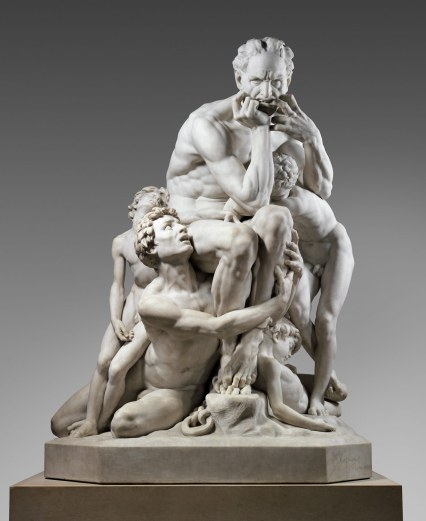
Ugolino

THE FOOD:

This was a challenge. After searching the book for a second time, skimming and rereading, it became clear that food references in a book where the heroine spent her childhood practically starving, were sparse. Most nights, the Bartons ate bread with molasses. In a scene that soured her feelings for the professor she was in love with in college, Lucy revealed that her family had eaten a lot of baked beans. Finally, there was the candy apple her father bought for her when he took her to see the Black Feet ceremony. Since none of those culinary delights struck my fancy, all that was left was a reference to William’s (Lucy’s husband) German POW father having worked on a potato farm in Maine. As it happens, I have a recipe for “Kartoffelpuffer,” German potato pancakes, that I have been making for more than thirty years. In a remarkable case of serendipity, I was making them that night, after having discovered the potato connection in the book  in the afternoon.

I serve them with sour cream and homemade apple sauce. If you love potatoes, as I do, you will love this recipe. (I can’t advocate strongly enough for the bacon fat. I save and freeze mine in 1 tablespoon dollops during tomato season when we’re eating a lot of BLTs.)

Kartoffelpuffer (German Potato Pancakes)

4 medium potatoes (1½ lbs.)                           ¼ C all-purpose flour
2 eggs, beaten                                                        1 tsp salt
1 small onion, finely chopped                           ¼ C bacon fat, margarine or butter

Shred potatoes in a food processor to measure 4 cups. Drain potatoes by giving small handfuls a squeeze over the sink to release the liquid. Repeat until all potatoes have been drained. Mix potatoes, onions, flour and salt in a large bowl. Add beaten eggs and mix well.

Heat 2 tablespoons of the bacon fat in a nonstick pan over medium  heat until hot. Pour in about ¼ cup batter for each pancake. Flatten each with a spatula into a pancake about four inches in diameter. Cook until golden brown, about 2 minutes on each side. Keep warm in oven at about 160º. Repeat with remaining batter, adding bacon fat as needed to prevent sticking. Serve with applesauce and sour cream.

You can freeze any leftover pancakes.

HOMEMADE APPLE SAUCE

4 apples, peeled, cored, cut into slices            ½ C white sugar
½ C  water                                                                ½ fresh lemon, juiced

Bring water, apples and lemon juice to a boil, reduce heat and simmer for 20 minutes, stirring occasionally, and adding more water if mixture gets too dry, until apples are soft. Move from heat and mash. Add sugar, mix well, return to stove and simmer on low for 5 minutes. (Add sugar in increments of tablespoons until the sauce is sweet enough for your taste. 2 tablespoons is usually enough for me.)

Use a mixture of soft apples for better flavor and faster cooking. I use  a combination of two of the following: Gala, Fuji, Braeburn, Cortland, McIntosh, or Golden Delicious. We pick in the fall and freeze for use over the long, dark, winter!
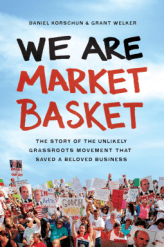
We Are Market Basket

THE BOOK:cover64555-medium.png

I’m accustomed to crying when I read a book, but it’s usually fiction that elicits that kind of response. This book, written by an associate professor of Marketing and a journalist for the Lowell Sun, is about business. Not exactly tug-at-your-heartstrings material, but cry, I did.  The story resonated with me because I am a loyal Market Basket customer who was genuinely moved by the saga that played at here in New England not long ago.

I have kept a journal since my wedding in 1994, a book where I summarize the previous year in terms of travel, entertainment, parties hosted and attended, and notable events for that year to name a few.  In my “Year in Review 2014” entry, I devoted a whole page to Market Basket. It follows:

“On June 23, 2014, Arthur T. DeMoulas, CEO; Joseph Rockwell, VP; and William Marsden, Director of Operations were fired by the Board of Directors. The CEO position was filled by former Radio Shack executive James Gooch and Felicia Thornton, formerly of supermarket company Albertsons. Six high level managers resigned in response and 300 employees rallied outside MB’s Chelsea store. Employees asked their customers to boycott until Artie T. was reinstated. Yada, yada, yada. On August 27 the shareholders reached a deal to sell their remaining 50.5% shares of the company to Arthur T. DeMoulas for 1.5 billion dollars.

Through the 2014 year, MB gave a 4% discount to customers on all purchases. I didn’t keep very good records, but we saved $104.87, and probably a lot more. During the months when we were boycotting Market Basket, it was really hard to find a good place to shop. When the deal was finally reached, I went to my go-to Market Basket store  in Danvers. There were employees standing outside the entrance applauding the return and support of their customers. What a story!”

The DeMoulas family feud goes way back to the ’90’s, but in a nutshell, the two factions were led by the sons of Telemachus (Mike) and George DeMoulas, who bought the business from their founder father, Telemachus. Arthur T.’s father was Mike, Arthur S.’s father was George, who died suddenly in 1971. George’s side of the family sued the other side claiming that their business interests were not well-represented by Mike. The courts found for George’s side and awarded them controlling interest in the corporation.

What the final dispute was about was drastically  different business models. Arthur S. had received a business degree and subscribed to the theory that the responsibility of business is to increase profits for the shareholders. Arthur T. believes that the corporation has a moral obligation to serve the community, and promotes the values of loyalty, courage and kindness for multiple stakeholders, including employees, vendors and customers.

While we were living all of this through social media, I kept thinking what a great movie this would make.  I think I had decided that Christian Bale should play Artie T. and maybe Brad Pitt Arthur S.

When Artie T. addressed his employees the next day after having reached an agreement to purchase the 50.5 share from Artie S.’s side,  he said:

“You have demonstrated to the world that it is a person’s moral obligation and social responsibility to protect a culture that provides an honorable and dignified place in which to work.”

THE BEAUTY:

What’s more beautiful than the culture of Market Basket where the values of loyalty, kindness, family, ingenuity, and hard work are cornerstones of the corporation.

THE FOOD:

This was a tough one. The recipe I’ve chosen is for ham salad sandwiches, because when I shop with my husband, we are usually hungry and split a package of finger roll sandwiches from the prepared foods section of the store. We usually get the chicken or ham salad. For $1.99 a package, it’s a delicious and economical snack.

Ham Salad Sandwich

12 oz. cooked ham, chopped, (ham steak works well)
3 T dill pickle relish or sweet pickle relish
2 T brown mustard
6 T Mayo, or more as needed
3 T minced onion

Process the ham in a food processor until finely chopped but not
pasty about 6 or 7 pulses. Place the finely chopped ham in a large bowl
Add the mayonnaise, onions, relish, and mustard to the processed ham.
Mix well and, if the mixture is too dry, add more mayonnaise. Refrigerate
until serving time.

Spread on your bread of choice, top with a Romaine leaf, cover with
second slice of bread. Yum.