 THE BOOK: When I finished reading the last page, I paused, and thought, what is this book about? Some themes were obvious: family, siblings, finding your own way into adulthood, choices. But there also seems to be so much more going on underneath all that, and I attribute that to the CHOICES this author made in crafting her story. For example, when I came to a plot point that I found implausible, (there were two, actually) I thought that the character simply would not have acted in that particular way based on what information the author had revealed about her. But the more I thought about it, the more I realized that what the author didn’t say about each of the characters was just as important as the things that she did. And that’s what made those two sticking points ultimately work for me, because in life, we think we know our loved ones, our friends – ourselves, and can predict what they will do. But in fact, there is much that is unknown to others beneath our veneers. That, coupled with the fact that different people will interpret observable behavior in different ways, makes it nearly impossible to be completely surprised by the actions of even those closest to us.
When the novel begins, the Gold children are surreptitiously making their way to a house in their neighborhood in 1969’s New York City. Having heard the rumors of a traveling psychic who arrived on Hester St., they have to sneak past their father’s tailor shop on the way to their destination. Eleven year-old Daniel leads the way, followed by Varya, the eldest at thirteen, Klara, 9 and Simon, 7. What the pyschic tells each child, shapes their lives in ways that are both interesting and exciting to read about.
I read this book in one sitting. (Late night reading due to insomnia, followed by reading well into the next day, which turned out to be a snow day!) I never lost interest in the story, and could not wait to see what would happen next. I think the writing was masterful, because I didn’t notice it as it propelled me through the narrative. I think it would be a good book for group discussion, because right now, I wish I had someone to talk to about it while it’s still fresh on my mind.
THE BEAUTY:
In a scene near the end of the book, Varya finally tells her elderly mother about that long ago visit of the Gold children to the psychic. When Gertie, her mother, pooh poohs the predictions the psychic made for each child, she calls it junk, as in “How could you believe such junk? After everything I gave you: education, opportunity- modernity! How could you turn out like me?” Finally, Varya understands that her parents, immigrants, gave their four children the freedom of uncertainty. The freedom of an unsure fate. Her parents had few options when they were young, and their choice to emigrate to America was a scary, and unselfish beginning to a lifetime of unselfish choices that gave their four children opportunities for a better life. Varya’s mother and father abandoned their dreams in order to support their family. Varya and her siblings had choices, and the luxury of self-examination. Especially now, while a DACA decision deadline approaches in the immediate future, the beauty is the immigrant stories that contribute to the fabric of American life.
THE FOOD:
Varya’s friend, Ruby, lives on the sixth floor of their apartment building. Her family is Hindi, and Varya frequently trades her own mother’s kugel for some of Ruby’s mother’s spiced buttered chicken. They eat their delicacies on the fire escape and talk about the strange woman who has reportedly come to town.
INDIAN BUTTER CHICKEN (CHICKEN MAKHANI)
For the marinade
Part 1:
1½ lbs boneless skinless chicken breasts
1 C full fat yogurt
1 T lemon juice
1 T Mexican chili powder (do NOT use chilli pepper! They are not the same!)
salt
3 – 4 drops liquid smoke
Part 2:
2 T garlic paste or 6 garlic cloves
1 T garam masala
3 T butter (melted)
1 T Mexican chili powder
2 T ginger paste
1 T lemon juice
1 T olive oil
To Marinate, Part 1: Place cubed chicken in a nonporous bowl with yogurt, lemon juice, chili powder, salt and liquid smoke. Thread the chicken pieces onto some pre-soaked bamboo skewers to marinate. This makes getting the pieces out of the marinade much easier and less messy. Refrigerate for 1 hour.
Marinate, Part 2: Mix in garlic, garam masala, butter, chili powder, ginger paste, lemon juice and oil. Replace cover and refrigerate to marinate for another 3 to 4 hours.
Preheat oven to 400°F. Place chicken on an oven sheet and bake in preheated oven for 20 minutes.
Sauce
1 T butter
1 T garam masala
1 T ginger paste
1 T garlic paste
1 green chili pepper, chopped
To Make Sauce: Melt butter in a large saucepan over medium heat. Stir in 1 T garam masala. When masala begins to puff and bubble, mix in ginger, garlic paste and green chile peppers. Saute 5 minutes.
1 (28 ounce) can crushed tomatoes
1 T tomato paste
1 T Mexican chili powder
salt
½ T garam masala
1 drop liquid smoke
1⁄2 tablespoon honey or 1⁄2 tablespoon sugar
1 tablespoon fenugreek leaves
1 cup heavy cream
Then stir in crushed tomatoes, tomato paste, chili powder, salt, ½ T garam masala, and liquid smoke. Bring to a boil, reduce heat to low and simmer, stirring in honey, fenugreek and cream.
Place cooked chicken in sauce mixture. Simmer on medium-low heat for about an hour or until liquid is reduced by ⅓.
Salt to taste and garnish with fresh chopped cilantro (optional).
**Be careful with the liquid smoke, it can easily overpower the dish.
When you simmer the sauce, be careful not too reduce it too much, or it will become a bit too red and “tomato’y”. Butter Chicken should be a nice orange color.
**You will need to go to an Indian grocery store for the fenugreek leaves though. Standard grocery stores will not carry them. Do NOT use seeds instead of leaves! Fenugreek seeds are very bitter whereas the leaves are more sweet. (I think the dish would have been fine without the fenugreek, but I had it, so I used it.)
We give the dish 2 enthusiastic thumbs up.




 This was an important book to me, because it clearly articulated questions I’ve had about race in America. Eddo-Lodge is British, born and bred, but in contemporary Britain, marginalized as an outsider. “What history had I inherited that left me an alien in my place of birth?” There is no summary I can write that would do justice to her narrative about race in Britain. What I can say is how convincing her writing is in supporting her assertions, mainly, that racism is structurally embedded in British society. “I choose to use the word structural rather than institutional because I think it is built into spaces much broader than our more traditional institutions… Structural is often the only way to capture what goes unnoticed- the silently raised eyebrows, the implicit biases, snap judgements made on perceptions of competency.” Reni Eddo-Lodge stopped talking to white people about race, because, even when she found like-minded white people in the context of feminism, for example, she always hit a wall when the white person tried to change the course of the narrative to black people’s failure to assimilate, or black people’s inability to demonstrate equal capabilities to their white peers competing for the same capital. In short, even sympathetic white people could not see that white privilege had afforded them a leg up that was not available to people of color. Simple. And profound. I urge you to read this book with the caveat that if you are white, prepare to be uncomfortable.
 This is the story of a Pakistani family living in London. They try to fly under the radar because their father was a terrorist, even though they never really knew him because he was not a part of their lives. When their mother died, the eldest daughter, Isma, put her education on hold to support her two younger siblings by working at a dry-cleaner’s shop. The book begins with Isma, detained for questioning at Heathrow and consequently missing her flight to Boston, where she would then travel west to Amherst to begin a PhD program, now that the twins were grown and going off to pursue their own careers. In Amherst, Isma met Eamonn, son of Karamat Lone, a Muslim MP recently elevated to Home Secretary. Isma concealed the fact that their lives were loosely connected until just before Eamonn returned to London, where their lives became inextricably connected. One of the themes of the book is “like father, like son,” relating to both Eamonn and his father, and Isma’s younger brother, Parvaiz and their father. Aneeka, Isma’s younger sister and Parvaiz’s twin, completes the cast of main characters. The more I think about this book, the more I love it. This one is so different from




 One of the things I love about this series is the reflections that Precious Ramotswe makes about life in Botswana, its traditions, and the way that people around her choose to live their lives. Frequently, in conversation, Precious’s thoughts will stray, based on something that was said, and she will completely lose herself in that train of thought until someone brings her back into the conversation by saying her name. The best digressions are the ones where something has amused her, and everyone wonders why she’s smiling, since what they had been talking about was rather serious. These are quiet books about everyday life, but infused with so much warmth and wisdom, that they function, for me, anyway, as a trip to a spa (although I’ve never actually done that!) for my soul. AMS’s books bring me to a place of peace and comfort, humor and compassion, in the company of like-minded friends.
 This is the story of an unlikely alliance among three people whose lives merge in a snowstorm in Brooklyn in 2016. Lucia is a visiting professor from Santiago, Chile who signed a one-year contract to teach at NYU’s Center for Latin American and Caribbean Studies. Her landlord and upstairs neighbor, Richard, is also her boss. Evelyn Ortega meets Richard when his car crashes into her Lexus at a snowy intersection during a particularly bad winter storm. Through the course of the book, the reader gets to know the characters’ backstory as they get to know one another. The circumstances they find themselves in are somewhat bizarre and scary, but the relationships that develop over a short period of time- just a couple of days, really- are life-affirming. When Evelyn shares the story of her escape from Guatemala and the horrific event that forced her to leave in the first place, she tells of a visit to a healer with her grandmother. The shaman, Felicita, a famous guardian of the traditions of the Maya, explained her power- that she channeled the earth’s healing energy. As she prepared for the healing, she lit some herbs in a painted pot, blowing the smoke into Evelyn’s face. Then she made Evelyn drink a disgusting ayahuascan tea that she could barely swallow. That was the beginning of Evelyn’s solo, frightening journey. Hours later when it was done, Evelyn emerged from the magic world and did not know where she was. What came next is the beauty of this post.
 This was an extraordinary book. The way that the main characters, Mamah Borthwick Cheney and Frank Lloyd Wright lived their lives defied the social mores of the time, and had me questioning the wisdom of staying in a failing relationship when one has met her true life’s mate. Mamah left her husband, her home and her children in order to be with Frank. But was he Mr. Right? The way he’s depicted in this book shows him to be an epic narcissist with the temperament of a spoiled child. He seemed to believe that creative geniuses were not bound by the morality of the masses. In order to nourish that genius, his behavior might occasionally fall outside the confines of what was expected of mere mortal men. After all that Mamaw gave up to be with him, I wonder if she ever experienced true happiness, and in the end, was it all worth it?
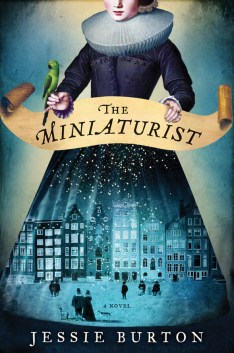 Seventeen year-old Petronella Oortman stood at the door of the Amsterdam home of her new husband, Johannes Brandt, and knocked. And knocked. No one came. This was not an auspicious beginning to married life. Even though she was expected, Brandt was not even in town to greet her when she arrived. Nella was shown to her room by Marin, Brandt’s sister, who in the early pages of the novel reminded me of Mrs. Danvers, with her curt comments and mysterious actions. Needless to say, I was hooked, even though I suspected that things would not end well for Nella. Marin was a real doozy. After sniffing Nella’s perfume (lily, a gift from her mother), Marin says, “You know what they say about lilies. Early to ripe, early to rot.” As Johannes traveled extensively for the VOC, the Dutch East India Company, Nella was subjected to Marin’s disdain on a daily basis. Seventeenth century Amsterdam afforded limited latitude about the proper occupation of women, so Nella was essentially a prisoner in her own home, which was more like a boarding house, since Marin took over the duties of wife that should have been Nella’s responsibilities under different circumstances. As distant as Johannes was, I liked him. I especially liked him when he said, “I find much of myself in food.” This was at a banquet, the first time he and Petronella appeared in public as man and wife, and their first real conversation. He went on to talk about how memory is connected to food and how food is a language in itself. It reminds me of the famous Brillat-Saverin quip, “Tell me what you eat, and I will tell you what you are.” That currently makes me leftover pizza from Santarpio’s.
 Dunbar is the latest addition to the Penguin Random House Hogarth Shakespeare Series. A retelling of King Lear, it is quite a gloomy little book, although, how could it not be. “Acclaimed” authors were asked to select a Shakespeare play upon which to base their own retelling. This one begins in a sanatorium in in Cumbria, England, near Manchester. Henry Dunbar, 80 year-old media mogul, was deposited here by his two oldest daughters, Abigail and Megan (Goneril and Regan). Comic relief is provided by Dunbar’s alcoholic comedian friend, Peter Walker, in the form of impressions of various celebrities and a lot of clever – silly sometimes- banter. It is a morality tale about what people who have dedicated their lives to the accumulation of wealth and power can expect when they’ve neglected a moral compass that would have tied them more closely, more sympathetically, to their fellow humans. The siblings, intending to take over the company after having elaborately staged their father’s incoherent demise, garnered the support of the apppropriate board members, and performed any number of other equally despicable business dealings that would secure their fortune. Being only cursorily familiar with King Lear, I don’t recognize how closely the book parallels the play, but even I recognized the most obvious nods. Aubyn’s writing is very smart, but the overall effect of this sad story is to make one want to take stock of one’s life before it’s too late. Before a lifetime of selfish choices leaves you old and alone.
 bbfbooksbeautyfood