THE BOOK:
 The transformation that this woman underwent is astounding. Raised in a survivalist household, pretty much off the grid, the circumstances of her childhood were sometimes brutal, both in the physical environment and the way in which her parents raised their children. In addition, both of her parents were Mormons, but the type that strictly adhered to the Bible, which caused them to be outsiders, even in their own church community. Being a child, and never knowing anything different, Tara grew up sharing her parents’ beliefs. When one of her brothers left to go to college, Tara became interested in the things he was learning. He encouraged her to seek an education for herself. That was the good brother. There was another brother I seriously disliked, and couldn’t believe how easily he manipulated his parents, often to the detriment of the other siblings. So when Tara attended Brigham Young University, her first time at school at the age of seventeen, it was against her father’s wishes, although he didn’t disown her. The transition was difficult because Tara continued to maintain her fundamentalist beliefs. It was the hardest though, on her freshman roommates because Tara’s practices (or lack of practices) offensive to them. So Tara led an isolated life that first year. To say that she is brilliant is an understatement. She got into BYU on a full scholarship never having attended any school! When Tara went to Cambridge to study abroad for a semester, she read with Professor Steinberg for a month before writing an essay comparing Edmund Burke to Publius, the name under which James Madison, Alexander Hamilton and John Jay wrote The Federalist Papers. I started following Tara on Twitter so that I could ask her if she would ever consider sharing that paper with her readers. She said she doesn’t think she still has the paper! I thoroughly enjoyed this book.
THE BEAUTY: I chose this image not just for the beauty of the landscape, but for the beauty that an education brings to those lucky enough to have one. As a former educator, I truly believe that education broadens one’s world view, opening up the possibility to understand differences and recognize that there’s more that brings us together than separates us. This is the campus of Brigham Young University. The person that she was entering school was not the same person she became. Tara began to question everything she though she knew, ultimately putting her in a position to have to make the most difficult choice of her life.

from utahprophoto.photoshelter.com
THE FOOD: Tara was eating this dish at Aunt Debbie’s near Brigham Young University when she got a call from her mother, bearing news of the family.
Beef and Potato Casserole
serves 4
3 large white potatoes (1½ lbs),
pared and sliced very thin (⅛”)
1 T vegetable oil
1 lb ground beef
1 medium onion, chopped (1 cup)
1 large garlic clove, chopped
3 T all-purpose flour
1 10 oz packet frozen baby carrots, thawed, cooked to
just beyond al dente
1 14½ oz can whole tomatoes, broken into pieces
¼ C dry red wine or water
½ tsp dried basil
½ tsp dried oregano
½ tsp black pepper
¼ tsp salt
½ C water
1 T butter, melted
In a 2-quart saucepan over high heat, bring potatoes to a boil in enough water to cover; cook 2-3 minutes until potatoes are crisp-tender. Drain, set aside.
In a 10” ovenproof skillet over medium-high heat add oil. Add beef and cook about 5 minutes until browned. Add onion, garlic and cook 2-3 minutes, stirring frequently until onion is softened. Sprinkle flour over mixture; cook stirring until meat is well-coated with flour. Add carrots, tomatoes, wine, basil, oregano, pepper, salt and ½ cup water; bring to a boil. Reduce heat to low; simmer 5 minutes, stirring occasionally. Heat broiler. Transfer contents of skillet to a broiler -safe casserole dish (Le Creuset stoneware is broiler-safe) and arrange potatoes over the beef mixture to cover completely; brush with melted butter. Broil 5-6 inches from heat source, 8-10 minutes until potatoes are golden.
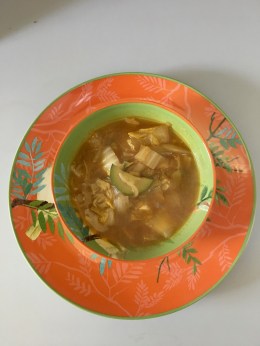
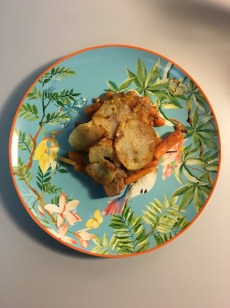 Forgot to take a picture of the casserole dish, so here’s what an individual serving looks like. Very filling and delicious.
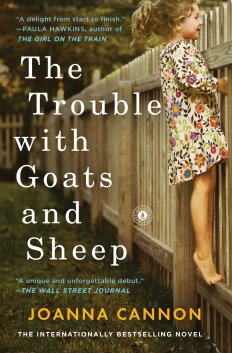 Here is another book that’s been on my TBR list for awhile. Simon, of The Readers, loved it. I was a little unnerved by his comparison to Flavia de Luce, because I didn’t enjoy the first book of that series at all, in fact, didn’t even finish. I think I was nudged into reading this now because Joanna Cannon’s new book (
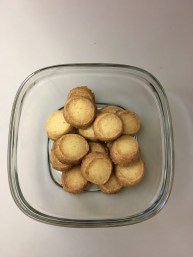
 What an endearing book. It took me awhile to warm to Eleanor, but when I did, her status in my literary hero catalogue ascended to join Don Tillman, Celine, Florence Gordon, and Veblen Amundsen-Hovda, to name just a few of my favorite literary iconoclasts. They’re all different, but share a unique view of the world that allows them to march to beat of their own singular hearts. Eleanor is a serial loner until a chance meeting with a co-worker changes her life. At it’s core, the book is about friendship, forgiveness, and finding one’s own way. Eleanor was very funny, although she didn’t usually intend to be. After assessing that the congregation in church were not enthusiastic enough in their rendition of a hymn,
 Parrot plant
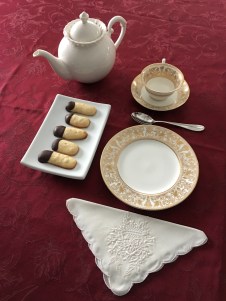
 I put off reading this book because I had heard that it was filled with brutality, but I was finally drawn to it because its Goodreads rating is 4.28. It was difficult reading, and I skimmed some of the more graphic violence. It’s very similar to many of the books I’ve read in the past year about man’s inhumanity to man. The difference however is that I cared more about the characters in the other books than these characters. From what I read in the introduction by the translator, Deborah Smith. “Born and raised in Gwangju, Han Kang’s personal connection to the subject matter meant that putting this novel together was always going to be an extremely fraught and painful process. She is a writer who takes things deeply to heart, and was anxious that the translation maintain the moral ambivalence of the original, and avoid sensationalizing the sorrow and shame that her hometown was made to bear.” I’m trying not to feel shallow in my reaction to the book, but for me, it’s the emotional attachment to the characters that makes all of the historical horror urgent and intolerable, and meaningful.
 This is my first Ishiguro. I don’t know why it has taken me so long to start. Recently I googled something like ‘which Ishiguro should I begin with?’ so when this title came up, I immediately put it on hold at the library. I also read that I shouldn’t read any reviews, or even the blurbs on the book itself, to go into it completely blind about its content. I’m so glad I did that. It was interesting trying to connect the dots without any hint of where the narrative was headed. I might try that more often with other books. In the end, this wasn’t what I expected from this author, but I wasn’t disappointed, just surprised. The writing was understated, so much so that I really didn’t pay attention to it, but it was very easy to read. Having finished reading it four days ago, I find that the details haven’t dimmed at all in my memory. I’m still very much connected to Kathy and Tommy and Ruth and their story. The central theme that impresses me now is what does it mean to be human? Ironically, I had just finished reading Han Kang’s
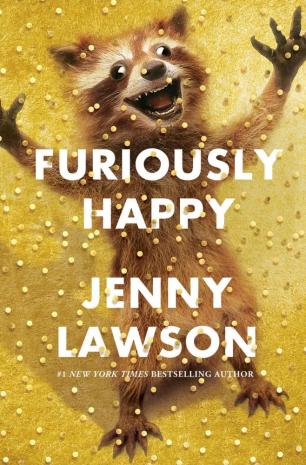 I loved this book: the cover, the end papers, the writing. And I wanted Jenny Lawson to be my friend. (Next best thing- I’m following her on Twitter, and thank fully, she posts regularly.) This was one of those books that I was reading at night, shaking the bed with my silent laughter while trying not to wake my husband. So the next morning, I asked, “Could you feel the bed shaking last night while I was reading this book?” He said, “No, but I heard you laughing.” So much for my lame attempt at late night bedroom etiquette.
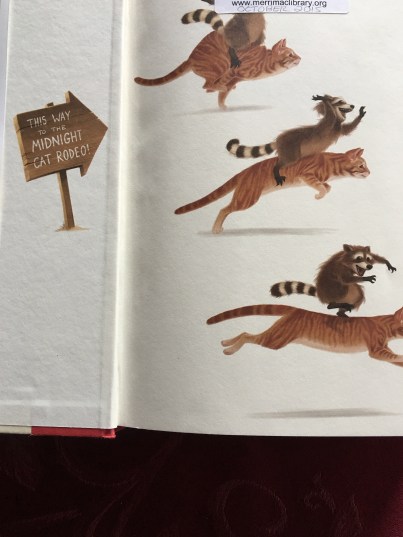 The endpapers. Midnight Cat Rodeo. You’ll just have to read the book.
 A friend whose taste in books is similar to mine recommended this book, and I’m so glad she did. Some of my favorite books have been YA recently, (young adult) as is this. It really transported me back to my own high school experience, although, I truly don’t remember the drama as it appears here, but I know it’s true to form. It has to be. I read it in a book. Five students arrive at detention one September afternoon, the usual suspects and some unlikely transgressors, but only four make it out alive. This is not a spoiler, it’s on the the inside front cover summary. The book continues from there chronologically, from the point of view of each of the characters involved. I have to admit, I did have an inkling about the who and why-dunnit, but it didn’t spoil the ending for me at all.
 This was one of those “highly anticipated” novels of 2018, coming out on January 2. A debut novel, it was #1 on the New York Times Bestseller list its first week on the market. In the fall of 2016, an 8-house bidding war was going on over the rights to this book. In the end, William Morrow won out, as did A.J. Finn, with a $2 million, 2 book deal. In addition, 37 international publishers are interested, and the film rights were secured by Fox 2000 Pictures before the book was even published. William Morrow may have had an unfair edge on the other houses, as Finn is the nom de plume for Daniel Mallory, who was a Vice President and Executive Editor at Morrow until five days before the book’s publication.
 If there are readers out there who don’t have a vague inkling of what this book is about, I’d be very surprised, so I’ll spare you the tedium of a detailed summary. Suffice to say that this murder mystery takes place during the maiden voyage of the Aurora, a super-luxury liner traveling through the fjords of Norway. It’s all about food and drink, spa treatments, with the occasional lecture about the aurora borealis, and rubbing elbows with the very rich, if not so famous. It put me in mind of Agatha Christie’s,




 bbfbooksbeautyfood