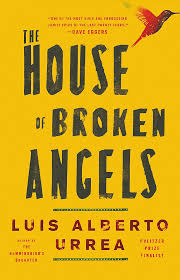
Sometimes I really struggle with a book, and yet I persist, for whatever reason- in this case, because the reviews were so consistently positive. And sometimes, I’m rewarded with something beautiful, something that puts everything that I struggled with before in context, and my feelings do a 180º, and I love the book. This happened on page 252. I don’t care how long it takes to get there, as long as I get there.
There were several things that I struggled with, primarily, the male voice of the protagonist. I know that was not the author’s problem, but mine, because his characterization seemed to be consistent with what I know of male Latino values. Next, there were the Spanish words, most of which I could ignore, getting the meaning from context, but being somewhat OCD when it comes to words, I just had to keep looking up the translations. Again, my problem, not the author’s. The third barrier to me really connecting with the book was the slang, or gang-speak, or, I don’t know what to call it. I literally dropped the book at page 73, thinking, “How is a sixty something white woman supposed to understand WTF this means?” Here is the passage: “His ‘stache drooped a little, and the soul patch under his lower lip looked bandido as hell.” (I know that’s tame, but I gave up on the more arcane ones that followed.)
This is a family saga, condensed. The patriarch is ailing, and his daughter has planned a 70th birthday party to celebrate his life, but his mother dies a week before, so the two events are scheduled back to back to accommodate out of town guests. The family has its array of characters: the prodigal son, the dutiful daughter, the son escaping his family to breathe and find himself, jealous in-laws, and on and on. But the patriarch is larger than life, and at first, I didn’t see that, but when I did I was totally won over.
When the ending of a book can bring the almost physical sensation of my heart filling up in my chest, I have to acknowledge that this was a very good book.
THE BEAUTY: “…when I’m gone and you see a hummingbird, say hello. That wil be me.”
Bumblebee hummingbird, found in Mexico. Image from The Internet IBC Bird Collection.
Hummingbirds are important to me. When I see one at our feeder, it makes my day. I don’t know why. I’ll probably never see this one in the wild, but I love this picture. I wonder which one Big Angel pictured when he made the comment above?
THE FOOD:
The family was crazy about pancakes. No hidden meaning. Just crazy about pancakes. They were, indeed, fluffy.
Fluffy Pancakes
¾ C milk
2 T white vinegar
1 C all-purpose flour
2 T white sugar
1 tsp baking powder
½ tsp baking soda
½ tsp salt
1 egg
2 T butter, melted
cooking spray
Combine milk with vinegar in a medium bowl and set aside for 5 minutes to “sour”.
Combine flour, sugar, baking powder, baking soda, and salt in a large mixing bowl. Whisk egg and butter into “soured” milk. Pour the flour mixture into the wet ingredients and whisk until lumps are gone.
Heat a large skillet over medium heat, and coat with cooking spray. Pour 1/4 cupfuls of batter onto the skillet, and cook until bubbles appear on the surface. Flip with a spatula, and cook until browned on the other side.
Another debut novel, this one grew from an article in a 1939 women’s magazine that Pearce happened upon. Emmeline Lake and her best friend, Bunty, were working girls in 1940’s London. Emmy dreamed of becoming a war correspondent, while Bunty worked in the War Office. When Emmy spotted an ad for a Junior at Launceston Press, she believed this to be her ticket to a correspondent’s life. Reality, of course, finds her doing clerical work, eventually typing Mrs. Bird’s responses to her advice column. Mrs. Bird was a very traditional woman and makes it clear that some subjects will not be addressed in her column, some of which are: marital relations, premarital relations, extramarital relations, physical relations, sexual relations, illegal activities… and on and on. As Emmy read more and more of the letters, she began to feel sorry for the letter writers, and at first, tried to subtly urge Mrs. Bird to extend a few words of kindness and encouragement. But Mrs. Bird had her rules and would not yield: nose “to the grindstone” and all that. She gave no thought to the living conditions in London during the Blitz. Daily raids and bombings were the norm, absolutely everyone had someone they knew and loved in the fight, women were doing jobs that the men had done before they were taken into service, in short, times were difficult and everyone, whether they knew it or not, was looking for comfort, however small. Without saying more, I think you can figure out where the story headed. A key event in the book was based on a historical fact. The Cafe de Paris was night club made popular by the Prince of Wales. On March 8, 1941, it was bombed by the Nazis, killing 34, injuring 80. Ken Snakehips Johnson, a bandleader, was one of the 34. More on him later.
While the plot is predictable, the reader comes away feeling hopeful, for this is a story of people pulling together in adversity, supporting one another in small ways. In life, there are no small kindnesses. In life, it’s really all about kindness.
THE BEAUTY: Kenrick (Snakehips) Reginald Hijman Johnson was born in British Guiana to wealthy parents. At 15, his parents sent him to school in Buckinghamshire, England, before studying medicine at Edinburgh University. At University he pursued his love of music and dance, and sought dance lessons with Buddy Bradley, the man behind Fred Astaire. In 1934, on a trip to New York, he went to Harlem and saw Cab Calloway. On this trip he was inspired to become a bandleader himself and back in England, he became a leader in the Black swing movement. His band, initially called Ken Johnson and his Rhythm Swingers, later changed the name to West Indian Orchestra, and played at the Cafe de Paris. He was 26 years old when 2 German bombs fell through the roof and onto the dance floor on March 8, 1941.
I include a clip of him dancing rather than a recording of his orchestra because I wanted to show a living man, and the music clips were only audio. What would he have accomplished musically in his life, had he had the gift of it?
THE FOOD:
Ths being a book about the British experience, a lot of tea is consumed, and along with tea, we must have biscuits. At one teatime, Emmy had Garibaldi biscuits. I toyed with making them myself, but then I had an epiphany! I don’t have to make everything in this portion of the blog, if I can buy the actual product mentioned. There’s a little shop called the The Best of British Fine Imported Goods in Newburyport where I bought this package for $3.95, along with the shortbread and Cadbury biscuits. I didn’t have to make anything at all! It was all store bought.
Tea time really is a lovely and relaxing way to refuel in the middle of the afternoon. Even on a hot August day, it was the pause that refreshed.
I picked up three books from the library the other day when I was already in the middle of a book I had bought, but when I was ready for the next book, this was the one. What a treat! A debut novel, it sets a high bar for Nova Jacobs’ future work. Once I started reading, I blew off all other activities on a beautiful summer day and read the whole thing in one sitting. It is a mystery that starts with the apparent suicide of Isaac Severy, a renowned mathematician, and professor at the Sloan Laboratory of Mathematics and Physics at California Institute of Technology. As the family gathers for his funeral, we learn that one of them received a letter from Isaac written the day before his death, the first of many secrets to be revealed. We quickly learn that the equation is so very valuable, extreme measures must be taken to protect it. There were twists and turns, and things I didn’t figure out, but the characters were compelling and the family drama felt real. There’s even a transgender character. Well done, Nova Jacobs.
THE BEAUTY: Well, it had to be the math, but I’m so math-challenged, I have no way of approaching its beauty, but I’m guessing it’s something akin to reading the Aeneid in Latin, which is also something I can’t do! So I wrote down Mandelbrot from the book, and in researching it, found that there is also a twice-baked cookie called Mandelbrot. Food, I get. Fractal geometry- not so much. A little aside here, my mother had a meeting with my sophomore geometry teacher a million years ago, concerned that I wasn’t doing well. She wanted to take me out of drama and put me after school for one-on-one time with this teacher. In his infinite wisdom, Mr. Trout told her, “Don’t take her out of what she’s good at. We’ll work around drama, and she will pass geometry.” God bless you, Mr. Trout! So, back to the Mandelbrot set. The word fractal was first used by Benoit Mandelbrot and it has something to do with chaos theory which says that a chaotic system will either emerge or collapse. Fractals are a geometric thing that always have the same shape whether you look at them close up or from far away. That’s about as far as I can take it. The image below is from Wikipedia and shows a Mandelbrot set.
The video version was too big a file, but if you google it, you’ll see the zoom in close- up that goes on for quite awhile. I certainly hope no mathematician reads this post, although if one does, and you can expand my fractal knowledge in “Fractal for Dummies” language, have at it.
THE FOOD:
My husband has a lot of influence on this part of my blog and I frequently give him choices, as I did for this one. Me: If you had to choose between a pastrami sandwich and biscotti, which would you prefer? Him: No contest. Pastrami.
The connection to the book is, Gregory invited his sister Hazel to lunch at Langer’s Delicatessen in LA, and they are famous for their pastrami. I googled to find out that Langers gets their pastrami from RC Provisions. Unfortunately, the quantity I would have had to order was so large, we’d never have been able to eat it all. So, instead, I went to several local markets on the hunt for the best pastrami. Boar’s Head was the one I chose for this, but next time, I’d have it cut thinner and I’d get the wider cut.
Langer’s Original No. 19 Hot Pastrami Sandwich Makes 4 sandwiches
8 slices seeded rye bread
2 lbs pastrami cut into ¼ inch slices
4 T Russian dressing (recipe follows)
4 slices Swiss cheese
1 C coleslaw (recipe follows)
Preheat the oven to 300º F. Wrap the bread in aluminum foil; bake for 10 to 12 minutes, until the bread is warmed through.
Meanwhile, to steam the pastrami, bring a pot of water fitted with a steamer basket to a boil. Wrap the pastrami in aluminum foil and place in the basket; cover and allow to steam for 15 to 20 minutes, until all the slices are thoroughly heated.
To assemble each sandwich, spread Russian dressing on one slice of warm rye bread. Add ½ pound of hot pastrami to the same slice, overlaying the Russian dressing. Top the hot pastrami with 1 slice of Swiss cheese and ½ cup coleslaw. Spread Russian dressing on the other slice of rye bread and place it on the sandwich. Slice in half. Garnish with the pickle of your choice.
Russian Dressing Makes about 2 cups
1 C mayonnaise
1 C sweet pickle relish
¼ C ketchup
1½ T buttermilk
In a large bowl, combine the mayonnaise, relish, ketchup and buttermilk. The dressing can be made in advance. Leftovers will keep for several days in the refrigerator.
Coleslaw Makes about 6 cups
1¼ C mayonnaise
½ C sour cream
¼ C plus 2 T granulated sugar
1 T white vinegar
2 tsp salt
¼ C water
1 small head cabbage, shredded (about 2 pounds)
½ red bell pepper, julienned
½ carrot, julienned
Whisk the mayonnaise, sour cream, sugar, vinegar, salt and water in a medium bowl.
In a large bowl, combine the mayonnaise mixture with the cabbage, bell pepper and carrot and stir to combine. The coleslaw can be made up to 1 day in advance and refrigerated.
This was quite delicious. I made the Russian dressing and the cole slaw the day before I was going to serve. Assembling the sandwiches and warming everything took about 20-25 minutes, so plan accordingly. The bread I used was a bit too dense, but still tasty. With good pastrami and good seeded rye, this is worth the effort, although, by all accounts, Langer’s #19 Pastrami Sandwich is somewhere this side of heaven.
This is a love story on so many planes: young love, parental love, familial love, love of friends… Layla is the protagonist, whose arranged marriage to Rafiq brought her from Hyderabad, India to California, to make a life and raise a family: Hadia, Huda and Amar. When Rafiq accepted a position that forced him to travel for weeks at a time, he made the sacrifice to better provide for his family. But Layla, reflecting on sleeping alone for the first time in her life, watches her husband early in the morning on the day of his first business trip. “His most beautiful face is his sleeping one, no stern expressions, just eyelids, lashes, defined nose, jawline. She pictures those cartoon cottages in shows her daughters watch, where a woman inside the cottage throws open the shutters and appears at the window singing. That is how it feels today to wake up and see his face, like a window in the room of her heart is being thrust open.” Reading this passage, I knew I was reading something very special.
Fatima Farheen Mirza has written an amazing portrait of a family. Her depiction of first love is heartbreaking in its beauty. She also plumbs with grace, what life in America was like for Muslims after 9/11. There were lots of food references, and I’m always happy with food as a presence in a book. I learned about wudhu, a ritual purification that precedes prayer; and a part of a Muslim wedding ceremony where the bride and groom look in a mirror together and the groom sees the bride’s face for the first time. (Although, I understand that this has become a rarity, as more and more couples spend time together before the wedding.) I loved Mr. Hansen, who Amar had in 3rd grade and was the first teacher to see beyond his shortcomings and find beauty and kindness in him. Finally, there is a passage where Baba (Rafiq) later in life explains his connection to God in a way that brought me much closer to understanding what the faithful feel: “People pray their entire lives for things they will never receive. There are people, my friends even, who say maybe there is no soul. Maybe there is no creator. My own son once said as much to me. But I have looked up at this sky since I was a child and I have always been stirred, in the most secret depth of me that I alone can access and if that is not my soul awakening to the majesty of my creator then what is it?”
I hope I have conveyed the degree to which I loved this book. I know the feeling I have now, having just finished reading, will fade over time, but I will remember the story and the characters and my affection for them. One of my favorite reads of the year, so far.
THE BEAUTY: The title is a reference to the Romeo and Juliet aspect of the plot with a nod to a song that Tony and Maria sing in West Side Story. Leonard Bernstein and Stehen Sondheim nailed it.
THE FOOD: At a point early in the book, Hadia is in her room packing for her first year at college, and hearing through her open window, the sounds of her brother Amar, and the Ali brothers playing basketball in the driveway below. She stops what she was doing to ask the boys if they wanted a drink. She says she’s making some for herself, which was true, but she knows that Abbas Ali loves mango lassi. The two share a moment while Abbas helps her prepare the drinks, and although they are physically in the same space, their private thoughts are about each other.
Mango Lassi Recipe
Yield: Makes about 2 cups
If you have cardamom pods, crush the pods to remove the seeds, then grind the seeds with a mortar and pestle.
1 C plain yogurt
½ C milk
1 cup chopped very ripe mango*, or a cup of canned mango pulp
4 tsp honey or sugar, more or less to taste
A dash of ground cardamom (optional)
Ice (optional)
Put mango, yogurt, milk, sugar and cardamom into a blender and blend for 2 minutes.
If you want a more milkshake consistency and it’s a hot day, either blend in some ice as well or serve over ice cubes.
Sprinkle with a tiny pinch of ground cardamom to serve.
The lassi can be kept refrigerated for up to 24 hours.
*Note: It took a very long time for my fresh mango to ripen, here in New England. In the future, I will use canned mango pulp that is readily available at my local supermarket. The flavor of my smoothie would have been improved if I had compensated for the lack of sweetness in my mango by adding more honey.
Looking down into the glass of partially consumed mango smoothie.
This debut novel by a young member of the Cheyenne and Arapaho Tribes of Oklahoma introduces a new voice to American literature. I had no idea what to expect, only that this novel was highly anticipated and received a starred review from Kirkus. The story is told from the perspectives of twelve individuals making their way for different reasons to the Big Oakland Powwow. Each chapter is short, around 9-10 pages. I had difficulty synthesizing how the characters’ stories intersected, and also had trouble remembering who everybody was. Tony Loneman is the first character introduced. Then each of seven other characters has a chapter devoted to them before getting back to Tony Loneman again. So each time I got to the second chapter about a character, I had to go back and refresh my memory. I had even taken notes about each one along the way. This is not a flaw of the structure or the writing. The flaw is my inability to easily transition from one character or setting to another, in successive chapters. If anyone has a “hack” for dealing with this style of writing, I am all ears!
Once again, the atrocities visited against a group of people is astounding and shameful to those who perpetrated them. Also embarrassing to me because I’d never heard of some of them. For example, the American Indian Wars were fought by European countries and finally, the U.S. over land in what is now Wyoming, Kansas, Nebraska and Colorado. Despite treaties signed by both sides acknowledging the Cheyenne and Arapaho’s rights to the designated land, the discovery of gold at Pike’s Peak caused the government to want greater access, so they entered into negotiations with the Cheyenne and Arapaho again, ultimately reducing Indian holdings to less than ⅓ of the earlier negotiated treaty. Many Cheyenne refused to accept the terms of the new treaty, claiming that it had not been approved by the whole tribe, and those that did sign didn’t know what they were doing, or were bribed with gifts. So without declaring war, there was a war, with the Cheyenne defending their land, and the US Cavalry viewing that as an act of war. The Sand Creek Massacre was a result of these tensions, when 675 men of the Voluntary US Cavalry attacked and killed or maimed 70-500 mostly women and children of the Cheyenne tribe on November 29, 1864. This is just one example of how the Indian nations were forced into treaties limiting their rights to their own land, ultimately confining them to reservations where their way of life became impossible to live. At various points of the book, the anger expressed is palpable, a blast in the reader’s face, beginning with the Prologue. It is appropriate.
THE BEAUTY: Edwin Black, living with his mother since completing his master’s degree in comparative literature, spent his days gaming, gambling online, incessantly checking his social media and searching for new music. He found a group of First Nation DJ’ and producers based out of Ottawa called “A Tribe Called Red.” He found their music the most modern, or postmodern form of indigenous music that is both traditional and new-sounding. A blend of instrumental hip hop, reggae, moombahton, and dub-step, with elements of First Nations music, particularly chanting and drumming, it is unlike anything I’d heard before. The clip below is only 3½ minutes, so do stick with it until the end. The chanting has a spiritual effect if you listen until the end. I love that the video shows a diverse group of urban native Americans, which is exactly the point of this book. When I find “beauty” for a blog post that perfectly embodies the theme of what I’ve read, it’s tremendously gratifying.
THE FOOD: The action of the book is all headed toward the powwow at the end, so it had to be powwow food. Since I’d already done fry bread tacos for Killers of the Flower Moon, I googled powwow food, and corn soup came up. I created the recipe here by modifying some recipes to suit my taste.
Native American Corn Soup Servings: 4
4 strips bacon
1 poblano pepper (or Anaheim chile pepper, seeded and chopped)
1 large (12 ounce) yellow onion (cut into thin wedges)
3 cloves garlic, minced
4 oz. corn kernels (½ cup, frozen)
1 can (15 ½ oz) hominy (golden or white hominy, drained)
1 can (14 ½ oz) diced tomatoes (no-salt-added, undrained)
1 can (14 oz) chicken broth
1 ¾ cups water
1 T lime juice
1 T dried oregano, crushed
1 T ground cumin
1 tsp ground chile pepper
1 tsp garlic powder (roasted)
¼ tsp black pepper
¼ C radishes, sliced
¼ C green onions, sliced
In a 4-quart Dutch saute the bacon to render the fat. Remove bacon pieces and reserve for another purpose, like garnishing a salad to go with the soup.
Add the poblano pepper, (or can of chili) onion, and garlic to Dutch oven. Cook for 5 minutes or until tender, stirring occasionally
Stir in hominy, corn, undrained tomatoes, broth, water, lime juice, oregano, cumin, chili pepper, and black pepper, and garlic powder. Bring to a boil, reduce heat. Simmer, covered, for 25 minutes.
To serve, ladle soup into bowls. Top servings with radishes, and/or green onions.
This was delicious, and definitely a keeper. I love soup, even hot in 90 degree weather.
Another book that I heard about in a podcast well enough in advance of publication to be the first to crack the cover of the library’s copy when it came in. I loved the cover, with its wildlife on the fringe of human habitation. It’s just the sort of story I’m drawn to: An American divorcee who goes to London to study the habits of urban foxes (quirky character, perhaps on the fringe herself, like the foxes she studies). Jean met Attila, a Ghanaian psychiatrist who traveled the world of war torn countries, to treat victims of PTSD. They met the first time when Jean literally ran into him on the Waterloo Bridge. Another chance meeting brought them together again, when they established a tenuous friendship. There is a lot going on in this novel. Both characters, Jean and Attila, are suffering from their own brand of loneliness and loss, but function perfectly well by throwing themselves into their work. Jean’s story raises the issue of how humankind and nature can share the same space and people can peacefully cohabit with the fauna that live in cities. (Perhaps the key to the success of that lies in the word “humankind.”) Attila’s passages are more complex as he contemplated the keynote address he came to London to deliver to colleagues in the mental health profession. He had come to believe that the current thinking on PTSD could be wrong. He no longer believed that trauma causes suffering which exclusively causes damage to the individual. Instead, he now believes that yes, trauma causes suffering, but suffering and damage are not the same thing. What we don’t know is whether the absence of adverse life events creates the ideal conditions for human development. We just assume that trauma causes damage.
Attila was a minor character in one of Forna’s earlier books (I have not read it) and in the years since, she had not let go of him, thinking that one day she might write a book where he was a more central character. Perhaps that is why Attila was a character I loved. Yes, he was a guarded person, still grieving his dead wife. But he also experienced what looked like happiness to me. He loved all kinds of music. When I first met him, he was listening to a tango by a Portuguese composer, and dancing, by himself, in his hotel room. He was very specific in his love of food, Brazilian cuisine, not Cuban. (He dined at a Latin American restaurant on Old Kent Rd., which unfortuantely has closed, permanently.) He attended a conference of psychiatrists in Cuba where the focus was the rising suicide rate of young men in industrialized countries. Despite the travel restrictions imposed on visitors, he hired a car and traveled across the country. He stopped in a small town in the center of the country on a Sunday night, and observed dancing. He did not know the steps, so he watched for a while, and discerned that a woman’s willingness to accept a dance with a partner was indicated by the way she held her fan. A woman in her late sixties accepted the hand of a young man. Attila watched how they performed the steps, that he later learned were to a slow rumba. Several songs later, when the music to another rumba began to play, he approached the same woman who had danced with the young man, and she accepted. “In the years to come, Attila thought from time to time about that Cuban town. It seemed to him like a place where happiness might exist.”
Finally, the writing is contemplative, thoughtful, beautifully wrought. In one passage, Attila had an encounter with a woman. When she left his hotel room, he selected some music and thought that he would dance, but failed. “Instead he turned up the music until it smothered the sound of the dead woman weeping in his heart.
THE BEAUTY: Once in Sri Lanka, even though Attila did not care to swim, he was persuaded to accompany his colleagues to the beach. When his buddies went into the water Attila followed the footprints of a man and a dog along the shore. The sky was full of frigate birds, which could not land on water because they didn’t have waterproof feathers. He listened through his headphones to a nuevo tango by Argentine-born composer Astor Piazzolla. He liked the way the music went straight to his heels. He took off his shoes and carried them in one hand as he walked away from his colleagues. “He did not see the frigate bird dive for the scrap of fish thrown by the fisherman, nor did he see his colleagues cease their horseplay, treading water the better to watch him as he danced alone on the wet sand.”
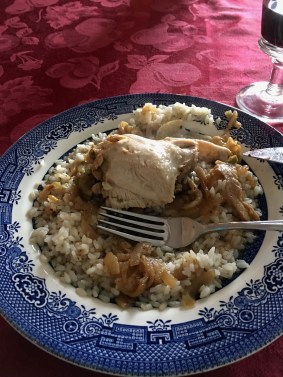
THE FOOD: Once, when Attila returned home from a mission, he had gone to the bedroom he shared with his wife to wash his hands before dinner. He got the sense upon entering the room, that it had been undisturbed for some time in an abandoned house. His evening shoes were on the floor beneath the stand which held the jacket he had worn the day before his departure. His wife’s gown hung on the chair in front of her dressing table. He realized that the room was exactly as it had been at the moment when he had turned at the door with his suitcase in hand, to check if he had forgotten anything. Attila realized that Maryse had not slept in their bedroom those days he had been away. She had slept on a daybed in her office at the hospital where she worked. The meal Attila had gone to the bedroom to wash up for was chicken yassa.
Chicken Yassa
Marinade ½ C white wine vinegar
3 limes, zested, juiced
1 1- inch piece ginger, thinly sliced
1 scotch bonnet pepper, slit
1 onion, peeled, sliced
2 tsp black peppercorns, crushed0
4 cloves garlic, peeled, thinly sliced
2 tsp Kosher salt
¼ cup olive oil
4 chicken leg quarters
Chicken and Onions 2 T olive oil
3 medium onions, peeled, thinly sliced
3 sprigs thyme
1 T ginger, peeled, minced*
1 tsp ground allspice
½ tsp cayenne pepper
2 C chicken stock
⅔ C pitted green olives,sliced
white rice, cooked, to serve
parsley, chopped, to garnish
For the marinade: In a large zip top bag add the vinegar, lime zest and juice, ginger, scotch bonnet, onion, peppercorns, garlic and olive oil. Season with salt and pepper, add the chicken legs and allow to marinate for 4-5 hours in the refrigerator. (Marinate the chicken up to 12 hours in advance.) When ready to sear, remove from the refrigerator 30 minutes prior to cooking to come to room temperature.
For the chicken and onions: In a large Dutch oven, add the olive oil and heat over medium-high heat. Remove the chicken from the marinade, discarding the marinade. Season with additional salt and pepper and add to the Durch oven skin side down. Sear until golden brown, about 4 minutes, flip and allow to sear on the other side another 4 minutes. Remove to a plate. Add the onions and cook, over medium heat, until caramelized, about 25 minutes. Once caramelized, add the thyme sprigs, ginger, allspice and cayenne and cook another minute. Season with the salt and pepper.
Add the stock, scraping the browned bits up from the bottom of the pan, and bring to a simmer. Add the chicken back to the pot, the stock should come halfway up the chicken, cover and continue to simmer for 35-40 minutes until the chicken is tender and cooked through, or a meat thermometer registers 165º. Stir in the olives during the last 5 minutes of cooking. Serve the chicken and onions over white rice. Garnish with parsley.
I forgot to take the picture when it was artfully arranged on the plate.
It’s no secret that I love all things Alexander McCall Smith (except for that bulldozer one) and consider time spent reading his books a chance to catch up with old friends. When I finished reading it I was smiling and hugging the book. I know I’m not alone in this, even if other readers are reluctant to admit that they, too, hug their books. In this latest Scotland Street incarnation, one of the characters is questioning their love for a significant other; Bertie experiences a dream come true, finally; Irene has contact with Dr. Fairbairn, Bertie’s former psychologist; Stuart is a up for a promotion; and intimations of a possible love interest for Big Lou are a big tease.
In a somewhat touching exchange as Matthew escorted the Duke to his car after dinner at Nine Mile Burn, the Duke sincerely thanked Matthew and Elspeth for their friendship, saying that we live in difficult times. “It’s the destruction of civility,” said the Duke. “Twenty years ago, people may have had their differences of opinion – of course they did -but they did not abuse one another for it. They respected those with whom they disagreed. They spoke courteously.” He went on to say, “And now there’s something very unpleasant on the loose. We may pretend that it isn’t; we may deny it, but we know that there are more and more people who hate those whom they used not to hate. And there are even some who encourage this hate, who harbor that hate within themselves, are are happy to see it flourish in the breasts of others.” I love how AMS (Sandy to his friends) references current cultural trends. It’s comforting.
THE BEAUTY: There is always so much beauty in AMS’s books, it was a challenge to highlight just one. I settled on an occasion that Bertie got to share with his father and his best friend. Stuart planned a special outing for his son, and his best friend, Ranald Braveheart McPherson to a rugby match between Scotland and New Zealand. It was an especially important game because Scotland had never beaten the all-powerful New Zealanders. After the Scottish fans sang their national anthem, “Flower of Scotland,” New Zealand responded with their haka, of which I had never heard, although I had seen similar gestures made by Samoans in a dance at a luau in Hawaii years ago. So here it is – a unique demonstration of power and intimidation. Ahead of the final of Rugby World Cup 2011 in New Zealand, the French team formed an arrow as the All Blacks performed their pre-match tradition – the haka.
THE FOOD: For food, I wrote down the following: king scallops, white onion veloute, Glass and Thompson’s on Dundas St. or the Cumberland Bar. I didn’t write down the page number and have been unsuccesful finding the reference by skimming the book. Loving scallops, that’s what I decided to go with.
White Onion Veloutè and Seared Scallops Serves 2
For the veloutè:
5 T unsalted butter
6 large white onions very thinly sliced*
3 sprigs of thyme
sea salt and white pepper
⅔ C white wine
3 C chicken stock
¾ C crème fraîche
optional black pepper to serve
10 large sea scallops, tendons removed, patted dry
To serve: extra-virgin olive oil and finely chopped chives
To make the veloute:
Peel, halve and slice the onions. Melt the butter in a large pan over a low heat.
Add the onions and thyme, sprinkle over a heaping teaspoon of sea salt and fry
for 30 minutes, stirring frequently to prevent the onions from coloring. By the
end they should be lusciously silky and soft. Pour in the wine, turn up the heat a little and simmer until it is well-reduced. Add the chicken stock, bring to a simmer and cook over a low heat for 15 minutes.
Remove the thyme stalks, and then purée the soup in a blender or food processer, along with the black pepper.
*White onions have a particular character and finesse, and here it’s quite important to use these rather than the ordinary brown ones that are better reserved for French-style onion soup.
To make the seared scallops: It’s important that the scallops be absolutely dry before searing. If they aren’t, they’ll steam instead of sear, and you won’t get the sweet, carmelized crust that makes seared scallops so delicious.
Heat a 10 inch skillet over medium high heat for 2 minutes. Add the oil and heat until quite hot. Pat the scallops dry once more and put them in the pan in a single, uncrowded layer. Season with salt and pepper and let sear undisturbed until one side is browned and crisp, about 2 minutes. Using tongs, turn the scallops and sear until the second side is well browned and the scallops are almost firm to the touch, 2 minutes. Take the pan off the heat and place 5 scallops on plate over a layer of the hot veloute. Drizzle some good extra virgin olive oil over the scallops and veloute, sprinkle with chives, and serve.
So, so good. The chives at the market looked lousy, and mine in the garden aren’t big enough, yet, so no chives. But still delicious!
Other than As You Like It which I read in 2016, I don’t recall having read any Shakespeare since high school, when it might have been Romeo and Juliet, or not, I seriously don’t remember. In high school, I thought Shakespeare was very boring and had to have everything explained to me. I felt inadequate, because, even though it was English, I understood very little of what was going on. Then we went on a class trip to a production of Shakespeare (again, I can’t remember what play) and I was shocked that people in the audience were laughing. I mean, laughing at Shakespeare! It was supposed to be funny? Who knew? So, I’ve always thought Shakespeare was out of my league. Then I heard about Hogarth’s Shakespeare project to oversee his works retold by acclaimed and bestselling novelists of today. I’ve read only four of the seven that have been published since 2015, starting with Margaret Atwood’s retelling of the “The Tempest,” called Hagseed.
Although I never read Jo Nesbo’s crime fiction, I had heard of him and knew he was among the best, if not the pinnacle in the genre, so I figured his rendition of Macbeth would be interesting, and that it was, along with complex and layered. I knew I should keep a list of all the characters, because that is one of the problems I had with the bard himself – so many characters to keep straight. One of the things I loved from its first introduction in the story was the journey of a single rain drop, imagery that reappeared, and served to draw the story to a satisfying conclusion at the end of the book. The magical qualities possessed by Lady, the witches, Seyton, and others, were subtle, and since I didn’t have a thorough understanding of the original work, I felt I was missing something. Macbeth’s transformation was the hardest thing for me to accept since he didn’t seem to have a strong need for power. His ambition was fueled by his love for Lady, who did have the uncompromising will to get to the top. I suppose that if I understood drug addiction from experience, either my own or someone close me, I would get how the drugs induce the feeling of omnipotence. Macbeth did say repeatedly that he felt like a new man, and then proceeded to act in a way that contradicted the character introduced at the beginning of the story.
There was much here that spoke to contemporary readers. 1. After Strega delivered the prophecy to Macbeth, she tells Hecate, “Human ambition will always stretch toward the sun like a thistle and overshadow and kill everything around it.” 2. Vera, beloved wife of Banquo, died of lung disease that she contracted during her employment in the town’s factories. Factories whose released toxins polluted the air, which was then forced down by low pressure weather systems hovering over the town like a lid. 3. A truth that was repeated many times was that “we never become what we aren’t already.” Duff used this knowledge to bring down Macbeth in the end. Having known him since childhood, Duff knew that Macbeth wouldn’t harm a defenseless man. It was against his nature, overruling even the instinct for self-preservation.
The intense detail about the ambushes that Macbeth engineered as the head of SWAT distanced me from the story. I’m really not interested in reading the nitty gritty details of crime fighting, and like an action movie, for my taste, there was way too much of that. Having said that, I was totally engrossed by the characters and the inevitability of outcome based on a character’s integrity and ambition. The end was great: a complex web woven together from multiple strands and stories, creating a satisfying conclusion.
THE BEAUTY: This being a tragedy, finding beauty was a challenge. The truths about human nature revealed in Macbeth, are beautiful in their ambiguity and accuracy. The love expressed between Lady and Macbeth, Banquo and Vera, and even Duff and Caithness, was beautiful. But once again, it is the music to which I ultimately turned. Macbeth heard strains of Todd Rundgren’s “Hello It’s Me” as he made his way down an alley to identify a body. I loved that song back in the day, but after I heard Lindisfarne’s “Meet Me on the Corner,” I was hooked and have had this earworm in my head for day. Hopefully you won’t have that same experience. I preferred this version to the original recorded in 1972.
THE FOOD:
Even though meals were mentioned, there wasn’t anything specific, so I focused on a scene where Duff is looking forward to going home to his wife and kids. Simultaneously, the reader sees that Meredith, his wife, has hung the sheets out to dry, while his daughter dutifully stirs a pot of broth awaiting the arrival of her father. When I googled “Scottish broth,” I found that in the 70’s when this Macbeth is set, there was a very popular stew that Scots turned to for comfort. Its main ingredients were lamb, barley split peas and lentils. Not being a lamb fan, I modified some recipes to make the vegetarian version below. The irony of this particular recipe is remarkable in that the scene that follows the one I described above is the antithesis of domestic bliss.
Scotch Broth Serves 8
2 T vegetable oil 4 sprigs of thyme, tied
1 C chopped onion 2 bay leaves
3 garlic cloves, chopped 1 tsp salt
2 bay leaves 6 C broth
2 sticks of celery, diced 1 large carrot, diced
½ C pearl barley 1 medium turnip, peeled and diced (¾ cup)
⅛ C yellow split peas 2 parsnips, peeled and diced (¾ cup)
2 T green split peas 1 medium leek, chopped, rinsed and drained
2 T blue peas 2 C kale, stems removed, coarsely chopped, packed
2 T red split lentils
The combination of barley, split peas, blue peas and lentils should equal a cup. If it doesn’t, add more pearl barley.
Heat the oil in a large pan. Add the onions and celery and saute on medium until lightly softened, about 5 minutes. Add garlic and bay leaves and cook, stirring constantly until fragrant, about a minutes. Add barley, split peas, lentils, 4 sprigs of thyme, salt and broth. Bring to a boil, reduce heat to simmer and cook for 1 hour. Skim off any foam. Add more water as needed
Add carrot, turnip (or rutabaga), parsnips and leek and simmer for another hour.
Remove bay leaves and thyme. Add kale and cook another 10 minutes. Check and
adjust seasoning before serving.
A very hearty soup, perfect for a cold wintry day.
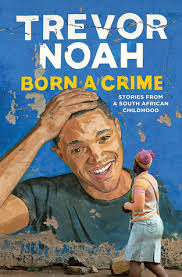
If I hadn’t already seen Trevor Noah on “The Daily Show, and laughed at his wit and marvelled at his intelligence, I probably wouldn’t have noticed this book, other than it being the selection for my book group this month. This is a series of essays that together form a jagged picture of a life, forged in circumstances that are so foreign to me, this was a real eye-opener. The title refers to the fact that when the author was born, it was against the law for people of mixed races to be together, and a crime for bearing children as a result of such a union. Had he not been carefully sequestered as a young boy, he might have been taken away from his parents. Astounding, but made very real by the anecdotes Noah related in the book. His father was Swiss, and white and laid back. His mother was Xhosa, and black, and defiant and rebellious. Because he was born under apartheid in South Africa, his story illuminates what life was like to be colored in a racially charged and oppressive environment.
Noah explained that apartheid, perfect racism, started with the Dutch in 1652 in Cape Town when the colonists warred with the natives, and developed a set of laws to enslave them. When the British took over, the descendants of the original Dutch settlers moved inland and became the white tribe of Africa, the Afrikaners. Then the British empire fell, and back come the Afrikaners to claim their inheritance. To control the black majority, the government knew they needed newer tools. “They set up a formal commission to go out and study institutionalized racism all over the world. They went to Australia. They went to the Netherlands. They went to America. They saw what worked, what didn’t. They came back and published a report, and the government used that knowledge to build the most advanced system of racial oppression known to man.” I don’t know what about this shocked me so much. Perhaps the fact that a more studied and systematic approach to oppressing a particular group of people implies the deliberateness of the effort. It wasn’t like, things just happened, and suddenly, “oh, my goodness, what have we created? We didn’t mean for this to happen!” This was a deliberate, conscious, ruthless undertaking. And yet, people survived. Trevor Noah survived. His mother, his friends, his family, survived.
In the same way that Barbara Lynch’s memoir Out of Line taught me about what it was like going to school during busing in South Boston, this book taught me about growing up black under apartheid in South Africa. I am so glad I read this, and now how even more respect for Trevor Noah and his indestructible mother.
THE BEAUTY: When people have no legal options, they still have to survive, so they do what they have to to feed themselves and their families. There weren’t enough jobs for blacks and coloreds, and the government made no provisions for people who were out of work, so it stands to reason that the threat of being arrested was a daily possibility. The beauty of the people who survived apartheid and came through on the other side, was their resilience and ingenuity. Trevor, had nothing to recommend him in high school, he wasn’t cool and he was poor. But he was fast on his feet, in part from learning to run away from situations that could potentially land him in trouble. So at school, when the bell rang for lunch, Trevor was always the first in line. After a while, he learned to leverage that ability to his advantage. Those who were slower to get to the truck, had less time to eat their food, so Trevor began buying their lunches each day in return for a cash tip. He built up quite a business, and was able to upgrade the equipment he used to make pirated cd’s of American hiphop music, selling to his customers at both at school and in the neighborhood. The business grew and grew, and was the start of his later success that placed him behing the desk at The Daily Show.
THE FOOD:
Trevor’s father was a presence in his life, even though he couldn’t live with him and his mother, until Patricia married Abel. Then Robert moved to Cape Town and they grew apart, mainly because of the geographical distance. When Patricia hounded Trevor to go find his father, because she believed he couldn’t truly become the man he’s supposed to be without knowing him, Trevor does. On that first meeting reuniting them, even though he was a young adult at the time, his father prepared his favorite meal from childhood, rösti with meat and gravy. Don’t be intimidated by the length of the directions. After you grate the potatoes, it’s really easy, and the resulting rösti is so deliciously crispy, it’s worth it.
Crisp Rösti Potatoes Yield: one 8-inch potato pancake or three to four 4-inch ones.
1 lb potatoes (Yukon Golds or russets are best)
1½ tsp salt
Generous ¼ tsp freshly ground black pepper
3 T vegetable or olive oil for frying; more as needed
Peel the potatoes and grate them, using the large holes of a hand grater or a food processor. Put the potatoes in a large bowl, add the salt and pepper, and toss to coat thoroughly. Let the potatoes rest for at least 5 minutes, and then, working with a fistful at a time, squeeze as much liquid as possible out of them and transfer to a second bowl. (The potatoes will start to discolor, but that won’t really affect the final results.)
Large holes mean faster work, better texture. A very finely grated potato could turn
mushy during cooking. To make one large rösti—Heat a heavy-based skillet that
measures about 8 inches across the base over medium-high heat. Add the oil (it should come to a depth of about ⅛ inch; add more if necessary.) When the oil begins to rippleslightly, test it by dropping in a potato shred—it should sizzle
enthusiastically. If not, wait a few more seconds. When the temperature is right, take a fistful of potatoes, wring it out once more, and let it fall loosely from your fingers into the center of the pan. (Be careful because the oil will spatter; getting hit by a few tiny droplets is inevitable.) Fill the pan gradually. Adding just a small amount at a time makes it easier to get an even layer. Working quickly, repeat until you’ve got enough potatoes in the pan to cover the bottom. With a fork, gently spread out the shreds of potato to make a layer about ½ inch thick, trying to distribute them evenly, avoiding dense or thin patches. If there are straggly potatoes around the edges, tuck them in with the fork also so they don’t burn. Adjust the heat so that you hear a lively sizzle but the bottom isn’t browning too rapidly. Cook until the underside is a deep golden brown and the potatoes on the top are starting to look translucent, 12 to 16 minutes.
To turn the pancake, carefully slide the rösti out of the pan onto a dinner plate and return the pan to the heat. Put another plate on top of the rösti and, holding tightly, flip the plates over. Slide the inverted rösti back into the pan and continue cooking until the new bottom is browned and the potatoes feel really tender in the middle when poked with a knife, another 6 to 8 minutes.
Slide the rösti onto a cutting board. Blot the top with a paper towel to remove any excess oil. Cut into wedges and serve as soon as possible.
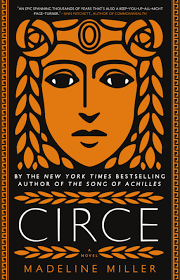
Having taught ancient Greece to eager (kidding) sixth graders, I have had an interest in Greek mythology for quite some time. I remember reading Greek myths as a child, but more vividly as a teacher, I remember an oversized book with a bright yellow cover called D’Aulaire’s Book of Greek Myths. I loved the stories and back then, had quite an extensive catalog of gods, goddesses, demigods, naiads, nymphs, rivergods, monsters, etc. in my head, but alas, you do lose it if you don’t use it. So when I heard about this book, I immediately put it on hold at the library. What a book. Miller gives the gods life like no author I’ve read. The gods of my youth were remote, distant. These characters pulse with life. This Circe starts out as a somewhat naive good girl, trying to please her daddy, Helios. Always telling the truth, her siblings and cousins see her as guileless. She was content to be alone, but didn’t know what she was looking for in life, unlike her siblings who blatantly schemed and did whatever needed doing, in order to grab more power. For example, Circe was punished by her father for doing exactly the same thing that her brother and sister had done, except that Circe told the truth about it, and they did not. When her brother Aeetes visited her in her room after her father had announced to the court what her punishment was to be, he accused her of being a fool for admitting what she’d done to their father. In anger she said, ” I suppose I should take you as my tutor and deny everything.”
“Yes,” he said. “That is how it works, Circe. I tell Father that my sorcery was an accident, he pretends to believe me, and Zeus pretends to believe him. And so the world is balanced. It is you own fault for confessing. Why you did that, I will never understand.” (and this was the sibling she genuinely loved and felt close to!)
This was yet another book, where a woman was marginalized because she had power that frightened the estableshment, in this case, the gods. That power was pharmakeia, (witchcraft, sorcery) the knowledge of plants and herbs and the proper way to mix them to make powerful draughts and tinctures. When her father found out that she had and used this power, Circe might have gotten away with it had she played the game like her brother, Aeetes, but she chose a different path, making her an enormously sympathetic and interesting character. I really loved this Circe, the flawed goddess who was destined to pay for her honesty into eternity. I intend to make a concerted effort to find out more about modern herbalism, starting with a book by Rosemary Gladstar (great name!) who, in addition to writing books about the subject, runs an herbal retreat center in Vermont. Not quite ready for that, but who knows? Maybe someday.
THE BEAUTY: Circe’s island, Aiaia, sounded very beautiful. Of course, noone really knows where it was, but it is suspected to be Ponza in the Tyrhenian Sea, vacation location of Romans in the know, and home to Pontius Pilate. Circe supposedly spent her winters in a grotto on Ponza, now known as “Grotta della Maga Circe,” and the summers on Mt. Circe on the Italian mainland.
Mt. Circe photo from geocaching.com
Grotto photo from ponzaviaggi.com
THE FOOD:
Circe had her hands full with her son, Telegonus when he was, literally, a wild child, but he grew up to be a thoughtful and wise young man, who had a passion for adventure. After not speaking to one another for several days, Circe finally relented, allowing him to pursue his passion, even risking a showdown with one of the more powerful Olympians to secure her son’s safety. The night before he was to embark on his journey, she prepared his favorite meal: fish stuffed with roasted herbs and cheese. Not much to go on, but I had to eliminate all the recipes I found that had tomatoes in them, because the ancient Greeks didn’t have tomatoes. But they did have cheese, so I’m thinking feta. This recipe, simple as it is, fits the description as much as it can all these centuries later, and is really delicious.
Greek Baked Fish Serves 4
4pieces of haddock salt and pepper 2 C loosely packed, coarsely torn breadcrumbs or chopped peasant-style bread
4 cloves garlic, finely chopped
1 stem fresh oregano, chopped or 1 teaspoon dried
generous handful of flat-leaf parsley, chopped 1 roasted red pepper, homemade or store-bought, patted dry and chopped handful of pitted Kalamata olives, chopped ½ medium or ¼ large red onion, finely chopped about ⅓ to ½ C EVOO (extra virgin olive oil)
1 cup Greek Feta, drained and crumbled
Lemon wedge
Preheat oven to 400 ºF. Arrange fish in a baking dish. Lightly dress with EVOO; season with salt and pepper.
Combine bread, garlic, oregano, parsley, red pepper, chili, olives and onions in a bowl and dress with just enough EVOO to lightly coat. Arrange topping all over the top of the fish and around the dish. Scatter feta around and over the bread layer. Bake fish 20-25 minutes. Serve with lemon wedges alongside.
 Sometimes I really struggle with a book, and yet I persist, for whatever reason- in this case, because the reviews were so consistently positive. And sometimes, I’m rewarded with something beautiful, something that puts everything that I struggled with before in context, and my feelings do a 180º, and I love the book. This happened on page 252. I don’t care how long it takes to get there, as long as I get there.
 Another debut novel, this one grew from an article in a 1939 women’s magazine that Pearce happened upon. Emmeline Lake and her best friend, Bunty, were working girls in 1940’s London. Emmy dreamed of becoming a war correspondent, while Bunty worked in the War Office. When Emmy spotted an ad for a Junior at Launceston Press, she believed this to be her ticket to a correspondent’s life. Reality, of course, finds her doing clerical work, eventually typing Mrs. Bird’s responses to her advice column. Mrs. Bird was a very traditional woman and makes it clear that some subjects will not be addressed in her column, some of which are: marital relations, premarital relations, extramarital relations, physical relations, sexual relations, illegal activities… and on and on. As Emmy read more and more of the letters, she began to feel sorry for the letter writers, and at first, tried to subtly urge Mrs. Bird to extend a few words of kindness and encouragement. But Mrs. Bird had her rules and would not yield: nose “to the grindstone” and all that. She gave no thought to the living conditions in London during the Blitz. Daily raids and bombings were the norm, absolutely everyone had someone they knew and loved in the fight, women were doing jobs that the men had done before they were taken into service, in short, times were difficult and everyone, whether they knew it or not, was looking for comfort, however small. Without saying more, I think you can figure out where the story headed. A key event in the book was based on a historical fact. The Cafe de Paris was night club made popular by the Prince of Wales. On March 8, 1941, it was bombed by the Nazis, killing 34, injuring 80. Ken Snakehips Johnson, a bandleader, was one of the 34. More on him later.


 I picked up three books from the library the other day when I was already in the middle of a book I had bought, but when I was ready for the next book, this was the one. What a treat! A debut novel, it sets a high bar for Nova Jacobs’ future work. Once I started reading, I blew off all other activities on a beautiful summer day and read the whole thing in one sitting. It is a mystery that starts with the apparent suicide of Isaac Severy, a renowned mathematician, and professor at the Sloan Laboratory of Mathematics and Physics at California Institute of Technology. As the family gathers for his funeral, we learn that one of them received a letter from Isaac written the day before his death, the first of many secrets to be revealed. We quickly learn that the equation is so very valuable, extreme measures must be taken to protect it. There were twists and turns, and things I didn’t figure out, but the characters were compelling and the family drama felt real. There’s even a transgender character. Well done, Nova Jacobs.

 This is a love story on so many planes: young love, parental love, familial love, love of friends… Layla is the protagonist, whose arranged marriage to Rafiq brought her from Hyderabad, India to California, to make a life and raise a family: Hadia, Huda and Amar. When Rafiq accepted a position that forced him to travel for weeks at a time, he made the sacrifice to better provide for his family. But Layla, reflecting on sleeping alone for the first time in her life, watches her husband early in the morning on the day of his first business trip. “His most beautiful face is his sleeping one, no stern expressions, just eyelids, lashes, defined nose, jawline. She pictures those cartoon cottages in shows her daughters watch, where a woman inside the cottage throws open the shutters and appears at the window singing. That is how it feels today to wake up and see his face, like a window in the room of her heart is being thrust open.” Reading this passage, I knew I was reading something very special.
 This debut novel by a young member of the Cheyenne and Arapaho Tribes of Oklahoma introduces a new voice to American literature. I had no idea what to expect, only that this novel was highly anticipated and received a starred review from Kirkus. The story is told from the perspectives of twelve individuals making their way for different reasons to the Big Oakland Powwow. Each chapter is short, around 9-10 pages. I had difficulty synthesizing how the characters’ stories intersected, and also had trouble remembering who everybody was. Tony Loneman is the first character introduced. Then each of seven other characters has a chapter devoted to them before getting back to Tony Loneman again. So each time I got to the second chapter about a character, I had to go back and refresh my memory. I had even taken notes about each one along the way. This is not a flaw of the structure or the writing. The flaw is my inability to easily transition from one character or setting to another, in successive chapters. If anyone has a “hack” for dealing with this style of writing, I am all ears!
 Another book that I heard about in a podcast well enough in advance of publication to be the first to crack the cover of the library’s copy when it came in. I loved the cover, with its wildlife on the fringe of human habitation. It’s just the sort of story I’m drawn to: An American divorcee who goes to London to study the habits of urban foxes (quirky character, perhaps on the fringe herself, like the foxes she studies). Jean met Attila, a Ghanaian psychiatrist who traveled the world of war torn countries, to treat victims of PTSD. They met the first time when Jean literally ran into him on the Waterloo Bridge. Another chance meeting brought them together again, when they established a tenuous friendship. There is a lot going on in this novel. Both characters, Jean and Attila, are suffering from their own brand of loneliness and loss, but function perfectly well by throwing themselves into their work. Jean’s story raises the issue of how humankind and nature can share the same space and people can peacefully cohabit with the fauna that live in cities. (Perhaps the key to the success of that lies in the word “humankind.”) Attila’s passages are more complex as he contemplated the keynote address he came to London to deliver to colleagues in the mental health profession. He had come to believe that the current thinking on PTSD could be wrong. He no longer believed that trauma causes suffering which exclusively causes damage to the individual. Instead, he now believes that yes, trauma causes suffering, but suffering and damage are not the same thing. What we don’t know is whether the absence of adverse life events creates the ideal conditions for human development. We just assume that trauma causes damage.
 I forgot to take the picture when it was artfully arranged on the plate.
 It’s no secret that I love all things Alexander McCall Smith (except for that bulldozer one) and consider time spent reading his books a chance to catch up with old friends. When I finished reading it I was smiling and hugging the book. I know I’m not alone in this, even if other readers are reluctant to admit that they, too, hug their books. In this latest Scotland Street incarnation, one of the characters is questioning their love for a significant other; Bertie experiences a dream come true, finally; Irene has contact with Dr. Fairbairn, Bertie’s former psychologist; Stuart is a up for a promotion; and intimations of a possible love interest for Big Lou are a big tease.
 So, so good. The chives at the market looked lousy, and mine in the garden aren’t big enough, yet, so no chives. But still delicious!
 Other than As You Like It which I read in 2016, I don’t recall having read any Shakespeare since high school, when it might have been Romeo and Juliet, or not, I seriously don’t remember. In high school, I thought Shakespeare was very boring and had to have everything explained to me. I felt inadequate, because, even though it was English, I understood very little of what was going on. Then we went on a class trip to a production of Shakespeare (again, I can’t remember what play) and I was shocked that people in the audience were laughing. I mean, laughing at Shakespeare! It was supposed to be funny? Who knew? So, I’ve always thought Shakespeare was out of my league. Then I heard about Hogarth’s Shakespeare project to oversee his works retold by acclaimed and bestselling novelists of today. I’ve read only four of the seven that have been published since 2015, starting with Margaret Atwood’s retelling of the “The Tempest,” called
 If I hadn’t already seen Trevor Noah on “The Daily Show, and laughed at his wit and marvelled at his intelligence, I probably wouldn’t have noticed this book, other than it being the selection for my book group this month. This is a series of essays that together form a jagged picture of a life, forged in circumstances that are so foreign to me, this was a real eye-opener. The title refers to the fact that when the author was born, it was against the law for people of mixed races to be together, and a crime for bearing children as a result of such a union. Had he not been carefully sequestered as a young boy, he might have been taken away from his parents. Astounding, but made very real by the anecdotes Noah related in the book. His father was Swiss, and white and laid back. His mother was Xhosa, and black, and defiant and rebellious. Because he was born under apartheid in South Africa, his story illuminates what life was like to be colored in a racially charged and oppressive environment.
 Trevor’s father was a presence in his life, even though he couldn’t live with him and his mother, until Patricia married Abel. Then Robert moved to Cape Town and they grew apart, mainly because of the geographical distance. When Patricia hounded Trevor to go find his father, because she believed he couldn’t truly become the man he’s supposed to be without knowing him, Trevor does. On that first meeting reuniting them, even though he was a young adult at the time, his father prepared his favorite meal from childhood, rösti with meat and gravy. Don’t be intimidated by the length of the directions. After you grate the potatoes, it’s really easy, and the resulting rösti is so deliciously crispy, it’s worth it.
 Having taught ancient Greece to eager (kidding) sixth graders, I have had an interest in Greek mythology for quite some time. I remember reading Greek myths as a child, but more vividly as a teacher, I remember an oversized book with a bright yellow cover called
 Grotto photo from ponzaviaggi.com
 Circe had her hands full with her son, Telegonus when he was, literally, a wild child, but he grew up to be a thoughtful and wise young man, who had a passion for adventure. After not speaking to one another for several days, Circe finally relented, allowing him to pursue his passion, even risking a showdown with one of the more powerful Olympians to secure her son’s safety. The night before he was to embark on his journey, she prepared his favorite meal: fish stuffed with roasted herbs and cheese. Not much to go on, but I had to eliminate all the recipes I found that had tomatoes in them, because the ancient Greeks didn’t have tomatoes. But they did have cheese, so I’m thinking feta. This recipe, simple as it is, fits the description as much as it can all these centuries later, and is really delicious.
 bbfbooksbeautyfood