THE BOOK:
 I love the cover! What the picture doesn’t show is the shininess of the copper-colored outlines of the flowers and the words, and that it is embossed. I love the color palette. I first heard about this book in an email from Simon and Schuster, and it sounded like something I’d enjoy. I absolutely loved the first chapter, how it drew me in so powerfully. It is the story of 17 year-olds Roya and Bahman in semi-democratic Iran in 1953. Roya is a bookish girl, whose father supports her desire to get an education. He sees great things in the future for both Roya and her younger sister, Zari. Zari is outgoing and outspoken, and sometimes, I just wanted her to be quiet! So much so that I wrote in my notes. “Zari, please, just shut your mouth.” Bahman is politically active in his support of Prime Minister Mossaddegh, but still had to be careful about concealing his political orientation, as there were always rumors about government overthrow, and people of many factions quite willing to give up a neighbor to the authorities. The stationery store is where they first met, and it, too, has a story.
I learned a bit about Persian culture, as when Roya’s mother told her that “our fate is written on our forehead when we are born.” It can’t be seen, can’t be read, but it’s there in invisible ink, and your life follows that fate. I don’t know if generalities can be made about Iranians in general, but the characters in this book were superstitious, especially about “chesm,” the evil eye. Roya’s mother performed a cleansing of their house with incense after a negative encounter with a guest, and asked for the jealous eye to be blinded. In a touching moment between Roya and her sister-in-law, Patricia, there was also a reference to the Haft Seen seven s’s table, with items that all began with the letter ‘s’ in Farsi, a traditional practice during Nowruz, the Persian New Year celebrated on the vernal equinox. Kind of like the Italian tradition of the seven fishes at Christmas to celebrate the bounty of the seven oceans.
I can’t conclude my discussion without a caveat, dear reader: this is a sad, sad, book, and when I was done reading, I, like Roya, was wrecked, and needed several hours to recover. In spite of the sadness, it was a beautiful story. And now is the perfect time in my life to be reminded of the healing power of love, and that love still exists in an otherwise cruel world.
THE BEAUTY:
The poetry of Rumi was important to both Roya and Bahman. The following poem appears several times in the book:
Look at love
How it tangles
With the one fallen in love
Look at spirit
How it fuses with earth
Giving it new life
When I googled “Persian art colors,” trying to figure out if the colors on the cover had any meaning, these images, among others, came up:



Beautiful!
THE FOOD:
A special occasion dish called Jeweled Rice was mentioned several times in the story. I did buy the barberries online, but I did not opt to purchase really good Persian Basmati rice because you had to buy it in ten pound bags, and there’s no way my husband and I would ever go through that much in a year, so I used a supermarket Carolina Basmati instead, which was very good. If I’m ever in a Middle Eastern market, I’ll look for more authentic rice in a smaller quantity to see if it really makes a difference.
Persian Jeweled Rice
2 C best-quality Basmati rice
2 T Kosher salt
Unsalted butter, 6 tablespoons in total
1 large onion, diced small
¼ tsp saffron threads, crumbled and soaked in 1/4 cup hot water
Large pinch ground cinnamon
Large pinch ground cardamom
Large pinch ground allspice
Large pinch ground black pepper
Large pinch ground cumin
⅓ C chopped dried apricots
⅓ C golden raisins or currants
⅓ C dried imported barberries, goji berries, dried cherries or dried cranberries soaked in warm water for 5 minutes and drained
⅓ C blanched slivered almonds
⅓ C roughly chopped pistachios
Rinse the rice several times in cold water until the water runs clear. Drain. Bring 3 quarts water to a boil in a large pot with 2 tablespoons kosher salt. Add the rinsed rice and boil, stirring occasionally, for 5 minutes, then drain well in a colander.
Heat 1 tablespoon butter in a small skillet over medium heat. Add the onion, season lightly with salt and cook until softened and lightly colored, 4 to 5 minutes. Moisten with 1 tablespoon saffron water and stir in the cinnamon, cardamom, allspice, black pepper and cumin. Cook for 1 minute more. Stir in the apricots, raisins, and barberries (or goji berries, cherries or cranberries).
Melt 4 tablespoons butter in a heavy-bottomed enamel or nonstick Dutch oven over medium heat. Spread half the par-cooked rice over the bottom of the pot. Spoon over the onion-fruit mixture, then the remaining rice. Leave the pot on the flame, uncovered, for 5 to 8 minutes to gently brown the rice. (Do not stir or move the rice — you will need to rely on your nose to tell if the rice has browned.)
Drizzle the remaining saffron water over the rice and put on the lid. Adjust the heat to very low and leave undisturbed for 30 minutes. Turn off the heat and let rest at least 10 minutes.
Heat the remaining 1 tablespoon butter in a small skillet over medium-low heat and gently toast the almonds and pistachios for a minute or so, taking care not to get them too brown. Set aside for garnish.
To serve, spoon the rice into a wide bowl or platter. With a spatula, carefully lift the bottom crust, placing the crisp side up. Sprinkle with the toasted nuts.

I’m so proud of the crust! When made correctly, the tahdig (crust) can be detached from the Dutch oven and served whole, which is what I attempted to do. I forgot to let it sit after I turned off the heat on the stove, so the first piece I tried to extract was a mess. But this one is a beautiful golden brown, and was crunchy and delicious.
 Initially I found the cover off-putting, probably because so many books with a female protagonist show a woman’s back on the cover and it just seemed cliche. When I saw the book at the library book sale, however, the rat and the sensible shoes won me over. Having read A Man Called Ove, I knew that there would be something I could relate to in the book, so I took the plunge. I loved Britt-Marie, although her relationship with Kent, her husband was stifling, in that she subjugated herself to his needs, and was happy to do it, but Kent never really saw her. Sadly, Brett-Marie spent most of her adult life hoping to be seen. “You are here,” was a revealing scene early on in the story when Britt-Marie took a position as the caretaker of the recreation center in tiny, run-down Borg. The girl in the wheelchair whom Britt-Marie called “Somebody” hung a map, rather low on the wall because of the wheelchair, that marked the location of the center with an arrow and the words “you are here”. Britt-Marie found that comforting because, “Sometimes it’s easier to go on living, not even knowing who you are, when at least you know precisely where you are while you go on not knowing.” Despite her social awkwardness and rigidity of habit, Britt-Marie forged ahead to do her job, and in the process discovered that she was more than just, “here.”
 A simple, yet filling meal.
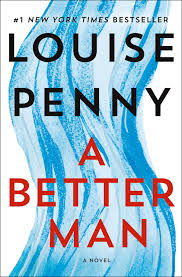 What struck me reading this book, was how Penny used the forces of nature to complement the action in the story. Gamache and Beauvoir running through the muck of an early April thaw, emphasized the danger, the struggle and the urgency of the two law enforcement officers attempting to identify a killer. And later, when the resolution was clear, everyone was safe, and the harsh winter was past, I literally got chills when I read this: “By that afternoon, the sun was out in full force. Snowdrops and fragrant, delicate lily of the valley were beginning to appear. Crocuses broke through the grass of the village green. Life had not just been restored, it had burst forth…”
 This was delicious and filling. I couldn’t stop eating it.
 Another Elizabeth Berg novel, another enjoyable read! Told from the point of view of 12 year-old Ginny, the book is set in Clear Falls, Wisconsin in the summer of 1958. Ginny is close to her sister Sharla, who is a year older, and although they do bicker a lot, they spend a lot of time together creating fantasies, someties in their yard, at midnight, unbeknownst to their parents. Their mother Marion, sort of a drill sergeant, scheduled their lives to fill them with enrichment opportunities. For example, Monday night was “Vocabulary Night,” and everyone in the family had to come to the dinner table with a new word to share. Each of the other weekdays had something else for the girls to do to keep them out of trouble. Their father was an insurance man who was extremely predictable: out every morning with a kiss for Marion and pats on the head for the girls, he returned promptly every evening at 6:00, tooting the car horn three times to announce his arrival, and calling out, “I’m home” as he came in the back door. The girls did their best to have adventures that they kept from their parents, and it all seemed like a typical American family. Until the new neighbor moved in, and their lives were never the same.
 When I first heard about this book, it didn’t particularly interest me, but I knew that I would read it because it’s by McEwan. Now I wish I hadn’t waited so long. The protagonist Charlie Friend came into some money when his parents’ home was sold. With that money, he purchased “Adam,” a synthetic human, one of 25 made world-wide. Fresh out of the box, Adam looked remarkably real, although inanimate because he needed a sixteen hour charge to get up and running, and then had to be programmed with characteristics of his owner’s choosing. At this juncture, Charlie opted to bring his neighbor, Miranda, closer into his sphere by asking her to choose half of the characteristics, which were completely concealed from Charlie. Given several days to acclimate Adam, the relationships among the threesome grow and the consequences of their interactions makes for some interesting action. The setting is an alternate 1980’s London, where history has been rewritten. JFK survived in Dallas, the Falklands was a raging success, and Alan Turing was still alive. For some reason that seemed to me to be the most audacious rewriting of history on McEwan’s part (The Turing bit). There’s a lot of history in here and also a lot of computer science, most of which was lost on me, but this story did what this author does so well, and that is cause the reader to examine her own values, prejudices and ethics in several spheres of human interaction. The book was a fascinating, if not frightening peek into the not-so-distant future.

 Simon, formerly of The Readers, recommended this book. It was the first ever winner of the Orange Prize in 1996, although it is now called the Women’s Prize. It is a gothic novel, which is not something I usually read. Gothic literature contains death and decay, haunted homes or castles, family curses, madness, powerful love and romance, and ghosts, or vampires. While there were no vampires here, the ghost wasn’t a ghost at all, simply an absent family member, albeit an important one. Cathy and Rob are teenage brother and sister, two years apart, living with their aging grandfather on a rundown estate in the English countryside. The siblings know very little about their parents, only that their mother deserted them and lives somewhere on the continent and their father is in a sanitarium. Under the circumstances it’s no wonder that Cathy and Rob forge a close relationship. Even thought I could sense where the plot was heading, I was still surprised when it happened. The historical context (1914) intervened as Europe entered WWI, and things changed for everyone. The kindly servant Kate went back to Ireland. Rob left for the war, and Cathy found a way to eke out a living on the estate, learning to plough and mend fences and live off the land as she cares for her grandfather. I didn’t anticipate the ending, but I was very happy with it. If all gothic novels end this way, perhaps I’ll read some more!



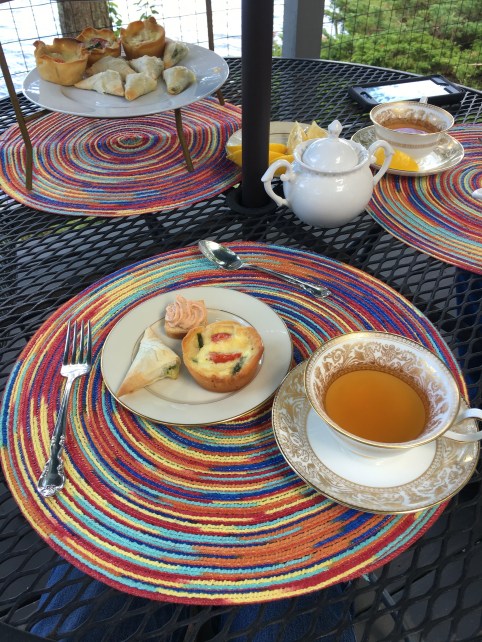 Pictured are the savory snacks: spanakopita, mini quiches and salmon toasts, and of course, the sage tea. Not pictured are the sweets: madeleines with homemade raspberry jam.


 Celestial and Roy are newlyweds with a promising future ahead of them. Enjoying each other’s company, working hard at jobs they love, they’re convinced that life will always be wonderful. Then something happens that only a black man in America can remotely understand, and the strength of their relationship is tested.

 A timely tale about a family living in Brownsville, Texas and their involvement with immigration. Nina takes care of her invalid mother, for whom she gave up an independent life, her job and the house she had worked so hard to buy. It all began quite innocently when her brother, Beto, called to ask if she would do him the favor of checking in on Mom on her way home from work, which, of course, she did. And then, one day years later, when Nina found her mother on the floor in the kitchen, unable to get up to turn off the screeching kettle, Nina’s fate was sealed. She sold her home, took early retirement from her teaching job and moved into the family home to care for her mother. Beto stopped in every now and then, and tried to insert himself into her life by constantly telling her what to do. When her nephew Eduardo called to ask if his son, her godson, Orly, could spend a couple of weeks with her in the summer, she was thrilled. But things got complicated when a favor she had done for her housekeeper a few weeks before Orly’s arrival, changed and complicated her life. Suddenly she had her mother, Orly, Daniel and countless others relying on her, and noone knew her secret.
 This was a delightful love story. An introvert and an extrovert are an unlikely couple, especially since they’ve never met each other face to face, and yet… When Tiffy realizes the true nature of her relationship with her ex, she begins to see the world, and her past, differently. Tiffy has answered an ad to be the flatmate of Leon, a palliative care nurse who works nights in a hospice. Tiffy is an assistant editor at a crafts publishing company and works days. They’ll never even see each other! It’s like living alone. Perfect arrangement. They communicate with each other through post-it notes left throughout the apartment. The way the personalities of Tiffy and Leon were revealed through the notes was well done. I found myself caring about the characters, and kind of mentally coaching each of them. I wanted them to find their respective happiness, and it was very gratifying when they did.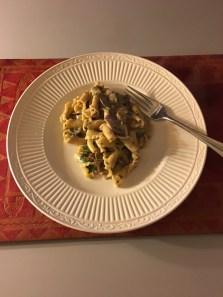
 bbfbooksbeautyfood