All posts by yogafrog

Elizabeth is Missing

THE BOOK:

2bee5de80ab30d96c5cfb67fccf1ad79

This mystery had been on my TBR shelf for quite some time, having been recommended on both “Books on the Nightstand” and “The Readers”podcasts. The tone of the book is launched in the prologue in the last sentence, “Elizabeth?” I ask. “Did you ever grow marrows?” Maud is the speaker here, a seventy-something year-old woman who is flirting with the complete isolation of dementia/Alzheimer’s, whose daughter, Helen, is helping her stay in her home by visiting daily, hiring help to check on her and cook for her, and by suggesting mnemonic devices to aid memory. Thus the sticky notes on the book’s cover. Maud has them everywhere – in her pockets, her purse, stuck to walls. They help somewhat, but frequently Maud will come upon one and not recall what it means or why she wrote it down in the first place.  Maud has become obsessed with the whereabouts of her friend Elizabeth. In attempting to sort out the mystery of her disappearance, she asks her daughter where Elizabeth has gone; she makes several unsuccessful attempts to walk to Elizabeth’s house, but gets lost; she calls Elizabeth’s son. Since the point of view in this story is primarily Maud’s, the reader doesn’t know the backstory, or what any of the other characters truly know about Elizabeth, or what they’ve told Maud. It is truly heartbreaking to watch Maud lose touch with her life and everyone in it. In that regard, Emma Healey has done a fine job of shining a light on what the internal life of an elderly person so stricken might be like. I began to experience my own degree of frustration with Maud when she ignored the advice of her caregivers, or perseverated on some detail. Imagine the frustration of her carers.

I love the way Healey placed clues very early in the narrative that were so unobtrusive as I read them, but so glaringly obvious as the mystery is solved. Very well-crafted.

THE BEAUTY:

Katy, Maud’s granddaughter, was dispatched by her mother to distract Maud, while  Helen takes care of some business Maud’s house. Katy has wisely chosen music of her grandmother’s youth to engage her. Unfortunately, though, Maud doesn’t like Vera Lynn singing “We’ll Meet Again.” She much prefers Ezio Pinza singing the Champagne Aria.” But Katy prevails. Here’s Maud’s preference.

THE FOOD:

Maud and her daughter Helen are having lunch at The Olive Grill. Reading the menu aloud is something Maud doesn’t seem to be able to stop doing, even though it yields eye-rolling and mimicking strangulation on Helen’s part. When she finds “Chorizo- stuffed Marrow” on the menu she asks Helen if marrows are fashionable again, not having seen one on a menu in many years. It turns out Maud had gotten to know Elizabeth in the first place because of some marrows. When they first met, Elizabeth described her garden wall, and Maud knew exactly where she it was because she remembered some marrows had been dug up there some sixty years ago. When Helen tells Maud she wouldn’t like chorizo, Maud gets distracted to the degree that when the waiter asks for her order, Helen has to order for them both. So, in deference to Helen, I have used Italian sausage instead of chorizo.

Cheese and Sausage Stuffed Zucchini

1 large zucchini (marrow)
12 oz spicy Italian sausage
½ C chopped onion
3 beaten eggs
Pinch garlic salt
1 C shredded Colby cheese
2 C cottage cheese
1½ C shredded Italian cheese blend
1 T Italian seasoning
½ tsp salt
½ tsp black pepper
1 C chopped tomatoes

Preheat oven to 350º. Butter a baking dish (size is dependent on the size of the zucchini.

Saute crumbled sausage in a large, deep skillet. Cook over medium high heat until evenly brown. Drain and set aside.

Partially cook zucchini in the microwave on high for 5 minutes. Remove from the microwave and let cool for about 10 minutes. In a medium bowl combine the eggs, Colby cheese, cottage cheese Italian blend cheese, Italian seasoning, salt and pepper.

Slice the zucchini in half lengthwise,remove the seeds and blot dry with paper towels. Place both halves in the baking dish and sprinkle with garlic salt. Layer the sausage, tomatoes and cheese mixture in each half.

Bake in a preheated oven for 40 minutes. Then broil for 5 minutes to brown the cheese.
 

Chance Developments

THE BOOK:

9781101871256

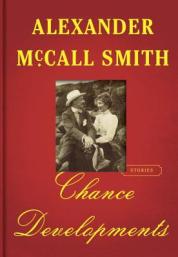
It’s no secret that I love Alexander McCall Smith’s books. In addition to tickling my reading fancy, this one is a tactile delight. The picture above is a photograph viewed through a rectangular hole in the hard cover of the book which has been cut to frame it. There are four other photographs of unknown people that AMS selected to build his stories around. I’m also enamored of the concept of creating stories abut random strangers, having spent a considerable time in airports with my husband passing time by imagining biographies for the people we observe as we wait for our flight to be called. Then there was the joy of holding the book in my hands. At 5×7 inches, it’s a cozy fit. I love the photos, the feel of the book, and the messages contained within, all about love.

My favorite story, the second one, was called “Angels in Italy.” Without giving anything away, in this story, the two main characters recall a conversation they had when they were teenagers about the existence of angels prompted by a sketch of a dove Harry made. Many years later, enjoying a lunch in Italy, they are reminded of the conversation because the room where they’re dining had angels painted on the ceiling. I tried to find images of what Harry referred to as “Della Robbia angels,” but I could only find ones that were sculpted, not painted. Google only takes me so far!

THE BEAUTY

Harry’s family summers for two months each year on a mountainous peninsula on the western edge of Scotland. The driveway to their home is lined with rhododendrons, which Phyllis, Harry’s mom thinks are beautiful, but Struan, his father, calls them “Nasty things…A haven for midges. They should have left them where they found them-in the Himalayas.” Who knew? Rhododendrons are Nepal’s national flower. Although, the ecologist for the National Trust for Scotland, James Fenton,  wants the government to make getting rid of wild rhododendrons a top priority, making it the biggest ecological issue, in his opinion, in Scotland today, there is no denying their beauty. The wild rhododendron has adapted to the Scottish climate to the degree that it crowds out native trees and plants. So, beauty comes at a price.

rhododendron2
from the website portsonachanhotel.co.uk

THE FOOD:

Harry, a painter, spent some time in Florence  where he had been invited to lecture. While there, a wealthy patron from Pittsburgh invited him to lunch at her villa in the hills of Fiesole outside Florence. It was to be a simple Tuscan lunch, of six courses! When I Googled “Tuscan lunch” a menu from Giada DiLaurentis came up including four courses: bruschetta, Bistecca Fiorentina (marinated, grilled steak) white beans, and chocolate cherry shortbread cookies. While the bruschetta was prepared in a way I’d like to try, (brush oil on one side of sliced rustic Tuscan bread and grill; brush with the cut side of a tomato sliced in half: salt and serve), I really like the bean and kale recipe, so thank you, Giada and The Food Network.

White Beans and Kale

2 C dried white beans, such as cannellini
1 sprig fresh sage
4 cloves garlic, peeled and smashed
2 T plus 1/2 cup extra-virgin olive oil
1 small bunch Tuscan kale, chopped
1 ½ tsp kosher salt
½ tsp red pepper flakes
½ C freshly grated Parmesan

In a medium Dutch oven, combine the white beans, sage, garlic, 2 tablespoons olive oil and 6 cups water (bottled preferred). Bring to a boil over medium-high heat, then reduce the heat to medium-low to maintain a gentle simmer. Cook, partially covered, for 1 hour 20 minutes, stirring occasionally; the beans should be just tender all the way through.
Add the kale, salt and red pepper flakes to the beans and stir to combine. Cover the pan and simmer until the kale is wilted and tender, an additional 15 minutes. Stir in the remaining 1/2 cup olive oil and the cheese to finish.


Ordinary Grace

THE BOOK:

ordinary-grace

This is a coming of age story set in the summer of 1961 in a small town in the Minnesota River Valley. It is told from 13 year-old Frank’s point of view. Perhaps partly because of the setting, but in greater part because of the writing, the tone of the book  is like a hug. The word that comes to mind is “decency.” Oh, there’s prejudice and gossip and hierarchical society and people who do bad things, but that time period, after World War II when memories of the war had faded but were still present, was a time of most people doing the right thing, behaving decently. So it was with nostalgia that this book transported me back to my own childhood, as I had just turned eleven in the summer of 1961.  Krueger’s writing is direct, with great attention to describing the natural world as Frank and his younger brother Jake experienced it, and as I experienced it vicariously through them and my memories. Here is a passage I selected randomly on the first page I turned to looking for an example of what I mean:

“The sky had changed. The gray had deepened to the color of charcoal and the clouds had begun to boil. An erratic wind had risen and within its gusts was carried the sound of distant thunder from the west. We crossed the backyard and the pasture where the wild grass and daisies rippled as if the skin of the earth was alive. We skirted the Sweeney’s house where laundry hung on the line and I could hear the pop of bed linen snapping in the wind.”

 The book was evocative of the time period because of the many cultural references intertwined in the story. “Have Gun Will Travel” was a western TV show as was “The Ruthless Gun,” both of which the brothers watched.  Cars referenced were a 1955 Packard Clipper, a Studebaker, and a Pontiac Star Chief. Books and authors mentioned were Of Mice and Men and Ayn Rand. Then there was Sugar Pops, root beer at the drugstore soda fountain, Jell-o salad, “Surfside Six,” Kool Aid, Boy Scouts, fried baloney sandwiches, tuna casserole, “Public Enemy,” baseball games with the neighborhood kids until it got too dark to see the ball. And so much more.

This is a terrific book, and I’m grateful to the friend who told me about it.

THE BEAUTY:

In thinking about the beauty in this book, I kept coming back to the word “decency,” and that led me to think about the art of Norman Rockwell. Isn’t decency really, a way of behaving in which one sees another person for who they are, shows respect, and treats the individual fairly?

mti3nzy2otu4nta5nza1mji2

THE FOOD:

There was a lot of food to transport me back to my childhood, but the one I selected was served after a funeral at the Fellowship Hall of the Methodist Church where Nathan, Frank’s father was the minister. The food was supplied by the female members of the congregation, and reminded me of the  “Church Ladies” I remember from our church, who showed up at the house of the family of the deceased with food and drink. They took care of all the details unobtrusively, and like phantoms, cleaned up the mess and were gone before the widow or widower remembered to thank them.

Congo Squares

⅔ cup shortening
2¼ C packed brown sugar
2¾ C all-purpose flour
2½ tsp baking powder
½ tsp salt
3 eggs, beaten
1 T vanilla extract
2 C (12 ounces) semisweet chocolate chips
1 C chopped nuts

In a saucepan, melt shortening over medium heat. Stir in brown sugar. Cool slightly. Combine flour, baking powder and salt; add gradually with eggs to shortening mixture. Stir in the vanilla, chips and nuts (batter will be very stiff).

Spread into a greased and floured 13-in. x 9-in. baking pan. Bake at 350° for 25-30 minutes. Cut into squares while warm. Yield: about 48 bars.

Commonwealth

THE BOOK:

920x920

I loved the opening line of this book: “The christening took a turn when Albert Cousins arrived with gin.” Although I didn’t know it at the time, it captures the tone of the story perfectly in its understatement and wry humor. The story is about the blending of two families and the relationships among them as they grow up or old or both. Patchett crafts these individual characters in ways that make them real, prompting me to take sides in my preference for one sibling over another. There are a lot of cultural references in here from the seventies, and having lived them, I enjoyed revisiting songs like George Benson’s “This Masquerade” and Lou Rawls’ “Nobody But Me.” One of the characters is an avid reader, so there are many books mentioned, including one that I’ve added to my To Read list called Kristin Lavransdatter by Sigrid Undset, in translation from Norwegian by Tiina Nunnally.  Caroline, the icy sister shows her contempt for her reading sister Franny when she comments on all the money Franny is wasting on books. Franny assures her that no money was spent, as her books are all from the library. “Thank god for libraries,” Caroline responds condescendingly. There was another line that I found sad, and off-putting, although, having been used in reference to Albie, it certainly reflects his attitude toward school as a teenager: “The halls were silent and wide without the hordes of furious children and bitter, defeated adults.” I sincerely hope that this view is the exception and not the norm in our high schools today. Finally, as someone who has struggled, given up, struggled some more, and given up, with meditation, I especially enjoyed (Holly’s elderly mother) Teresa’s stream of consciousness narrative on her attempt to achieve one breath that was unburdened by thought when she meditates with the pros at her daughter’s Zen retreat home in Switzerland. It’s not just me. Meditation is hard.

THE BEAUTY:

alps-goats-switzerland-walking-via-francigena-ways-638x359
francigenaways.com   alps-goats-switzerland-walking-via-francigena-ways

On the drive from the airport in Lucerne to the Zen center where Holly lives, Teresa is overwhelmed by the clarity of the Swiss air and the majestic beauty of the Alps. As she rolls down the window of the Citroen (that she likens to a soup can), “I have to tell you, Holly, I didn’t understand until now. I mean, I’ve been happy for you, but in the back of my mind I was always thinking, “What’s wrong with Torrance?”  And this is when  they drove past two shaggy mountain goats on the road, no doubt waiting for Heidi and Grandfather to herd them back into the mountains.

THE FOOD:

As this book was about families, there was a fair amount of food mentioned, but it was pretty basic, like salad, asparagus, baked potato, steak. Toward the end of the book, Beverly has prepared onion dip to satisfy one grandson’s need for salt and caramel cake for the other’s need for sweet when they visit with their parents for the Christmas holidays. Since I am one who craves salt, the recipe choice was a no-brainer.

French Onion Dip

2 T olive oil
1 T butter
2 yellow onions (peeled, diced)
¼ tsp garlic powder
2 tsp Worcestershire sauce
12 oz. plain Greek yogurt (or sour cream)
8 oz whipped cream cheese
kosher salt and freshly ground black pepper

To a large saute pan add olive oil and butter and heat over medium heat. Add onions, garlic powder, and Worcestershire sauce. Season with salt and pepper. Stir and cook for 5 minutes. Reduce heat to low and cook for 30 minutes, until onions are golden and caramelized. Remove from heat and set aside. 

In a large bowl, add the Greek yogurt and cream cheese, and mix to combine. Add the cooled onion mixture and mix to combine. Refrigerate until ready to use.

You Will Know Me

THE BOOK:

                                          3e060e62f3695c249f0f6a706700786b

This is my first book by this author and I have to agree that she was masterful at making me want more, propelling me through the novel at a fast pace. Listening to an audiobook is not my favorite way of experiencing a book, and it is no fault of the author that I did not like this particular narrator’s interpretation and delivery, but in spite of that, I kept at it because I wanted to know what was going to happen next. This story of the Knox family’s journey to the Olympics through daughter Devon’s gymnastics was a peek into the world of competitive sports. Jealousy, back-stabbing, politicking, undermining, and gossip-mongering all appear in abundance- not unlike any other organization-only magnified in intensity because so much was at stake. The novel explores the ambiguity of desire: is it the child’s wish to become an Olympian, or do the parents subtly force their desire onto the child to the degree that she learns to believe it is her heart’s desire only, and not her parents’? No matter how the parents answer that question, it remains unclear how can they ever be truly sure. Another central issue is the lengths to which a parent will go to protect their offspring. As Katie, Devon’s mother, reflects, “So many things you think you’ll never do until you do them.” A book group could have a great discussion about who the exemplary parents were in this story- that is, assuming there were exemplary parents! On another note, having just watched the American gymnastic team achieve gold at the Rio summer Olympics, the sacrifices they made to get there are so much more apparent to me having read this book. I hope they are grounded enough to cultivate true friendships, because it those relationships that are so important to lifelong happiness and well-being.

Finally, the character I found most interesting was Drew, Devon’s younger brother. (Although I must say I HATED the lisp and tone the narrator adopted for his voice, again, not the author’s fault.) Drew, always the bystander, always pushed aside because the family focus was on Devon, spent his younger years in her shadow. And yet, he processed all of that and what it said about his family, and still was himself. A truth teller, quietly affirming what he knew, even though his parents never really listened to him. The story I’d like to read is his. How he grew up after Devon won the Olympics, (assuming that she did, of course) whether or not he went to college, what he studied, what kind of man he became. If I have ever have the opportunity, that’s what I’d ask Megan Abbott to write.

THE BEAUTY:

After a lifetime of practice and sacrifice, the strength and artistry of an Olympic gold performance is a beautiful thing. Rio 2016: Simone Biles’ gold medal-winning vault.

THE FOOD:

The story begins at the BelStars boosters’ Polynesian party after Devon won her first regional championship title on the vault, and qualified for Elite Qualifiers in six months’ time. Throughout the book, the characters, especially Katie, Devon and Drew continue to reflect on how things changed that night, and for one of them, a life-changing revelation happened. The key element in that party, (as perhaps one can generalize alcohol to most parties) was the mai tais. In honor of that memorable   night, the original Trader Vic’s mai tai recipe from 1944:

ORIGINAL TRADER VIC’S MAI TAI FROM 1944
makes 2 drinks

4 oz Bacardi rum
1 oz orange curacao
½ oz simple syrup
1 oz orgeat syrup
1½ oz orange juice
1½ oz pineapple juice
juice of 1 lime

Mix all ingredients in a shaker and pour over glassed ice. Float dark rum on top. Parasol optional (but fun!). If you can find it, Trader Vic’s Mai Tai Mix is fabulous, but only available, to my knowledge, online. And it’s pricey, but worth it, if you like mai tais.

mai_tai_by_rudat


The Reluctant Fundamentalist

THE BOOK:

                                                 the-reluctant-fundamentalist-novel-cover

Although this book was published in 2007, was shortlisted for the Man Booker Prize, was a motion picture directed by Mira Nair, starring Liev Schreiber, it did not come to my attention until I began listening to book podcasts several years ago. Consequently it had been on my TBR list for at least two years when I came across it in a used bookstore. I needed something short (it is 184 pages) and different (about Islam) to read between two ponderous books, when I found this book on my shelf.

This is a disturbing book. I will reveal no spoilers, but there is one line in it that affected me as though I had been struck, and it has stayed with me, and probably will stay with me into the immediate future. Four words. But as a westerner and an American, one very short, scary sentence.

The story is narrated by Changez, an American-educated Pakistani man who holds a powerful job in a valuation company in New York City after graduating from Princeton. He is living the American Dream. Fast forward to 9/11 when everyone’s life changed, although, admittedly some in more profound ways than others. It is from that point on that Changez’s values become clear to him.

This book has caused me to think anew about how countries in the Middle East view America and to reconsider the historical narrative that is our legacy. Looking at America from another perspective suggests an alternate interpretation of the military and diplomatic actions our government has taken. Looking forward, I wonder if I will view American foreign policy in quite the same way and hope that our leadership can find a way forward in that region, with strength and compassion, in an effort to diffuse a forever more volatile political climate where American intervention is frequently unwanted.

THE BEAUTY:

One of the revelations that Changez has when he returns to Lahore after 9/11 and the arrival of American troops in Afghanistan, Pakistan’s next door neighbor, is that he had been conditioned to look at things as an American. As he puts it when talking to the American in a Lahore cafe, “I was looking about me with the eyes of a foreigner, and not just any foreigner, but that particular type of entitled and unsympathetic American who so annoyed me when I encountered him in the classrooms and workplaces of your country’s elite.” Once Changez recognized this in himself, he felt the depth of his youthful impressionism, and could once again begin to appreciate the enduring beauty of his country’s rich history as reflected in the architecture and the grandeur of the Mughal art in his own home town. In that spirit, I searched and found the Wazīr Khān, a Mughal era mosque in Lahore. The mosque was completed in 1642 during the reign of the Mughal Emperor Shah Jahan. It is the most ornately decorated Mughal-era mosque with intricate faience tile work and interior surfaces that are almost entirely embellished with elaborate frescoes, as you can see from the images below.

10387714775_eb4775029f_b.jpg

acce24f76b67c698f76202167a926b6e.jpg
From Pakistan Insider; insider.pk

1385354_428758203895604_1514050158_n.jpg
From findmessages.com Muhammad Ashar  CC By – SA 3.0

14106510196_1d6866421f_b.jpg
From picssr.com

THE FOOD: 

Changez orders for himself and the American in the Lahore cafe where they meet. When the food is delivered to the table, we know  only that there is yoghurt, chopped vegetables, and kebab, which the American approached enthusiastically. In researching Pakistani recipes, I kept reading  how much people like Seekh kebabs, prepared with minced meat with spices and arranged on skewers. The kebabs can be cooked in a Tandoor or grilled, and since I had no Tandoor, I grilled them on the griddle on our gas stove. The kebabs made a great sandwich in naan with the chutney- especially good the next day using the leftovers. Seekh kebabs are part of the traditional Pakistani diet, they say. They are well worth the effort and will be made again in this household. Delicious!

Chicken Seekh Kebabs

1 tsp cumin seed
1 tsp coriander seed
1 lb. ground chicken thighs (grind in food processor)
2 T finely grated onion
2 T chopped fresh cilantro
1 T freshly minced garlic (about 3 medium cloves)
2 tsp finely diced green chilies (about 2 whole chilies, I used jalapeño)
1½ tsp finely grated ginger
1½ tsp turmeric powder
1 tsp kosher salt
¼ teaspoon garam masala

6 wooden skewers, soaked in water for at least 30 minutes prior to use.

Place cumin and coriander seeds in a cast iron skillet over medium heat and toast until fragrant, about 2 minutes. Transfer to a spice grinder or mortar and pestle, and grind into a fine powder.

In a large bowl mix together ground cumin and coriander seeds, chicken, onion, cilantro, garlic, chilies, turmeric, salt, and garam masala until chicken is evenly seasoned.

Form meat mixture into 6 skewer-length cylinders on a baking pan or tray. (I did not use the skewers.) If using skewers, press one into the chicken cylinder and form meat around the stick. Repeat with remaining meat. Place chicken (both skewered or unskewered) in the freezer for 20 minutes.

Remove the chicken from the freezer and carefully transfer to a hot grill. Cook until the skewers are brown all over and are cooked through, about 3 minutes per side. Transfer to a serving tray, let rest for 5 minutes, then serve immediately with green chutney.

Cilantro-Mint Chutney (Green Chutney)

2½ tsp chopped fresh ginger
3 scallions chopped
½ C (packed) fresh mint leaves
½ C (packed) fresh cilantro
1 T fresh lemon or lime juice
1 jalapeño chili, seeded, chopped
2 T (or more) plain yogurt
½ tsp salt (or to taste)

Place ginger into the bowl of a food processor and process until coarsely chopped. Scrape down the sides of the bowl, then add scallions, mint, cilantro, yogurt, jalapeno, lime juice, and salt. Process to a textured paste similar in consistency to pesto, adding water to adjust the consistency if desired. I used a small food processor that worked quite well with these ingredients.


Seating Arrangements

THE BOOK:

f0f8ba78-65b9-4ef4-9026-abc8908a1134img400

This was a highly anticipated debut novel written in 2012, and had been on my TBR list because of recommendations from multiple trusted sources. Searching for a readily accessible audiobook on my library’s website to help me achieve a 6th Bingo on my summer reading card, I put a hold on this book. However, the format I ordered was ebook, not audiobook, so I read it today on my phone. (I’ll still get the Bingo because it satisfies the square “by any Booktopia author.”)

The writing did compel me to keep reading, so it succeeded for me on that level. As a social commentary on the lives of “WASPs” (Shipstead’s designation, not mine)- not so much. The main character, Winn, was less of a “winner” than he initially appeared to be, unraveling in an unbelievable series of improbable events. Why would  a conservative middle-aged man suddenly, with no past history of such behavior,  wantonly risk losing everything that he held most dear? Although in truth, one only has to give a cursory glance to the daily news to find multiple reminders of lives in ruin consequent to some life-changing, perhaps fleeting, act of passion, or simple bad judgment.

Dominique, a long time friend of Winn’s daughter, had returned to Waskeke island for Daphne’s wedding, carrying the images and impressions of the Van Meter family she had formed during her association with them when she and Daphne attended Deerfield, a private prep school in western Massachusetts. Dominique’s parents were Coptic doctors from Cairo, so, due to the distance from home, Dominique spent her breaks from Deerfield with the Van Meter family, way back when she was a lost foreign teenager in a strange new culture. Biddy Van Meter, the matriarch, had been a kind and loving mother-figure in those days and Dominique continued to feel a special fondness for her. It was unsettling to Dominique, that her adolescent impressions of the family could have been so wrong. In a passage exemplary of Shipstead’s beautiful writing:
“Dominique was ready to leave Waskeke [the Van Meter oceanside summer retreat]. Spending so much time with the Van Meters was like returning to a cherished childhood home and discovering that either her memory had been wrong at the time or time had taken its toll and the place was not magical or special at all, but ordinary, flawed- a revelation doubly offensive because it made a certain swath of past happiness seem cheap, the product of ignorance.”

Dominique had believed that the privileged world of the “upper class” that she had been welcomed into as a teenager was immune to the banalities of life that beleaguered so many of the unfortunates not born to such refinement. Never having had that naive impression of the family, I didn’t feel the betrayal, only a lack of interest in their lives, and disbelief, that those with so much to lose, would behave so recklessly.

THE BEAUTY:

Fictional Waskeke has been compared to the island of Nantucket. I had the good fortune  in the mid 90’s, to spend a couple of days on Nantucket at the summer rental of a family friend. After a glorious day on the beach, my husband and I were treated to an amazing meal prepared by the 12 year-old son of our friends, who, we thought at the time, might grow up to be a chef, such was his interest in food. The dessert was an incredible concoction, assembled to look like a hamburger. It was a beautiful thing! Had this happened now, I would be able to display an image of it from my iPhone. The 90’s however, were the dark ages of technology when I relied on a device called a camera to capture such images. Whether I had even brought a camera, or remembered to use it, is information lost to the mists of time. So instead of that image, I call upon a natural one from that trip. After dinner, the six of us went out to the dunes to enjoy the nighttime scenery. Lying on our backs looking up into night sky, I beheld the Milky Way for the first time. Having lived close to urban areas all of my adult life, I had never been in a place where the night sky was dark enough for the majesty of the Milky Way to be fully evident. Naturally, a photograph can only partially evoke the grandeur of Mother Nature as one experiences it, but, look at the image below, compare it to your experience of the night sky, and imagine looking at this, surrounded by good friends, after a delightful meal, and tell me that’s not beautiful.

fqysubvfts-t7ps2vp2wnkyn8wxywmxty0-fwsgxo7vefslnkfjxvjbxxalrhivvxshngnmwxheje_botzpkjcqbakiyptv1fatghi9rrfimeutpmiy12lidzme2bgq1whji_nkp4a16qqmoiy8xviuzz8o8lncccctziazoxl5mwtak3lrqqj8ts5wfknajsllp1jn7

THE FOOD:

Winn’s father spent most of his leisure time at the Vespasian Club located on a hill near the State House in Boston, where vichyssoise was served everyday in the summer. As a potato lover, I have had a long and happy love affair with potato soup, although, I have always called it potato-leek soup, whether I served it hot, or cold. There is some question as to the Frenchness of this recipe. Julia Child maintained that it was an American invention, and Louis Diat, the French chef for the Ritz Carlton in New York in 1917 supports that view with his claim that he created it for his patrons after reminiscing about a soup his mother and grandmother made in his youth. He called it Vichyssoise because Vichy was close to his hometown.

Potato Leek Soup
Serves 6 to 8

2 pounds Yukon Gold potatoes,                           ½ cup dry white wine
peeled and cut into 3/4-inch chunks               6-7 C chicken or
4 C chopped leeks, white and light green               vegetable stock
parts, cleaned of all sand (2 leeks)                     1 sprig fresh thyme
Kosher salt and freshly ground black pepper     chopped chives for
3 cloves garlic, smashed                                                garnish
3 T unsalted butter                                                       butter pats for
2 bay leaves                                                                         garnish
paprika

In a large pot or Dutch oven, melt the butter, add leeks and cook on medium heat for 5 minutes, until leeks start to wilt. Add garlic and salt and pepper and cook another 5 minutes until fragrant and soft. Stir in the wine and chicken or vegetable stock, bay leaves and thyme sprig and cook over low heat, for 30 minutes or until potatoes are soft.

Discard thyme sprig and bay leaves. Transfer the potato mixture to a food processor fitted with the steel blade in batches to make a purée. Pour the purée back into the pot. Correct seasoning, adding more broth or water if the consistency is too thick. You could add ¾ of heavy cream as you heat up the soup, but it’s creamy enough for my taste without it. When ready to serve, place a pat of butter in the center of the filled soup bowl, sprinkle with a dusting of paprika and chopped chives. You might also like to serve homemade croutons. (Store bought flavors are too strong for this soup.)

If serving cold, refrigerate the soup for several hours before serving, eliminate the pat of butter garnish, and sprinkle with paprika, chives and croutons.

To make the croutons, preheat the oven to 400º and move the rack to the upper-middle position. Cut six slices of a baguette or ciabatta into ½ inch squares to make about 3 cups. Melt 3 tablespoons of unsalted butter. Combine the bread cubes, butter and salt and pepper to taste in a large bowl and stir to coat evenly. On a baking sheet lined with parchment spread out covered cubes  in a single layer. Bake until golden and crisp, 8-10 minutes, turning once halfway. Remove from the baking sheet to cool. Store up to 3 days in an airtight container or plastic bag. They are worth the effort.


The Dinner

THE BOOK:

15797938

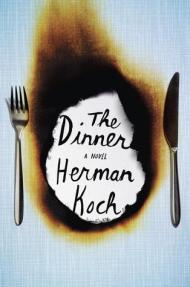
What a disturbing book. I was reminded of Defending Jacob by William Landay, although that one was more of a page-turner. One of the main differences between the two was the way Jacob’s father looked back on his son’s past to consider whether or not he had missed clues about his son’s nature. Paul does this only sparingly, making this book more economical, not only in length and depth, but in character development. Yes, the characters are mostly unlikeable, but as Paul points out in his history class, were all the victims of all the atrocities in the world’s many wars nice people? Probably not. But the question for the reader then becomes, does that make them any less a victim? Did they, then, deserve their fate? And, disturbingly, it is here in the story where I truly began to understand Paul. There are several plot points that Koch is deliberately foggy about, including something that is wrong with Paul: a syndrome, an illness, a hereditary characteristic. Something. Also deliberately unclear is the reason for his wife, Claire’s sudden hospitalization. Did it have anything to do with Paul? After all, the incident was reported by Paul, not Claire, so we learn of it only through what he chooses to tell us. Ultimately, it is sometimes the characters to whom we can best relate, who seem the most normal, that are the ones to be most feared.

THE BEAUTY:

Having skimmed through the book several times now, looking for the beauty, I keep coming back to the notion of parental love. That should be the beautiful thing in this story. However, can something be beautiful and horrible at the same time? And is it really love that would make a parent do unspeakable things in order to protect their child? Or is it, instead, a way of protecting some extension of oneself? All good questions for discussion.

THE FOOD:

Serge and Babette and Paul and Claire have met for dinner to discuss their fifteen-year-old sons. Serge is a well-known politician, and his younger brother, Paul, is a high school teacher. The evening, told from Paul’s perspective, describes what went on during each course. Serge has chosen a trendy, pretentious restaurant where the portions are miniscule, the prices are exorbitant, and everyone knows and fawns over him. Paul describes Claire’s appetizer thusly: “The first thing that struck you about Claire’s plate was its vast emptiness. Of course, I’m well aware that, in the better restaurants, quality takes precedence over quantity, but you have voids and then you have voids. The void here, that part of the plate on which no food at all was present, had clearly been raised to a matter of principle. It was as though the empty plate was challenging you to say something about it, to go to the open kitchen and demand an explanation. ‘You would’t even dare!’ the plate said, and laughed in your face.”

One interpretation of this phenomenon is horror vacui, meaning “fear of empty space.” I know this because I saw it used at the DeCordova Museum last week to describe an artist’s approach to a particular canvas; was charmed by it; and vowed to my friend that I would work it into my lexicon in the near, if not immediate future. So there you have my explanation for this minor digression from the business at hand, which is, of course, identifying the context in the book for the recipe that I’ve selected.

When the manager approached their table as the appetizers were served, he said, “The crayfish are dressed in a vinaigrette of tarragon and baby green onions’… he was at Serge’s plate now, pointing with his pinky.’ And these are chanterelles from the Vosges.” (The Vosges are a range of low mountains in eastern France near its border with Germany.) I love crawfish, and wondered where you would get them in Europe, as this story takes place in Amsterdam. Turns out, there is a species of crayfish (note the spelling) in fresh waters in France, throughout central Europe to the Balkan peninsula and north as far as the British Isles, Scandinavia and eastern Europe. In all of my reading, and touring in England, Italy, France and Greece, I had never come across crayfish on a menu or in a cookbook. This was a revelation that also charmed me.

Crawfish Salad with Tarragon Vinaigrette
4 servings

3 lbs. frozen crawfish, or three 1- 1¼ lb. lobsters, or 1½lbs. shrimp
2 shallots, minced                                     ¼ teaspoon pepper
1½ tsp chopped fresh tarragon            ¼ cup olive oil
1½ tsp chopped fresh parsley               3 T fresh lemon juice
¼ tsp salt                                                     2 T white wine or Champagne vinegar
1 lb. Bibb lettuce
garnish with fresh tarragon sprig

If using lobster, fill a large pot with enough water to easily cover the lobsters. Bring to a boil. Place the lobsters in the boiling water, cover, and cook about 8-9 minutes. Drain and cool. Break off large claws and legs. Crack claw and leg shells using a nutcracker; remove meat and set aside. Break off tails. Cut (using kitchen shears) the shell of the tail segments lengthwise on the underside. Pry open the tail segments; remove meat, and cut into ½-inch slices. Chill the lobster meat.

If using shrimp, bring a large pot of water to a boil. Put frozen shrimp in a colander, place the colander in a large bowl and cover the shrimp with cold water to thaw them. Let them sit for 10 minutes. They should be completely thawed before you cook them. Place thawed shrimp in boiling water, and  cook for about 2 minutes, or until shrimp turn pink. Remove shrimp and place in an ice bath until cool. Remove shells and chill the shrimp.

If using frozen crawfish, bring a large pot of water to a boil. Put crawfish in a colander and rinse them. If they have been previously cooked, they will only need about two minutes in the boiling water. If they are raw, they’ll need longer time in the boiling water, 5 minutes or until the shells are red. When cooked, place in colander and run cold water over them to stop the cooking process. Remove shells and chill the crawfish.

Combine minced shallots and next 7 ingredients in a jar; cover jar tightly, and shake vigorously.

Arrange lettuce on individual salad plates; top with crawfish, lobster, or shrimp and drizzle with shallot mixture. Garnish with a tarragon sprig, if desired.


Dinner with Edward

THE BOOK:   

{A745C159-DE00-4481-AC2B-ECD44D4CEACD}Img400

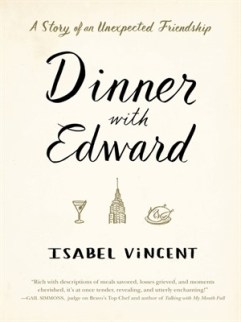
Sweet without being sentimental, this memoir about moving forward from loss, reminds us of the importance of friendship. Sometimes the friend that we most need at a particular point in our lives is the one we would least expect. Instead of marginalizing her friend Valerie’s 90-plus recently widowed father, Edward, Isabel listens to him, drawing on his wisdom to bolster her own crumbling sense of self at a low point in her personal life. As their relationship blossoms with each exquisite dinner Edward prepares, despair and loneliness are overcome by companionship and hope. The message is lovely, and the dinners, described with a foodie’s attention to detail, make one’s mouth water.

THE BEAUTY:

Edward and Isabel were each at a low point in their lives. Edward’s loss of the love of his life left him wishing to die himself, but for a promise he made to his beloved Paula on her deathbed, that he would go on living. Isabel’s marriage was foundering, and she struggled to get her groove as a reporter in her new job at the New York Post. When Valerie, Isabel’s friend visiting from Canada after her mother’s death, tells Isabel that she’s worried about her father, she suggests that Isabel have dinner with Edward, as a distraction for him. He’s quite a good cook. And so, several months after that meeting with Valerie, Isabel has her first dinner with Edward. The beauty here is how these two hurting people, in the communal sharing of Edward’s delicious food, put their pain on hold for a bit, and enjoyed each other’s company. Multiply these experiences, and soon you have two people transformed, hopeful, different from who they were before they knew each other. I wish that some of Edward’s poetry had been included in the book. But alas. It wasn’t.

THE FOOD:

While all of the food in the book sounded wonderful, the recipe that intrigued me the most was the apricot souffle. Edward got the recipe from the New York Times in the early 1990’s. This from the book:

“Edward had made us individual souffles in little ramekins, putting them in the oven as we began our main course. He served them immediately after they were done, their puffy meringue swirls tinged golden brown and looking like the whimsical domes of some dreamy cathedral from a fairy tale, dusted with confectioner’s sugar and topped with freshly whipped cream. There was magic in Edward’s confection. That first time-and every time he made it for me- I savored each spoonful as the swirl of cream, meringue, and apricot melted in my mouth.”

APRICOT SOUFFLES WITH VANILLA RUM CRÈME ANGLAISE
GOURMET MARCH 1996

The recipe below was based on the apricot soufflés served by Sally Darr at her former New York City restaurant, La Tulipe. This recipe calls for five large egg whites. When separating your eggs, reserve the yolks for the accompanying crème anglaise.

Souffle
6 ounces dried apricots  (1½ cups)                 1 T dark rum if desired
1½ C water                                                             ½ tsp vanilla extract
¾ C sugar plus additional                                  pinch of salt
sugar for coating ramekins                                ¼ tsp cream of tartar
1 T fresh lemon juice                                             5 large egg whites, pinch of salt

Vanilla rum crème anglaise                                 ¼ C sugar
2 C half-and-half                                                    1 T dark rum, or to taste
½ vanilla bean, split lengthwise
5 large egg yolks

To make the apricot soufflé:
In a heavy saucepan simmer apricots, water, and 1/2 cup sugar, covered, 20 minutes. Transfer hot mixture to a food processor and purée until very smooth. Force purée through a fine sieve into a bowl and stir in lemon juice, rum, vanilla, a pinch salt. Cool purée completely. Purée may be made 2 days ahead and chilled, covered,. Bring to room temperature before proceeding. Transfer purée to a large bowl.
Preheat oven to 350°F. Generously butter 7-ounce (3 1/2- by 1 3/4 – inch) ramekins and coat with additional sugar, knocking out excess.

In another large bowl with an electric mixer beat whites with pinch of salt until foamy. Beat in cream of tartar and beat whites until they hold soft peaks. Beat in remaining 1/4 cup sugar, a little at a time, and beat meringue until it just holds stiff peaks. Whisk about one forth meringue into purée to lighten and fold in remaining meringue gently but thoroughly. Ladle batter into ramekins and bake soufflés on a baking sheet in middle of oven 20 to 25 minutes, or until puffed, golden brown, and just set in center.
Remove ramekins from oven. With 2 forks pull open center of each soufflé and pour some crème anglaise into each opening. Serve soufflés immediately.

To make the vanilla rum crème anglaise:
In a small heavy saucepan bring half-and-half just to a boil with vanilla bean and remove pan from heat. Scrape seeds from bean with a knife into half-and-half, reserving pod for another use if desired.

In a bowl whisk together yolks, sugar, and a pinch of salt and whisk in hot half-and-half in a stream. Return custard to pan and cook over moderately low heat, stirring constantly with a wooden spoon, until thickened (170°F. on a candy thermometer), but do not let boil. Pour sauce through a fine sieve into a bowl and cool, stirring occasionally. Stir in rum. Chill sauce, covered, until very cold, at least 2 hours and up to 2 days. Makes about 2¼cups.


Lizzie Bright and the Buckminster Boy

THE BOOK:

51d6FwyxtBL._SX334_BO1,204,203,200_

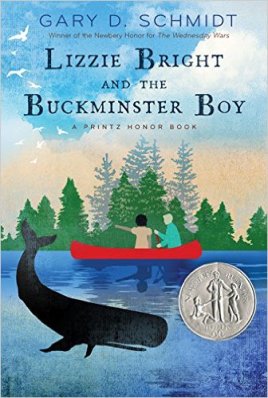
After a slow start, I became invested in Turner’s story when he began to grow into himself. Roughly based on an actual episode on Malaga Island in Maine in the early 1900’s, the story is a great starting point for a discussion with Middle School students because their sense of justice is finely tuned, even though most of them are guilty of having already given in to peer pressure to preserve their own dignity and cool factor at some point in their young lives. The community on Malaga Island was founded by former slaves. Turner’s family moved to Phippsburg, on the mainland across from the island,  when his father was appointed pastor of the First Congregational Church. Turner is immediately homesick for Boston, until he meets Lizzie Bright, an orphan who lives on the island with her preacher grandpa, Reverend Griffin. The Phippsburg town fathers have decided that they need the tourist trade to jump start their economy, and Malaga Island is too much of an eyesore, so its inhabitants must go. Pressure is applied to the islanders and anyone who doesn’t support the will of the powers that be. Turner has an ambivalent relationship with his father early on, because of his many youthful missteps that reflect poorly on his father.  Eventually, Turner must decide for himself with whom he wants to interact in his new community. Watching Turner grow up in this story, and the intimations of the kind of man he will become, was joyful.

THE BEAUTY:

Schmidt’s descriptions of the natural world of Maine evoke vivid mental pictures and memories of salty air, low tide, pine trees and sea breezes. Turner and Lizzie spend a lot of time together exploring the bay area in her grandpa’s dory. One day, Lizzie fell into the mud flats and hit her head on a rock. Turner helped her back into the boat, but Lizzie, injured and nodding, could not captain as she usually does, so it’s up to Turner to man the dory and get her safely back to the island, even though he’s never rowed a boat before. It is during this journey to safety that Turner has a magical first encounter with whales. A whale five times the size of the boat rode quietly alongside them. When the whale flipped its tail and began to roll side to side, so did the dory.When the rocking finally stopped, Turner quietly slipped the oars into the water and rowed forward, hoping the whale would wait on the surface. It did. And when the boat reached the front of the whale, they looked at each other a long time-two souls rolling on the sea under the silvery moon, peering into each other’s eyes. Turner wished with a desire greater than anything he had ever experienced that he might understand what it was in the eye of the whale that shivered his soul. While this might have been a harrowing experience, through the entire episode, Turner remained calm, unafraid. And through his travails in the future, he comforted himself with the thought, “I have looked into the eye of a whale.”

THE FOOD:

Much of the time when Turner meets Lizzie, she’s digging clams. The first time Turner went to Malaga Island and met Reverend Griffin, he made chowder for Lizzie and Turner and all the Tripp children, which they all ate outside on the rocks in the sun. Turner wasn’t sure if it was the scent of the chowder or of the sea that filled him, but to him, it was as good as any baseball game played on Boston Common.

New England Clam Chowder
serves 4

2 qts. littleneck clams, well-scrubbed            2¼ C clam broth
1 C water                                                                    1  can fish stock (15 oz.)
1 clove garlic, minced                                            1 lb. potatoes, peeled and diced
2 ounces salt pork, finely chopped                   ¾ C light cream
1 C onion, chopped                                                 oyster crackers
2 T all-purpose flour

DIRECTIONS

Bring the 1 cup of water to boil in large covered saucepot. Add the clams and garlic. Cook 6-10 minutes over med-high heat, or until all the clams have just opened. Discard any that didn’t open.  Drain clams, reserving the broth. Strain the broth through coffee filters or cheesecloth to remove grit. Remove the clams from their shells, chop finely.

In a large heavy saucepot, cook the salt pork over low heat until the fat is rendered and becomes liquid. Using a slotted spoon, remove the “cracklings” and reserve them.
Add the onions to the fat and cook over med-high heat for 5-7 minutes, until softened but not browned. Add in flour and cook for 3 minutes, stirring constantly. Add the reserved clam broth, the 2¼ C of clam broth and the fish stock; whisk to remove lumps. Bring the liquid to a boil; add potatoes, reduce heat and simmer for about 15 minutes or until the potatoes are cooked through.

Stir in the clams, salt pork and the light cream. Heat chowder to desired temperature.
Serve with oyster crackers.