All posts by yogafrog

Books for Living

The Book and The Beauty:

9780385353540Two years ago, a friend recommended a book lover’s book, The End of Your Life Book Club by Will Schwalbe. When I finished reading this one today, I looked up my comments on Goodreads for the previous one, and found that both provoked the same response: commenting on how my mother and I were finally able to connect through books during the last summer of her life. There will be another post in the not too distant future about this, but I mention it here to highlight how reading and books lately, bring me back to thoughts of my mother.

This will be tough post to keep short, because there is so much in here to love. In a departure from the usual format, I’ve combined “The Book” and “The Beauty” because a discussion of the book is the beauty of it. What follows are examples of the book recommendations, poetry, philosophy and wisdom that made this book such a delight to read and record.

While there were eight all together that I wrote down, the first book I added to my list of recommendations  was David Copperfield by Charles Dickens.The name David is an important one in Will’s life, as his husband, first best friend, person he wrote a book with about email, and college friend all share the name. When Will included Dickens’ quote, “Of all my books, I like this the best,” I knew I had to read it. The other book I mention here had been recommended to me by a guy we met at the bar of our favorite Chinese restaurant. Somehow I manage to get in a question about reading and books no matter where I am, and the Mai Tai emboldened me. The guy raved about a middle grade fiction book called Wonder by R.J. Palacio, claiming it to be one of the best books he ever read. When Will included it in a chapter, called “Choosing Kindness,” I moved it to the top of my list.

On to poetry. Will’s college friend David wrote his thesis on John Ruskin, a nineteenth-century artist and critic, attempting to explain how Ruskin’s views of nature changed the way we view nature. In researching his poetry, this is the one that moved me, capturing the fleeting nature of life and love.
              The Last Smile 
She sat beside me yesterday
With lip, and eye, so blandly smiling,
So full of soul, of life, of light,
So sweetly my lorn heart beguiling
That she had almost made me gay
Had almost charmed the thought away
(Which, like the poisoned desert wind,
Came sick and heavy o’er my mind)
That memory soon mine all would be,
And she would smile no more for me.

The following poem in the book Death Be Not Proud by John Gunther, was penned by his son, Johnny, and was included in a chapter on prayer.
          Unbeliever’s Prayer
Almighty God
forgive me for my agnosticism;
For I shall try to keep it gentle, not cynical,
nor a bad influence
And O!
if Thou art truly in the heavens,
accept my gratitude
for all Thy gifts,
and I shall try
to fight the good fight. Amen

In the chapter called “Searching,” where Will talks about Stuart’s quest to find Margalo in the book Stuart Little, E.B White came under fire for what many considered an ambiguous ending. He reasoned that he left Stuart in the midst of his quest to indicate that questing is more important than finding, and a journey is more important than the mere arrival at a destination. The philosophy of the journey was first brought to my attention years ago by my philosopher-husband who introduced me the notion of “it’s about the journey” with  C.P. Kavafy’s poem “Ithaka,” from which the following lines come:
“Keep Ithaka always in your mind.
Arriving there is what you are destined for.
But do not hurry the journey at all.”

In a chapter titled “Slowing Down,” Will tells of finding the book The Importance of Living   by Lin Yutang through his teenage obsession with writers of the 1930’s. (Weren’t we all obsessed, although perhaps not with writers of the 30’s?) The book was a radical rejection of the philosophy of ambition that is so much a part of the culture not just of China where Lin grew up, but of France and Germany where he worked and studied, and, of course, the US, where he attended college, briefly. He wanted to give people a framework for enjoying life, summarized by “If you can spend a perfectly useless afternoon in a perfectly useless manner, you have learned how to live.”

In Wonder, Mr. Tushman, the principal, sums up the most important lesson of the year in his commencement address: Choose kindness. And he explains it to the students referencing J.M. Barrie’s book, The Little White Bird. “Shall we make a new rule of life…always try to be a little kinder than is necessary.” He goes on to say, “Why I love that line, that concept, is that it reminds me that we carry with us, as human beings, not just the capacity to be kind, but the very choice of kindness.” I wholeheartedly feel that “Choose Kindness” should be emblazoned on every forehead, so that we humans can make that choice with every interaction. The other bit of wisdom comes from the chapter called “A Final Word,” and the words are Will Scwalbe’s. “Books remain one of the strongest bulwarks we have against tyranny- but only as long as people are free to read all different kinds of books, and only as long as they actually do so…Reading isn’t just a strike against narrowness, mind control and domination: It’s one of the world’s great joys.”

The Food:

Naturally the food has come from a chapter called “Nourishing.” Laurie Colwin was a New York writer, food lover, cookbook author and entertainment guru who has been  described as “not Martha Stewart.” In her book, Home Cooking: A Writer in the Kitchen, she writes about nursery food, a specific category of home cooking that evokes the wonderful, mushy, fork-only meals of childhood. She writes about being “filled with gratitude after a friend made her a shepherd’s pie after the death of her father. It was just what she didn’t know she wanted.”

In an effort to make a delicious, healthy meal, the recipe here is a composite of many that speaks to my concerns about good eating. There isn’t a lot of beef in my diet, so when I do serve it, I want it to be lean. Also, I am wary of supermarket ground beef, and prefer to grind my own using my Kitchen Aid stand mixer with the grinder attachment. Finally, this recipe is an invitation to overeat, so instead of putting the mixture into an 11 x 7 inch glass baking dish, I portioned it into 6 aluminum tart tins, meaning that each serving contains about 4 ounces of lean beef. We ate one each the day I made it, and I froze the other 4 for future snowy day meals.

Shepherd’s Pie

For the potatoes:
2 lbs russets, peeled, cut into 1” chunks           ¾ tsp Kosher salt
½ C milk or half and half                                       ¼ tsp freshly ground black pepper
3 T unsalted butter                                                     1 large egg yolk

For the meat filling:
2 T canola oil                                                                2 T all-purpose flour
1 C chopped onion                                                      1 T tomato paste
2 carrot, peeled, diced small                                   1¼ C beef broth
2 cloves garlic, minced                                             2 tsp Worcestershire Sauce
1½ lbs ground beef*                                                 sprig of thyme
1 tsp Kosher salt                                                          bay leaf
½ tsp freshly ground black pepper                      ½ C fresh or frozen peas
½ C frozen corn

*I ground my own beef using 1½ lbs. beef loin choice sirloin tips (90% lean). Cut meat into 1 inch cubes, place on baking sheet in a single layer and freeze for 20-30 minutes. Using the small hole attachment for a Kitchen Aid stand mixer, run meat through grinder. To counteract the dryness of the lean meat, toss it with 2 T water, ½ tsp baking soda, 1 tsp salt, and ¼ tsp pepper, and let rest in a bowl for 20 minutes while you prepare the potatoes and filling.

Put the peeled, chopped potatoes in a saucepan and cover with cold water. Over high heat, covered, bring it to a boil. When boiling, uncover and decrease the heat to cook at a simmer until potatoes are tender and easily pierced with a fork, 10-15 minutes. Drain the potatoes, return to the saucepan and mash, add milk ad butter, salt and pepper and continue to mash until smooth. Stir in the yolk until well combined and set aside.

Preheat oven to 400º

While the potatoes are cooking, place the oil in a 12 inch saute pan set over medium high heat. Add the onions and carrots when the oil starts to shimmer. Saute for 3-4 minutes until the veggies start to sweat and take on color. Add garlic, stir to combine. Add ground meat, salt and pepper and cook until browned and cooked through, 3-5 minutes. Sprinkle the mixture with 2 T flour, toss to coat, and cook for an additional minute. Add the tomato paste, beef broth, Worcestershire Sauce, thyme sprig and bay leaf and stir to combine. Bring to a boil, then reduce the heat to low. cover and simmer slowly 10-12 minutes until the sauce thickens. Remove and discard the thyme and the bay leaf. Add corn and peas to the mixture. Spread combined mixture evenly in an 11 x 7 inch glass baking dish, or distribute evenly among 6 aluminum individual tart pans. Top with mashed potatoes making sure to carefully seal the edges so the mix doesn’t bubble over in the oven. Smooth with a rubber spatula. Place on a parchment-lined baking sheet, place in the middle of the oven and bake for 25-30 minutes or until the potatoes just begin to brown. Remove to a cooling rack to rest for 5 minutes before serving.

If freezing for future use, cool down to room temperature, then place the filled aluminum tins on a baking sheet and put in the freezer for at least 4 hours or overnight. Bag, label and store. To cook frozen shepherd’s pie, leave in the refrigerator overnight to thaw. Next day, preheat oven to 400º place individual pies on a parchment lined baking sheet and cook in the middle of the oven for 25-30 minutes until cooked through. Allow to set on a rack for 5 minutes before serving.

                                        img_3107-3


Idaho

The Book:

61mpe2wuzelI loved this book. There is an engaging plot and deeply developed, multi-layered characters. The setting is so richly drawn that it looms as another character in the story. But it is the writing – the writing that makes my heart respond with a flutter, an ache, a longing? I’m not sure how to describe it, and I’m also not sure if an excerpt, taken out of context will do the writing justice, so I’d better select carefully.

This is a love story told from Ann’s perspective. “She loved him so much that there was never anything else she might have done.” Her love for Wade was pure and encompassing and a motivation for the choices in her life.  Guilt also plays a role in Ann’s choices, and is also a basic plot element.

The Beauty:

The beauty is, as indicated above, the writing. When I first started to think about the beauty of this book, I looked up images of the landscapes described: the Camas Prairie Railroad on stilts; the plains; the mountains; Spirit Lake; Ponderosa, the most beautiful town in the USA. But when I started writing this post, I realized that it had to be the writing. It’s the first time I’ve ever thought about comparing writing to music, because of the visceral response it evoked in me. Ruskovich’s words share harmony, melody and rhythm, so that when combined, they touch the heart, the soul, the place where emotional connections live. I found myself drawing in a breath upon reading some particularly beautiful passages. Hopefully, the following will evoke a similar response in you, the reader of this, as it did in me when I read it in context. Wade has just returned home with a sledful of food and supplies, and a pair of frozen feet from trudging through the snow. He finds his wife sitting by the fire.
“Outside, the coyotes’ howls bore tunnels through the frozen silence. The ravens in the trees anticipate the spring, when they will nudge their weakest from their nests, this act already in their hearts, as if already committed. The garter snakes, deep in the ground, hibernate alert. Bodies cold, unmoving; minds twitching, hot. So many secret, coiled wills, a million centers spiraling out, colliding into a clap of silence that is this very moment in the house, this beautiful oblivion in which they love each other.”

The Food:

I’m so glad that the food to represent this book is an out-of-the-ballpark winner. The recipe reminded my husband of a favorite cake his mother used to make, so he looked forward to testing the recipe with me. I’m not much of a sweet eater, but I kept going back for more. My husband pronounced it better than his mother’s!  Do make this one.

Apple Cake

3 cups flour                                     ½ C brown sugar
1 tsp baking soda                           3 eggs
1 tsp cinnamon                              2 tsp vanilla
½ tsp salt                                       1 T almond milk or water
1 ¼ C vegetable oil                      4 C apples, peeled and cut into ½ x 1 inch pieces
1 ½ C granulated sugar              about 3 large (I used Gala, Fuji and Golden Delicious)

Preheat oven to 325º . Grease and flour a 9 by 13 inch pan.

In a large bowl, sift together flour, baking soda, cinnamon, and salt.

In the bowl of a stand mixer, using the whisk, combine oil and both sugars, and mix until well blended.
Add eggs one at a time, mixing thoroughly after each addition. Add vanilla and mix again.
Add the dry ingredients to the batter and mix thoroughly. (When I added the dry ingredients, I switched to the paddle attachment.) If the batter seems too thick add almond milk or water. By hand, fold in apples and and mix until evenly combined.

Spoon the batter evenly into the prepared pan. Bake for 50 minutes or until a toothpick inserted into the center of the cake comes out clean.

Remove cake from the oven and allow to cool in the pan for 20 minutes before slicing. We ate half and froze the rest in individual servings because we couldn’t be trusted around it!


I Hate Everyone Except You

The Book:

i-hate-everyone-except-you-9781476776934_hrThis collection of essays had me laughing out loud in places both public and private. My favorite one, called “Clinton for President,” contains the phrase “…at which point she assumed I had a ‘special friend’ over,” which, for reasons I can’t go into without spoiling the story, had me hooting like a hyena.  In sharing stories about his family and growing up in Port Jefferson Station, New York, the child behind the man is explicated, and who he is as a human being is revealed, sometimes hysterically.  I became retroactively envious of Lisa, a high school friend who helped Clinton lay a guilt trip on a fetal pig, and Meredith, the Wendy’s cashier who withheld revelation of a crush from Clinton (because he’s a guy), but not Lisa. There are a few words that will never be the same for me, due to Clinton’s unique usage of them. They are, in no particular order: leprechaun, Kamikaze, prolapsed anus and punchbowl.  I loved his idea of mandatory restaurant work for all Americans, like military service, only more random. This system was not designed to level the economic playing field, but to ensure that every citizen over the age of twenty-one understands what jerks people become over their pork chop in a restaurant. When you’re drafted, which can come at any point in your life, you report to the Bureau of Food and Beverage Service where you are assigned to a restaurant within a fifteen mile radius of your home, for two years of service. Finally, I cannot end this review without acknowledging one of the most truly profound and profane commencement addresses I have ever heard. Genius.

THE BEAUTY:

When the show “What Not to Wear” ended, Clinton was asked about his favorite and least favorite makeovers and the worst fashion mistakes he had ever witnessed. No one ever asked him what he had learned about women during those ten years of listening to their concerns about their bodies and their clothes. What he learned was that women want to feel beautiful. He felt qualified to make that generality based on asking the question over and over and over. According to him, the problem is that women spend so much more time than men paying attention to competing with and worrying about everyone else but themselves. Every time you make a comparison, you lose. Someone else’s beautiful hair or skin has nothing to do with you.
“And the more you keep comparing, the less your own beauty becomes self-evident. Just because you’re not a supemodel, movie star, or Instagram celebrity does not mean that your beauty is less important than anyone else’s. Sure, it’s OK to look, even admire, just be careful when comparing apples to oranges. (Apple: You getting yourself ready for work in the morning. Orange: Woman who has paid a stylist, personal chef, trainer, light director and photo editor to help her post “selfies.”) Sometimes the beauty is simply an idea or an observation.

THE FOOD:

In the essay called “Stockholm Syndrome,” Clinton started having disturbing visions connected to the political scene in 2015. He was convinced that he could expunge them in Scandinavia and talked his Swedish-meatball loving husband into taking a vacation in Sweden. While there, they both developed a love for skagen, essentially shrimp salad on toast, and the food I selected from this book. You’re probably wondering why I didn’t go for the Swedish meatballs. While I have made them as an appetizer in the past, given a choice between shrimp and veal (the ones Clinton had in Sweden were made of veal), I’m always going to opt for shrimp.

Toast Skagen
Yield: 16 toasts

3 ½ T mayonnaise
3 ½ T creme fraiche or sour cream
3 T finely chopped fresh dill, plus dill sprigs, for garnish
½ T fresh lemon juice
¼ tsp coarse salt
⅛ tsp freshly ground white pepper
1 lb. precooked peeled small shrimp or rock shrimp, patted dry and cut into 1/2-inch pieces if large
2 T unsalted butter, divided

4 slices white bread, crusts removed, bread cut into 2 triangles
4 ounces golden whitefish caviar (paramountcaviar.com), for garnish
16 lemon wedges, for serving

Stir together mayonnaise, creme fraiche, chopped dill, lemon juice, salt, and pepper in a medium bowl until well combined. Stir in shrimp.

Melt 1 tablespoon butter in a skillet over medium-high heat, and saute half the bread triangles until golden brown and crisp. Transfer to a plate, and saute remaining bread in remaining tablespoon butter.

Spoon a generous amount of shrimp mixture onto toasts. Top each toast with caviar, (I used supermarket black lumpfish caviar) and garnish with dill sprigs. Serve with lemon wedges. Shrimp mixture can be refrigerated 1 day.

Mrs. Sinclair’s Suitcase

The Book:

9780399169502Another WWII tale, this one was set in Lincolnshire, England, about Polish fighter pilots- a story I hadn’t heard before. The narrative is told from two perspectives: Dorothy, during the war, and later, Roberta, her granddaughter. We first meet Mrs. Albert Sinclair, Dorothy, who is estranged from her mother because of whom she met at her her aunt’s funeral and subsequently married. Dorothy remains in the cottage they shared after Albert took leave of her, taking care of a couple of girls from the Women’s Land Army, who have come to take over farming in the absence of all the men who were called away to fight in the war. Roberta works in a bookshop where she collects the things she finds between the pages of the used books they sell- the notes and pictures, letters and postcards. She carefully records the name of the book where the item was found, how much it sold for and the shelf on which it was filed. A book about a bookstore! What’s not to love? One day, Roberta’s father brought in a suitcase full of books that belonged to his mother, Dorothea, who Roberta calls “Babunia,” or grandmother in Polish. John had been gradually sorting through his mother’s things after she was put into a care home well into her hundreds. Roberta finds letters among these things that lead her to believe that her grandmother had some secrets. I figured out the main secret from the very first letter Roberta unearthed, but did not know how the details would eventually come together. So in addition to estrangement from family members, there are a couple of love stories in this debut novel.
The Beauty:

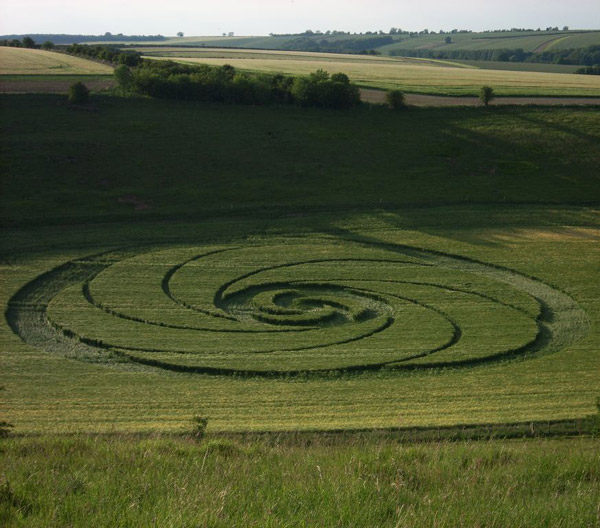
A Google search led me to Lincolnshire Wolds, which are chalk hills in an area known for wide open beauty, where people walk, bike, ride horses or go to the pubs. It is an AONB, Area of Outstanding Natural Beauty in England, Wales or Northern Ireland which has been designated for conservation due to its significant landscape value. This led me to a comment by a visitor to the area recommending a drive on the ancient Bluestone Heath Road. This led me to the image I selected of a crop circle taken near Louth in Lincolnshire in June of 2011. The farmer who owned the land claimed that the circle had not been there the previous night. Weather conditions at the time of its making were reported to have been light rain.

crop-circles

The first crop circle was reported in 1966 in Tully, Australia, where a farmer reported seeing flying saucers that made an imprint in his field. It was more of an alien story than a crop circle report. The first real crop circles didn’t appear until the 1970s in the English countryside. The number and complexity of the circles increased dramatically, reaching a peak in the 1980s and 1990s when more elaborate circles were produced, including some illustrating complex mathematical equations. In order to appreciate the real beauty of these formations, from reports I’ve read about them, one has to experience them close up to see how the stalks are laid down. Perhaps I should this to my “Bucket List.” The whole topic of alien visitation is fascinating both to me and to my husband.

The Food:

Several times in the book Dorothea prepares a lunch of fish paste sandwiches. Some research revealed that it is a type of anchovy paste that is commercially available. There were several brands I found, including “Peck’s Gentlemen’s Relish,” “Shipham’s Salmon Paste,” and “Poacher’s Relish.” My recipe is based on that of an expat who grew up on Peck’s, but living abroad, was unwilling to pay 12 dollars for 4 oz. on Amazon, and so concocted the recipe herself.

Sardine and Anchovy Fish Paste  

2 x 3.75 oz tin of sardines in water (Bumblebee Sardines)
1 x 2 oz tin of anchovies  in olive oil (Reese’s Flat Fillets in olive oil)

Drain the water of the two sardines tins, and place the fish in the blender. Add the anchovies with oil to the blender and blend the ingredients together until smooth. The large blender didn’t work for me. I had to use a small food processor.

Substitution: Sardines come in different sauces such as mustard or hot sauce, so you can play around with the flavors of this recipe by substituting the sardines in water to sardines in hot sauce for instance. Store in a sealed container in the refrigerator for about 10 days.

Serving suggestions:
For a filling sandwich, spread some paste on whole wheat, top with a thin layer of cheese, and add some lettuce, tomato and cucumber.
For an appetizer, spread or pipe some paste on a piece of cucumber garnished with parsley or chopped chives.
For a quick snack add a little cheese to the fish paste on a cracker.
For a great dip mix it with some cream cheese. Serve with veggies like baby carrots and celery, or potato, corn or pita chips.

Full disclosure: While we enjoyed this unique sandwich spread, the next day when the novelty had worn off, my husband and I decided that fish paste was not a taste that we had acquired. I will not be making it again. So, unless you love, love, love the taste of anchovies and sardines, or have grown up with these flavors, this probably isn’t a recipe worth making.


A Great Reckoning

The Book:

 louise-penny-a-great-reckoningWhat a delightful time I spent with this, my second in the Chief Inspector Armand Gamache series. This is also the first book I have completed in 2017, although I had two others going simultaneously: a book of short stories and a nonfiction. This story completely captured me from the first paragraph. Penny initially gives the reader an intimate peek of Gamache at work before we know what that work is, and how he came to be doing it. I’d love to know how the author constructed this plot, because I suspect that a graphic of it might look like a spiral, or a mobius strip, or DNA curling its way around the characters, with connections the reader only understands at the end. I’m slowly getting to know Armand. He is a poet-quoting philosopher and historian, regularly including Machiavelli and Marcus Aurelius in his teaching and conversation. He is a devoted family man, husband to Reine-Marie, father to Daniel and Annie, grandfather to Honore. He is an ethical law enforcement investigator who genuinely, not only wants to make the world a better place, but believes he has the power to exact change. There’s so much wisdom in this book. A sampling:

“Don’t believe everything you think.”- a Buddhist nun
“Give bad news swiftly, and spread out the good news.” – Machiavelli
“Oddities eat up time and energy in an investigation.”
And my favorite, spoken by Michel, Gamache’s childhood friend and colleague. Substitute any name you like for the one in parentheses:
“(Serge LeDuc) was a stupid man. A man driven by an infected ego. But he was also a powerful man, I’ll give him that. A charismatic personality. A dangerous combination, as we’ve found out many times, eh, Armand? Especially for anyone young and vulnerable. He’d have made a good cult leader…”

The Beauty:

At the beginning of the story, Armand and Reine-Marie visit Michel at his home on the Gaspe Peninsula, where “the edge of Quebec met salt water.” The area is described as desolate and treeless, but with a view of Perce Rock, a huge sheer limestone rock formation in the Gulf of Saint Lawrence on the tip of the Gaspé Peninsula in Quebec, Canada, off Percé Bay. It appears from a distance like a ship under sail. The 49 foot tall arch was name by Samuel de Champlain in 1607.
The Food:

A companionable exchange between Jean-Guy and Isabelle revealed a tradition in the early spring/late winter when the maple sap runs. Families visit “cabane a sucre,” maple sugar shacks to partake of a sweet treat called “tire d’erable,” or maple taffy. I found a recipe using just 2 cups of pure maple sugar, 1 teaspoon butter and 3 1/2 quarts of crushed ice or snow. Now all I have to do is raid one of the neighbor’s sap buckets on one of my runs!

The recipe I chose was the grilled sandwich that Armand made for Deputy Commissioner Gelinas, of fresh bread, Brome Lake duck, Brie and fig confit. Upon further investigation, I found that Brome Lake lies over the border of Vermont, and there’s an annual Duck Festival there in September that we’re going to have to attend.

Grilled Duck Breast, Brie, and Fig Jam Sandwich

Fig Jam
Servings:Three ½-Pint Jars
2 lbs. green or purple figs, stemmed and cut into 1/2-inch pieces
1 ½ cups sugar
¼ cup plus 2 T fresh lemon juice
½ cup water
In a large, nonreactive saucepan, toss the fig pieces with the sugar and let stand, stirring occasionally, for about 15 minutes, until the sugar is mostly dissolved and the figs are juicy.
Add the lemon juice and water and bring to a boil, stirring until the sugar is completely dissolved. Simmer the fig jam over moderate heat, stirring occasionally, until the fruit is soft and the liquid runs off the side of a spoon in thick, heavy drops, about 20 minutes.
Spoon the jam into three½-pint jars, leaving ¼ inch of space at the top. Close the jars and let cool to room temperature. Store the jam in the refrigerator for up to 3 months.
(Full disclosure: failing to find fresh figs on a grocery run, I used “Bonne Maman Fig Preserves” instead, and it earned the husband seal of approval.)

Variation: Substitute ½ cup of white port for the water and add one 4-inch sprig of rosemary with the lemon juice; discard the rosemary before jarring.

1 boneless, skin-on duck breast
Kosher salt and freshly ground black pepper
4 slices rustic bread
2 tsp softened butter
¼ C baby arugula
¼ C Kalamata olives, pitted coarsely chopped
2 ounces Brie cheese, sliced

Sear the duck breast: Rinse the duck breast thoroughly under cool water and pat dry with a paper towel. Place the meat on a cutting board with the skin side facing up. Use a sharp to knife score the skin and underlying fat in a checkerboard pattern, being careful not to cut all the way though to the meat. This will help ensure that the fat can render out properly and render the skin perfectly crisp. Season all sides thoroughly with salt and black pepper.

Set a large, heavy skillet over high heat and allow it get very hot before placing the duck breast in the center, skin side down. Turn down the heat to medium and allow the meat to cook undisturbed for 8 – 10 minutes, to ensure an even sear. Use tongs to carefully flip the meat, cooking for an additional 5 – 6 minutes on the opposite side. Once crisp and golden all over, remove the meat from the pan, letting rest for at least 10 minutes before slicing thinly. The meat should remain light pink inside. (Full disclosure: I used a supermarket rotisserie chicken breast since I couldn’t find duck breast.)

Warm panini maker. Spread ½ teaspoon butter each on 2 slices of bread. With the buttered sides down, top with an even layer of fig confit, Brie, olives, arugula, and sliced duck. Divide the remaining butter between the two remaining slices of bread, placing the butter sides facing up. Once assembled, place sandwiches in panini maker until grill marks appear and cheese is melted, according to your appliance’s instructions. Or you can grill the sandwiches in a heavy, cast-iron pan on the stove until the cheese is melted and the bread is lightly browned.

Slice and serve. Yum!

(More full disclosure: I didn’t feel that the chicken breast stood up as well to the other ingredients as duck might have, and will try using seared duck breast, which, according to my husband who loves duck, has more flavor. I will write an update once I try it.)

The Underground Railroad

THE BOOK:

cyxltn6waammdqtA book’s appearance on an awards list has been a pretty good indicator in the past of my inability to read it. I knew that this book was selected for Oprah’s Book Club- not a deal-breaker for me. Then it was longlisted for the National Book Award and I got nervous. It was starting to sound like something I would not be able to read my way through. Happily, I was wrong. I loved it. I began googling on the second page, starting with Ouidah, which is currently Benin, formerly Glewe, and center of the Vodun religion, which is more familiarly known as voodoo. Any time a book sends me researching ideas or places in the real world, I’m in my school-mode heaven. I love to learn, even if my aging brain at this juncture allows me to retain only a small portion of what I unearth.

A concern of mine when reading historical fiction is what the book contributes to the existing narrative, in this case, about slavery in the US. Does promote a different or more complete understanding? Does it illuminate? Most emphatically, yes, this one does. In a moving speech to a community of “Africans in America,” an abolitionist leader tells the crowd that, “sometimes a useful delusion is better than a useless truth.” He goes on to enumerate some delusions, starting with, “Here’s one delusion: that we can escape slavery. We can’t. Its scars will never fade.” Finally,  he speaks of America as the grandest delusion of all. “The white race believes-believes with all its heart- that it is their right to take the land. To kill Indians. Make war. Enslave their brothers. This nation shouldn’t exist, if there is any justice in the world, for its foundations are murder, theft and cruelty. Yet here we are.” He goes on to say that he doesn’t know how the community should proceed into the future, but that color binds them together, and they will rise and fall as one. “We may not know the way through the forest, but we can pick each other up when we fall, and we will arrive together.”

The rhetoric is unique and profound, and the prose is at times very beautiful. A man whose father was white and mother was black describes himself: “I’m what the botanists call a hybrid,” he said the first time Cora heard him speak. “A mixture of two different families. In flowers, such a concoction pleases the eye. When the amalgamation takes its shape in flesh and blood, some take great offense. In this room we recognize it for what it is- a new beauty come into the world, and it is in bloom all around us.”

THE BEAUTY:

I was having trouble finding the beauty in this book because there is so much brutality. When I told my husband about it, he advised me to keep going because there was likely to be something I could find if I persevered.  Then I came to this heartbreaking scene where Cora, the main character, is alone in the train station waiting for the next arrival. Feeling so bereft in the dark, dank underground, all by herself, she muses about her condition. “She was a stray after all. A stray not only in its plantation meaning-orphaned, with no one to look after her-but in every other sphere as well. Somewhere, years ago, she had stepped off the path of life and could no longer find her way back to the family of people.” Cora had chosen this lonely path primarily to protect and insulate herself, until she was no longer able to connect with others. I cared about her character, and kept reading, hoping that she would experience in some way, a connection to another human being.

Later, Cora found her way to Valentine’s farm in Indiana with Royal’s help. When  he brought her the year’s almanac, reminding her of a very lonely, scary time in an attic in North Carolina, she began to tell him about her childhood on Randall, where she had picked cotton. She talked about her grandmother, Ajarry, and her mother, Mabel. About the small plot of earth she cultivated, and the doghouse, and the night behind the smokehouse. “He told her that every one of her enemies, all the masters and the overseers of her suffering, would be punished, if not in this world then the next, for justice may be slow and invisible, but it always renders its true verdict in the end. He folded his body into hers to quiet her shaking and sobs and they fell asleep like that, in the back of a cabin on the Valentine farm.” And with that, Cora finally rejoined the family of people-a stray no more, for at long last she had someone to take care of her. Beautiful.

THE FOOD:

In Tennessee, on the road with Ridgeway, the travelers, including Cora, shared a plate of salt pork and beans. This is apparently a southern staple, served with cornbread. Some use red kidney beans, or white like navy or great northern beans, or even black-eyed peas. The recipe below is a composite, designed to suit my personal taste.

Slow Cooker Pinto Beans
Makes about 8 cups

16 oz bag of pinto beans, sorted and rinsed
¾ C chopped carrots
1 C diced onions plus additional for topping
1 ham hock or 6 oz salt pork
2 cloves finely chopped garlic
6 cups water
½ tsp cayenne
1 T bacon drippings or butter
salt and pepper, to taste
hot sauce or Cajun seasoning to taste

Soak beans in 8 C of water overnight.

Set slow cooker on high. Spray sides with Pam for an easier post-meal clean-up.
Put in all the ingredients except hot sauce or Cajun seasoning, salt and pepper and bacon drippings or butter.

Heat 10 minutes on high. Reduce heat to low and cook 8-10 hours. Add the bacon drippings or butter, Cajun seasoning or hot sauce and salt and pepper to taste.

Serve topped with diced onions and hot sauce, with corn bread.

Cornbread
Servings: 8

1 C yellow cornmeal ( fresh, and preferably stone-ground)
1 C unbleached all-purpose flour
1 T baking powder
¼ teaspoon salt
¼ tsp baking soda
1 ¼ C buttermilk
1 large egg
2 T sugar
¼ C corn oil ( or plain vegetable oil)
2 T unsalted butter

Put a 10 inch cast iron skillet in the oven and preheat to 375º. (I only had a 12 inch and an 8 inch cast iron skillet. I used the 8 inch, baked it for 30 minutes, and it turned out fine.)

Combine the dry ingredients except for the baking soda in a bowl.
In another bowl, mix the buttermilk and the baking soda. Set aside.
In a small bowl, beat the egg with the sugar until combined.
Add the oil and mix until combined.
Pour this mixture into the buttermilk/baking soda, and mix.
When the oven is preheated, toss the butter into the skillet and let it melt.
Meanwhile, pour the wet ingredients into the dry, and mix in as few strokes as it takes to just make the dough come together.
Pull the skillet out of the oven, swirling to get the butter covering the bottom and up the sides of the skillet.
Pour the batter immediately into the pan, smoothing the top, then back into the oven for about 25 minutes, or until golden brown and pulled away from the sides of the pan.

Turn out onto a cutting board, cut into wedges and serve.


The Rosie Project

THE BOOK:

the_rosie_projectI had read this book several years ago when it was first released and loved it. I particular enjoyed the humor, which was due in great part to the main character, Don Tillman’s voice. His approach to the world and life was logical, linear, and frequently hilarious. And yes, sometimes, I was laughing (only in my mind, of course) when he wasn’t. Don is a genetics professor at a university in Melbourne Australia. At the age of 39, he decided that it was time to get married, so he began what he called “The Wife Project.” Don recognized his social awkwardness and developed strategies to help him navigate ordinary social situations. The following passage illustrates his thinking when he shares his first meal with Rosie:
I remembered the basic rule of asking a woman to talk about herself. Rosie had already raised the topic of dealing with difficult customers in a bar, so I asked her to elaborate. This was an excellent move. She had a number of hilarious stories, and I noted some interpersonal techniques for possible future use.

What becomes troubling to Don after he started spending more time with Rosie, was the frequency with which he began to act driven more by instinct than logic. His life became chaotic as he attempted to fit those instinctual responses into his very logical life. For example, when he and Rosie were drinking at Jimmy Watson’s (a real place near the campus of the University of Melbourne) and he saw Gene, his best friend, with a woman who was not his wife, he became rattled. So, when the waiter offered him a table, instead of saying no, as he should have, he accepted it, resulting in him having to freeze the food he had bought at the market that morning for his dinner, and deal with the resultant loss of nutrients caused by freezing fresh food. As troubling as illogic is to Don, ultimately, it saves the day.

There were a couple of scenes that didn’t ring true, like Don and Rosie’s visit to Max Freyburg’s office in New York, and the scene at the ball where Rosie “… pointed at me [Don} in a stylized manner…It was the signal that Olivia Newton-John gave to John Travolta in Grease to commence the dance sequence…” But overall I laughed a lot and was completely charmed by Don.

THE BEAUTY:

When Rosie doesn’t recognize a line from the movie “The Bridges of Madison County” that had brought her to tears on the plane from New York, it reminded me of this very beautiful song from the musical version by Jason Robert Brown, one of many men with three names with whom I’m infatuated. We saw it a couple of summers ago in Williamstown and Jason Robert Brown was in the lobby after the performance. I was too star struck to speak to him, but if I remember correctly, my lovely husband got his autograph for me. Kelli O’Hara, who was slated for the role of Francesca was pregnant and could not fulfill the commitment to Williamstown, but Steven Pasquale played the photographer, and Kelli opened with him on Broadway.

from YouTube

THE FOOD:

It has to be lobster salad, right? According to Don’s “Standardized Meal System,” every Tuesday dinner is lobster, mango and avocado salad with wasabi-coated flying fish roe and crispy seaweed and deep-fried leek garnish. Fortunately, I am typing this on a Tuesday, so there’s a kind of neat symmetry going on here. The author kindly included these remarks at the end of his Acknowledgments:

“Don’s lobster salad is based on a recipe from Teage Ezard’s Contemporary Australian Food. Perfect for a romantic evening on a balcony with a bottle of Drappier rose Champagne.”

I googled “Teage Ezard” and his website came up, with the following:

THIS IS THE RECIPE FEATURED IN GRAEME SIMSION’S  THE ROSIE PROJECT.
Graeme chose the recipe because he and his wife have made it on several occasions: “it’s probably the most complicated thing we’ve ever cooked more than once – but the results are worth it.” Graeme is a founder of wine distributor Pinot Now and recommends a wooded Sauvignon Blanc, like Domaine A from Tasmania, as a great match.

Crayfish, Mango and Avocado Salad with Wasabi Flying Fish Roe, Soy and Bonito Dressing and Crispy Seaweed Salad

Crayfish
1 live medium crayfish (about 1.5 kg, or 3.31 lbs.)
Peel of 1 orange, roughly sliced
Peel of 1 lemon, roughly sliced
½ head celery, sliced
1 teaspoon white coriander seeds
½ bunch of coriander
½ bunch dill
1 cup rice wine vinegar
Sea salt to taste

Mango and Avocado Salad
1 large or 2 small heads of white witlof (endive)
1 tablespoon hazelnut oil
Salt and pepper
1 large ripe mango
1 ripe avocado
Squeeze of lemon juice
100g (3.9 oz.)somen noodles
1 tablespoon peanut oil

Soy and Bonito Dressing
½ tablespoon dried dashi (cooking stock, buy instant dashi)
2 tablespoons dried bonito flakes
1 tablespoon very hot water
1 egg yolk
1 teaspoon Dijon mustard
40ml  (1.35 oz. or 2.7 tablespoons) Japanese rice wine vinegar
2 teaspoons sweet soy sauce (kecap manis)
150 ml (5 oz.) peanut oil
Juice of ½ lemon

Crispy Seaweed Salad
1 L vegetable oil (for frying)
2 leeks (white part only) cut into 6cm (2.36 inches) lengths
1 sheet nori seaweed
Salt
3 teaspoons tobiko (wasabi flying fish roe)

Crayfish
To kill the crayfish, place it in the freezer for one hour, where it will go to sleep. Place the orange and lemon peel, celery, coriander seeds, fresh herbs, vinegar and salt in a large 5 litre (1.3 gals.) cooking pot. Fill three-quarters full with water and bring to the boil. Plunge the crayfish into the rapidly boiling stock, then cover with a lid and turn off the flame. Let the crayfish sit in the hot stock for 25 minutes, then drain and allow it to cool. Once the crayfish reaches room temperature, refrigerate it until completely chilled.
When the crayfish is cold, pull the tail section away from the head. Use a pair of sharp scissors to cut the inner shell of the tail to get to the meat. Carefully draw out the tail flesh in one piece and reserve. Remove the legs from the body. Break each joint then pick out the meat using a skewer or crab-pick. Cover and refrigerate both tail and leg meat until ready to assemble the final dish.
Mango and Avocado Salad
Slice off the base of the witlof then pull away the individual leaves, discarding any which are damaged. Finely slice each of the leaves lengthwise and place in a mixing bowl. Dress lightly with hazelnut oil and season with salt and pepper.
Slice off each mango cheek and use a large spoon to carefully scoop out the flesh. Dice into bite-size pieces and reserve. Slice the avocado in half lengthwise, remove the stone and carefully scoop out the flesh. Dice into bite-size pieces, toss in a little lemon juice to stop it browning and reserve.
Bring a small pot of salted water to the boil and cook the somen noodles until al dente (about 3-4 minutes). Tip into a colander and refresh under cold water to stop the noodles cooking further. Drain well, then tip into a bowl, toss with peanut oil and reserve.
Soy and Bonito Dressing
Dissolve the dashi and bonito flakes in the hot water to form a paste. Allow to cool completely. Place the egg yolk, mustard, vinegar, sweet soy sauce and prepared dashi paste into a food processor. Blend to a puree, then slowly add the peanut oil until the mixture emulsifies and thickens, Stir in the lemon juice and reserve.
Crispy Seaweed Salad
In a medium pot or a small deep fryer, heat the vegetable oil to 180 degrees. Cut the leek in half, lengthwise, then shred it finely into hair-like strands. Fry in the hot oil until it turns golden brown, then remove with a slotted spoon and drain on absorbent paper. Allow to cool, then season with salt and store in a dry place until needed. Cut the nori sheet in half and shred it finely into hair-like strands. Reserve until needed.
To Serve
Using a very sharp knife, slice the crayfish tail meat into rounds. Depending on size, it should yield between 18-24 slices. Roughly chop the crayfish leg meat and put in a large mixing bowl with the witlof, mango, avocado and somen noodles. Pour over dressing and combine gently. Season with sea salt and freshly ground pepper. Place three Chinese soup spoons on each plate and divide the salad equally between them. Top each little mound of salad with a slice of crayfish tail meat followed by a teaspoon of wasabi flying fish roe. Finish with a pinch each of fried leek and nori.
Serves six.

I will not be making this dish. Good luck to those brave enough to hunt down all the ingredients. I did make the conversions from the metric system in parentheses.

A Man Called Ove

THE BOOK:
a-man-called-ove-9781476738024_hrOne of the first things we learn about Ove is “He was a man of black and white. And she was color. All the color he had.” It really describes Ove and his wife Sonja perfectly. They’re so fundamentally different and yet their relationship works because they love each other. Ove yells a lot, enjoys confrontation and polices his residential community to make sure everyone is following the rules. So why did I not hate the guy? In the hands of a less competent writer, I might have. This could have been a really tacky book. But it wasn’t. It was true. Maybe I could understand the narrowness of Ove’s psyche. Maybe his decency allowed me to look beyond his anger. Whatever the reason, I loved spending time with these characters. Having just attended the wake of a friend whose sudden death rocked my husband and me, the portrayal of grief in the book seemed very real. Ove, thinking of his wife, “And one Monday she was no longer there.” Only for us, it was one Sunday, and he was no longer there. Scary, but real life. If there’s one thing that novels about grief teach, it’s that after the loss of a loved one, you’re meant to live- even after bone-crushing grief- until you die.

THE BEAUTY:

I found it beautiful that the author, who was thirty-one when the book was first published, has such a grasp of human nature that he could write a moving narrative in which people who are very different from one another come together to form a family. Family, whether it be the one you were born with or the one you choose, is one of the great gifts of life. Well done, Fredrik Backman.

andries_van_bochoven_-_portrait_of_the_painter_andries_van_bochoven_and_his_family_-_google_art_project
Photo: Wikimedia Commons
Andries van Bochoven Portrait of the painter Andries van Bochoven and his family 1629
Those van Bochovens have mastered the head tilt.

THE FOOD:

After the debacle with Patrick and the trailer and Ove’s house and mailbox, Ove’s doorbell rings. There are two young children with dark eyes and dark hair who hand him a warm plastic container. “Rice!” yells the littlest one. “With saffron and chicken,” adds the older of the two. After determining that the Foreign Woman next door sent it over, he asks why. “Mum said you were “‘ungry,” says the little one. Ove later learns from Patrick why Parvaneh, his wife, keeps sending food to Ove. “She’s Iranian, you know. They bring food with them wherever they go.” I wish I knew more Iranians.

CHICKEN AND RICE
Serves: 4-6

3 lbs of chicken (tenders and thighs), thighs have skin on
Some extra virgin olive oil for braising chicken and for rice (butter can be substituted for topping rice)
1 white or yellow onion, diced
1 tsp turmeric
1 tbsp salt
1 tsp pepper
4 cups basmati rice
½ tsp ground saffron mixed into ¼ cup hot water

For the Rice:
Boil water in a large pot and add plenty of salt (just as you would if you were cooking pasta) and 4 cups rinsed rice. Put stove on med-high heat. Don’t let it over-boil. When the rice is just hard in the middle and soft on the outside (al dente rice!), turn off the burner and drain the rice into a colander, about 7 minutes.
Add olive oil to the large pot to cover the bottom of it and put on medium heat. Add the rice to the pot, poke some holes with the back of a spatula almost to the bottom of the pot to release steam, and cover.
When steam rises to the lid of the pot (this is easy to tell with a clear lid, otherwise wait about 5 minutes) remove the lid and drizzle 2 tbsp of melted butter/olive oil along with most of the saffron-water mixture to the top (the small remainder will be added to the chicken). Replace the lid with a large folded napkin or kitchen towel placed directly and tightly underneath it to catch the steam.
After about 5 min, put on med-low heat for ~30 minutes or until the pot sizzles when you splash a couple drops of water on side of it—whichever happens last. You can either carefully flip the rice over onto a serving platter so that you can see the beautifully crisp tahdig (crispy rice at the bottom of the pot) or just serve yourself directly out of the pot, but make sure to dig for some tahdig at the bottom.

For the Chicken:
In a large pot on med-high heat, add a splash (or approximately 1 tbsp) of olive oil. After oil is hot, swirl it around the pot and add in chicken thighs, skin down. Let them cook for a few minutes and then they should be easy to lift up when they’re ready to flip. Cook for a few more minutes on other side and remove them from the pot and onto a plate.
Cook the chicken tenders the same way and then add back in the chicken thighs and add the onion. Place on medium heat and add turmeric powder, salt, and pepper and move everything in the pot around to coat.
Add about 3 cups of water to the pot to keep it from burning, mix ingredients around, and place lid on top.
After 20 min, place on med-low and cook for about another 20 minutes or until chicken is tender.
Add a bit of the saffron-water mixture on top of the chicken while it’s simmering.
If the liquid in the pot starts to evaporate, don’t let it dry out. Add more water to replace liquid loss.
When plating, add this liquid/broth to your chicken and your rice for added flavor.

When I first made this, I was using up some frozen chicken wings. It was delicious, but would have been better with the meatier thighs and tenders. I used only 2 cups of rice and had plenty left over. The rice took about a third of the time and yielded a very crunchy layer at the bottom. The leftovers the next day were as good as the first time. This recipe is a keeper.


We Have Always Lived in the Castle

THE BOOK:

we-have-always-lived-in-the-castle

I have recently been fascinated by Shirley Jackson. I think it began when a podcast I listen to reported that this is the 100th anniversary of her birth. Upon discovering her, I first read, the short story “The Lottery,” realizing that I had read it before when I got midway into it. My research revealed that Shirley was somewhat of a disappointment to her parents, who expected her to participate in activities that would land her a suitable husband. Instead, Shirley was a solitary girl, preferring reading and writing to dancing and socializing.  She was a rebellious teen who later flunked out of the University of Rochester. When she transferred to Syracuse, she met young, aspiring literary critic Stanley Edgar Hyman. He couldn’t have been farther from the match her parents had hoped for, and they opposed the marriage, as did Hyman’s family. When the two graduated in May, 1940, they married and moved to New York. So Shirley was an outsider, which, considering her body of work, comes as no surprise.

When I googled “Shirley Jackson Syracuse University,” I found a paper that she had written for an English class in 1940! Her professor praised her writing, considering it far beyond that of the average student. Her thesis was about the ambiguity around gender roles in Hemingway’s work.

We Have Always Lived in the Castle is a dark tale about class, outsiders, and the contempt between the haves and the have-nots. The youngest daughter of the Blackwood family, Merricat, believed that she had the ability to control her environment using a number of methods, including the use of talismen and magical words and thoughts. At one point in the story, she senses that a change is coming. She doesn’t like change, so she thinks of three powerful words for protection. She wrote the first word, “melody,” on toast in apricot jam, and then ate it, satisfied that she was now one-third protected. She worried over the second word, “Gloucester,” that Uncle Julian might “take it into his head to say almost anything and no word was truly safe when Uncle Julian was talking.” Merricat rejected “digitalis” for the third word because it was too easy for someone to say, replacing it in her thoughts with  “Pegasus.” 

When I Googled, “meaning of melody Gloucester Pegasus,” this clip came up. It is from a Schumann work entitled Kinderscenen, meaning “Scenes from Childhood,”Opus 15. In the repeating phrases, you can hear how”melody Gloucester Pegasus” would fit after the first 6 notes. Beautiful.

THE BEAUTY:

Much adaptation has been done of this book. It was a radio broadcast in 1951; a ballet in 1953; a short film in 1969; a TV movie in 1996; and it was on an episode of the  Simpsons. Filming began in Ireland last August for a new movie version that will be released in 2017.

The clip below is from a Yale Repertory Theatre premiere of the musical “We Have Always Lived in the Castle” in 2010; book and lyrics by Adam Bock, music and lyrics by Todd Almond. from YouTube

THE FOOD:

The Blackwoods, a wealthy family in a small town owned a big house and a lot of land that was safeguarded against intruders by gates and fences. When we meet them, their numbers have been reduced to three. Merricat, the youngest daughter, made twice weekly forays into town for food. People in town quieted and physically withdrew at the grocery store when Merricat walked in to ask a for leg of lamb or roasting chicken, or whatever else older sister Constance had put on the list. The dish I’ve selected is one that Uncle Julian spoke of when reminiscing about the family’s last meal together. He proclaims that he personally never cared much for rarebit, but this recipe is delicious. I’m going to try it over puff pastry next.

Welsh (actually Vermont) Rarebit
2 servings

2 T unsalted butter
2 T all-purpose flour
1 tsp Dijon mustard
1 tsp Worcestershire sauce
½ tsp kosher salt
½ tsp freshly ground black pepper
½ C porter beer
¾ C heavy cream
6 ounces (approximately 1½ cups) shredded Cheddar (I used Cabot extra extra sharp)
2 drops hot sauce
4 slices toasted rye bread

In a medium saucepan over low heat, melt the butter and whisk in the flour. Cook, whisking constantly for 2 to 3 minutes, being careful not to brown the flour. Whisk in mustard, Worcestershire sauce, salt, and pepper until smooth. Add beer and whisk to combine. Pour in cream and whisk until well combined and smooth. Gradually add cheese, stirring constantly, until cheese melts and sauce is smooth; this will take 4 to 5 minutes. Add hot sauce. Pour over toast and serve immediately.

I added about a cup more cheddar, and used whole milk instead of cream. It was very rich and filling.

Hag-Seed

THE BOOK:

hag_seed_5_17

I was looking forward to this book for two reasons: first, because it was part of the Hogarth Shakespeare project where distinguished contemporary authors were asked to revisit Shakespeare’s works, and second, because I had never read Margaret Atwood before. I know. How can I call myself a reader if I’ve never read the goddess of fiction?

All I can say is, “Wow!” This was masterful from start to finish. While I thought I knew where the plot was headed, I was skeptical about whether or not Atwood was going to surprise me. I’m not sure how, but surprise, she did. The structure of the book modeled the play, The Tempest, perfectly! There was so much content in here, it would be a great book for a discussion. While I was reading I kept thinking, who do I know who might have read this, or might want to read it who would be willing to talk to me about it? I usually don’t like to know much about a book before I read it, so while I was curious about the title, I figured Atwood would clue me in in her own time. When she did, I was glad that I hadn’t researched it in advance. There was one detail in the story that I thought was genius that had to do with profanity. That’s all I’m going to say. If you’re not already an Atwood fan, this possibly might make you one!

The plot in more than 140 characters: Felix, the protagonist, has fallen from glory as an innovative director in a local theater. After laying low for a time, he gets a job teaching English at a correctional facility. One of his terms of employment is that his students will perform a Shakespeare play after studying it in the class. The play is, of course, laden with personal meaning to Felix, The Tempest.

THE BEAUTY:

In a book where Shakespeare features heavily, the beauty simply has to be the language. The Bard was such an inventive flinger of invective, I’ve included my favorites here, along with a couple of memorable phrases. Happy Birthday, Will.

Hang cur, hang, you whoreson insolent noisemaker.
Hell is empty and all the devils are here.
Toads, beetles and bats light on you.
Most wicked sir, whom to call brother would even infect my mouth.
Watch out he’s winding the watch of his wit, by and by it will strike.

Good wombs have borne bad sons.
We are such stuff as dreams are made on, and our little life is rounded with a sleep.
What’s past is prologue.
How beauteous mankind is! O brave new world that has such people in’t.
Now I will believe that there are unicorns.

THE FOOD:

Felix wasn’t a big eater, so food played a minimal role in the book. Felix regularly had a boiled egg and soda crackers for breakfast, but that was too boring. While he had lunch at a restaurant a few times with Estelle, they drank martinis and once ordered “deep fried calamari,” but I’m not a fan of calamari, nor was it significant to the book. So that left me with potato chips, which were significant. What follows is a healthier take on one of my favorite snacks. Can’t say no to a chip, and though time-intensive with the microwaving, they were worth it. If you’re sharing them, DO NOT SAMPLE as you cook them. You literally cannot eat just one.

Microwave Potato Chips

1 tablespoon vegetable oil
1 Yukon gold potato, sliced paper thin 1/16 ” (peel optional)
1/2 teaspoon salt, or to taste

Use a mandoline to cut uniform slices of potato, or carefully slice with a sharp knife. Place them in a cold water bath and agitate the water to release starch. Rinse and repeat until the water is clear. Lay the slices on a kitchen towel and blot to dry. The drier the better.

Mix the salt in the vegetable oil and pour into a plastic bag. Add the potato slices, and shake to coat. Arrange potato slices in a single layer on a microwave safe dish.

Cook in the microwave for 3 to 5 minutes, or until lightly browned (if not browned, they will not become crisp). Times will vary depending on the power of your microwave. Remove chips from plate, and toss with more salt to taste, or other seasonings. Let cool. Repeat process with the remaining potato slices.