All posts by yogafrog

I Capture the Castle

THE BOOK:

31122                                        icapturethecastle

Dodie Smith is famous for the book One Hundred and One Dalmatians, later a Disney movie, but is also known as the most successful female playwright of her age. I Capture the Castle was first published in 1949 and has never been out of print sine then. NEVER been out of print! That is astounding to me. I picked it up during my birthday book haul because I had read that J.K. Rowling loved it. Dodie Smith wrote the script for a two-act play with ‘musical notes’ for a 1954 West End production. A 2003 film starring Romola Garai as Cassandra, Bill Nighy as her father, Rose Byrne as her sister and Henry Cavill as Stephen Colley was generally appreciated by the audience. Finally, in April 2017 a musical version was put up at the Watford Palace Theatre northwest of London to positive reviews.

The first line is often quoted as one of the most memorable novel openers, “I write this sitting in the kitchen sink.” The journal keeper is seventeen-year-old Cassandra Mortmain and she’s in the sink because she’s found that sitting in a place where you’ve never sat before can be inspiring. As evidence, she confides that she wrote her very best poem while sitting on the henhouse. Cassandra is a bookworm and her father was a one-hit wonder of an author who suffers from writer’s block, so the literary references abound. The family lives in a run-down castle that is part of the estate of nearby Scoatney Hall, whose owner has recently died. Village gossip has it that the heir is a wealthy American, Simon Cotton. Simon, his mother, and younger brother Neil become intrigued with the genteel but impoverished Mortmain family, and Rose, Cassandra’s beautiful older sister decides that she will wed Simon. From this point on, the book reads rather like Shakespeare, where no one seems to be in love with the right person. As it is told from a teenager’s perspective and in a more naive age, the 1930’s, it is an endearing coming of age story with a supremely loveable character. I wondered if Cassandra’s warning to her family would go unheeded as in the Greek myth, but it didn’t play out that way.

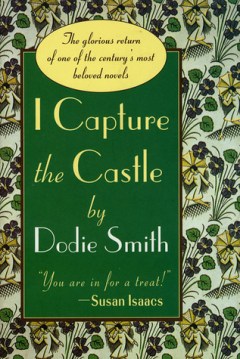
Speaking of book covers, the book I read had the top cover. I wish it had been the other one because it so succinctly captures the gist of the book, including whimsy. The green one lacks imagination, and that is kind of insulting to this most imaginative book.

THE BEAUTY:

While Rose is in London, Cassandra goes forward with their annual Midsummer’s Eve celebration without her. Everyone else had someplace else to be, so Cassandra was utterly alone in the castle, except for the dog and the cat, Heloise and Abelard (of course). Just as Cassandra was beginning the rituals, someone called out to her. It happened to be Simon Cotton, the object of Rose’s affections. Having spent the day at Scoatney with the estate agent, Simon decided to pay a call on Cassandra and her father at the castle. When he realizes that its Midsummer’s Eve, he asks to be a part of the rites, as Rose had told him about the fun she and Cassandra used to have with them. When they were done and waiting for the fire’s embers to die down, a carpet of mist had crept in and mounted so high down by the moat that only the castle towers rose above it. The last of the day’s light faded as the moon rose, casting a silver light upon the mist. Simon, totally charmed by the view, wondered if anyone could capture the atmosphere in paint, then decided that Debussy could have done it in music. When Cassandra claims not to know Debussy’s music, Simon insists on taking her to Scoatney for dinner and a listen to Clair de Lune on the record player. This is Jean Efflam Bavouzet’s interpretation from Youtube.

THE FOOD:

Cassandra and Rose are dispatched to London to collect their deceased Aunt Millicent’s clothes. They have been given money for the train and taxis, and lunch. Laden down with furs they hadn’t known about, when they couldn’t quickly find a taxi, Cassandra persuaded Rose to go get something to eat first. They found a white table-clothed restaurant on Oxford Street, (la dee dah) where they finished off their modest meal with a treacle pudding.

Microwave Treacle Sponge Pudding
yield: 4-5 servings

½ C self-rising flour*
½ C sugar
½ C butter
2 eggs
3 T treacle or jam, if you prefer
1 T hot water
English custard or fresh cream

Cream the butter and sugar together with an electric hand mixer, then beat in the eggs and flour.

Grease a medium (roughly 1½ pint) bowl, and pour in the treacle. Microwave the treacle on medium power for 30 seconds, or until the syrup has melted.

Add 1 tbsp of hot water to the flour/egg mixture and mix in.

Pour the flour/egg mixture into the bowl with the hot syrup, cover the top of the bowl with Saran wrap, and microwave on full power for 3 minutes, or until done.
Note: Microwave wattages vary; please watch your mixture carefully to make sure it does not overcook in the microwave. Also make sure your saran wrap is microwave safe. Not all plastic cling wraps are safe for microwave use.

Leave the pudding to cool for 5-10 minutes, and then turn out onto a serving plate.
Serve with English custard or fresh cream, and a few summer berries.

*I didn’t have self-rising flour, but a google search had me add about a teaspoon of baking powder to cake flour and it worked fine, although I’d like to see if it would rise higher with the right flour.

Emergency Custard:
If you don’t have any custard powder on hand, you can mix up a batch using cornstarch, an egg yolk, milk, and vanilla essence. Mix 1 cup milk with 2 tsp cornstarch and bring to a boil while stirring. Remove from heat and beat in egg yolk and 1 tsp vanilla essence. Return the mixture to the heat, and continue stirring until it boils.

This was not as successful. I added some confectioner’s sugar to sweeten it, and that improved the flavor, but it never set like a custard should. We still spooned it over the pudding for the flavor, if not the texture.


Pictures of Hollis Woods

THE BOOK:

Picture of Hollis WoodsThis Newbury Honor Book is the third book in my recent reading that deals with foster children/orphans, or underprotected young adults on the fringes of social services. (Preceded by Invisible Thread and My Name is Leon.) Hollis Woods was abandoned as an infant with a note saying “Call her Hollis Woods.” She has an incredible artistic gift that allows her to see beyond what is visible to the eye. Everyone who sees her work recognizes the genius behind it, but to Hollis, it’s just a mode of communication that allows her to maintain an icy distance from those she encounters, while at the same time, expressing her inner thoughts and feelings, however hidden they are in her imagery. Her art is a release. When adults connect with Hollis through her art, her guard lowers, and there arises an opportunity for genuine human interaction. Whether or not she can submit to these moments is the struggle she faces in this book. Through straightforward, unsentimental storytelling, Patricia Giff introduces the reader to a variety of memorable characters, some of whom make the leap to true connection with this singular, gifted and lonely girl.
Hollis prides herself on being “a mountain of trouble,” which is kind of ironic since a mountain causes her a lot of trouble later in the story. When she is sent to Branches on the East Branch of the Delaware River to spend the summer with the Regan family, something softens within her, and she begins to want again. Izzy Regan, the mother, is nurturing and fun, and the father, whom Hollis calls “Old Man,” sees beauty in her that she didn’t know was there. Steven, two years her senior, is a worthy companion and playmate. They all welcome her into their family. But how boring would the story be if it was all just happily ever after?

THE BEAUTY:

I make it a point to never include spoilers in my blog posts, so some of you may think that I’m cheating in this section of the blog. But I’m going to do this anyway, because of the way it made me feel when I read them. The beauty in Pictures of Hollis Woods is the last two words of the book. If you’re going to actually read the book (you can easily do it in one sitting-164 pages), do yourself a favor and don’t go to the last page to read them before you’ve read the rest of the book. Their impact only works in the context of the story.

THE FOOD:

Hollis first meets Steven and his father, “Old Man,” at the bus depot. Hollis is parched from traveling all morning with no liquid refreshment. Steven announces that they are going to have lunch at the diner, and also says that his mom stayed in Branches baking a carrot cake. Holly was going to say, “I hate carrots,” but caught herself. Seeing how pleased the two of them were with the prospect of lunch at the diner and carrot cake for dinner, she didn’t have the heart to burst their bubble with her negativity, and besides, she really had to use the bathroom.

Izzy’s Carrot Cake*
Yields: one standard loaf pan (9×5-inch)

1 cup all-purpose flour
½ tsp baking soda
1 tsp baking powder
¼ tsp salt
¾-1 tsp ground cinnamon
½ cup granulated sugar
½ C light or dark brown sugar
2 large eggs
½ C plus 1 T canola oil (or vegetable, safflower)
1 tsp pure vanilla extract
1½ C (about 2 large or 3 medium carrots, grated)
½ C pecans or walnuts, roughly chopped (optional)

Preheat oven to 350º. Butter a 9×5-inch loaf pan.

In a large bowl sift together flour, baking soda, baking powder, salt and
cinnamon. Set aside.

In a mixer bowl fitted with paddle attachment, beat together eggs,
granulated sugar and brown sugar on medium-high speed until light and
fluffy, about 2 minutes. On low speed and with the mixer running, add the
oil slowly and beat until combined. Beat in vanilla extract until combined,
then turn off mixer. Fold in carrots by hand until combined. Fold in dry
ingredients just until combined. Don’t overmix. Fold in nuts.

Pour the batter into prepared loaf pan. Bake for 40-50 minutes or until a
toothpick inserted into the center of the cake comes out clean. Allow cake
to cool completely.

*I can’t say for sure that this was Izzy’s carrot cake recipe, but if hers was delicious, as I’m sure it was, then it could  have been this one. Even my carrot cake averse husband loves it!


My Name Is Leon

THE BOOK:

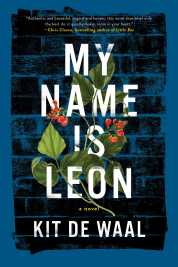
my-name-is-leon-9781501117459_hrThis has been on my list of books to read, although I’m not sure where the recommendation came from. What a heartbreaking story about Leon, a 9 year-old boy in foster care in Britain in the early 1980’s. Leon is a treasure of a kid. I liked him so much, I wanted to adopt him myself! There is a backdrop of racial tension between blacks and whites that finally erupts into riots in several cities, including London, and is an important part of the story. Leon loves his baby brother, and provided most of Jake’s care when he was an infant, because his mother, Carol, is frequently unable to take care of even herself. When Jake, a blonde, blue-eyed white child was adopted, Leon felt betrayed by all of the adults in his life who wouldn’t let him visit Jake. Leon’s foster carer, Maureen, is a wise and good woman, but also absent through most of the book due to a debilitating illness that kept her in the hospital for an extended period of time. Ultimately, however, this book is about the meaning of family- the one you make, not the one you were born with, necessarily.  All it took here to make one, was to assemble multiple people who love each other and are committed to one another during the good times and the bad. Families don’t necessarily look like what I grew up with in the 1950’s, and that’s great. The story stayed with me long after finishing the book.

This is a debut novel by someone who knows her way around the foster care system. De Waal’s mother was a foster carer, and Kit herself worked in criminal and family law, was a magistrate, sits on adoption panels, and wrote a training manual on adoption and foster care. The characters she has brought to life in this book are fully developed and multi-dimensional. I feel warm and fuzzy having been a part of their lives however briefly while I read about them.

THE BEAUTY:

Leon.

THE FOOD:

When Leon first arrives at Maureen’s, she feeds him a bacon sandwich, also known as bacon butty, bap or sarnie in the U.K. When he finishes the first one, she makes another, and keeps feeding him until he’s full. Leon is unused to 1. being taken care of, and 2. having as much as he wants to eat. This was a harbinger of his future, although he didn’t know it at the time. When I was thinking about what food to include in the post, I immediately thought of the bacon sandwich, but then thought, “that’s pretty mundane,” so I did a Google search and found out that a bacon butty is a big deal in England. In a  poll, it was ranked the number one thing that people love about Britain! There are different ways to prepare it, with variations on the type of bread to use and whether or not to toast the bread, or butter it, but the one constant was that it had to be served with HP Sauce, also known as brown sauce. Too impatient to wait for an Amazon delivery, I decided to make my own. There were a myriad of recipes out there, so after extensive reading, (the reviews were very helpful in making corrections to the given recipes to nail down the flavor of the original sauce).  I combined several to come up with the recipe given here.

HP Sauce has a story. It was originally produced by HP Foods in the U.K., but is now produced by the H.J. Heinz Company in the Netherlands. It was named after London’s House of Parliament. The sauce was called “Wilson’s gravy” in the 1960’s and 1970’s after Harold Wilson, the Labour Prime Minister. In an interview with the Sunday Times, Mary Wilson, his wife, said, “If Harold has a fault, it is that he will drown everything in HP Sauce.”

Too bad I don’t know anyone familiar with the original sauce to let me know how I did.

Bacon Butty Sandwich
Serves 2

4 slices Pepperidge Farm sandwich bread
6 slices of cooked bacon* (use more to suit your personal preference )
unsalted butter

Butter 2 slices of bread. Place 3 strips of bacon on each slice. Spread some HP Sauce on the bacon. Close the sandwiches with the other 2 slices of bread, cut and serve.

HP Sauce
Yield: 4 Cups

3 C chopped Granny Smith apples
1 onion, chopped
3 cloves of garlic, chopped
¼ tsp cardamom
¼ tsp ground cloves
½ tsp cayenne*
2 tsp allspice
1 tsp pickling spice
pinch of black pepper
1 C dates, chopped
⅓ C dark brown sugar
1 T tomato paste
1¼ C malt vinegar
¼ C treacle (found at Whole Foods)
3 T tamarind paste (found at Whole Foods)
1 T oil for frying

Heat the oil over medium heat, add the onions and saute for 5 minutes until the onions are soft, but not browned. Stir in the garlic and spices and saute another minute to bloom the spices. Add the remaining ingredients and boil down until fairly thick, about an hour and 15 minutes. (I added water when the sauce got too dry.) When cooked, cool slightly and press through a fine sieve, discarding the remaining pulp. I put one cup in a pint jar for the fridge and froze the other three cups in individual containers to be used at a later date.

* When I tasted the sauce after it had cooled down, I thought it had too much heat, and decided to use less cayenne when I make it again. However, when I put it on the bacon sandwich the next day, it wasn’t too hot at all, so I would keep the recipe as is. The sandwich, simple as it is, is a keeper.


The Essex Serpent

THE BOOK:

61HINX3QoBL._SX308_BO1,204,203,200_I waited a long time for this book, and wanted to love it because of a glowing review by a blogger I follow. I plodded, rather than flew, through the book. Still, there was much to love, and I find myself thinking about the characters long after finishing the book. Set in Victorian England, there are distinct Gothic overtones to the story, that enhance the setting: London and Colchester. In the city, Charles Ambrose, a wealthy aristocrat and friend of the main character, Cora, expresses compassion for the poor of Bethnal Green who were forced to live in sub-human conditions: ” Even animals in the zoo should have their cages cleaned,” he says nobly. Before you get all judgy, remember that this is the England of Charles Dickens, and disdain for the poor was based on the upper class belief that their squalor was due to a moral deficit, not economic circumstances that left them with few resources to compete for a chance at a better life. The other location, Colchester, is the oldest recorded town in England, having been referenced by Pliny the Elder in 77 BCE. Wow! The 500 year-old George Hotel, where the Ambroses stayed when they visited, has Roman cellars, and is still in operation. In spite of its history, when Cora left London for Colchester after her husband died, her friend, Katherine Ambrose chided her, “If you wanted the sea, you could have used our house in Kent: here it’s little but mud and marsh for miles and the sight of it would depress a clown.” I love these people.

Apparently 1890’s London was mad for science, and that is what drew Cora to Colchester, where she hoped to find a fossil of some unique creature that would insure that her name and discovery would be preserved in the British Museum. When reports of sightings of an elusive serpent reached London, Cora packed up her son, her companion, Martha, and her things, and headed off to Colchester. The serpent sighting is based on a real 1669 pamphlet, “The Flying Serpent or Strange News out of Essex.”

Charles and Katherine Ambrose, Cora’s dear friends, arranged for her to meet their friend, the Reverend William Ransome, who lived in Aldwinter, not far from Colchester. There is an immediate bond between the two, despite their nearly polar oppposite views of the cosmos. Cora’s faith is totally rooted in science, while, Ransome is a man of God, believing that if there is a serpent, its presence is a warning from the Almighty about the moral depravity of the community.  And yet, Cora finds his intellect a worthy match for hers, and she enjoys sparring with him about scientific evidence versus divine presence. Their common ground is their mutual love of nature. Perry’s best writing lies in those descriptive passages where the characters are outdoors. Nature frees their thoughts and their tongues, allowing them to connect on their walks in ways that don’t happen in the Reverend’s parlor. During one of their sojourns, they stop in a clearing to argue a point, when Will suddenly looks around and notices that the canopy of the trees has created a natural cathedral. Will feels his faith most in nature, while Cora feels most free and alive there.

My favorite part in the book is one of Cora’s letters to Will. She relates a story about a friend of her father who loved to amuse her with stories and puzzles when she was a child. Once he asked her if she knew two words in the English language which are spelt the same and pronounced the same but have opposite meanings. The word was “cleave.” It can mean splitting or adhering. In a lovely passage, Cora uses it to express her feelings for Will.

There is so much in this book that I think about and would comment on but for the fear that this post would rival the actual book in length. Suffice to say that I did love it. Also,  my confidence in the above mentiond blogger is confirmed, as his literary taste continues to match my own.

THE BEAUTY:

The book’s cover! So far it’s my favorite of the year. Designed by Peter Dyer for Serpent’s Tail, a division of Profile Books. Ltd., it is based on a William Morris design.

THE FOOD:

After an extended falling out between Cora and Will, she plans a midsummer party to mend fences. The foods mentioned were capons (just a roasted chicken, really), eggs (boiled, of course, this is Victorian England after all), ham studded with cloves (just had that at Easter), small potatoes, salmon, and tomatoes with mint – the last the most mouth-watering option, in spite of the fact that I’m not  big fan of mint. I could find no Victorian recipes, so I figured Cora must have improvised, as did I in the salad below.

Tomato and Mint Salad
Serves 4

1 pint cherry tomatoes, halved
1 small red onion, sliced thin
¼ C extra-virgin olive oil
1½ T white balsamic vinegar
1 clove crushed garlic
¾ tsp kosher salt divided into ½ tsp and ¼ tsp
2 heirloom tomatoes, sliced crosswise
½ tsp sea salt
¼ C loosely packed mint leaves

Put the crushed garlic in a small bowl with the olive oil to infuse
while preparing the other ingredients.

Slice the onion and place in a medium bowl of ice water to
mellow the pungency of the onion. Let sit for 10 minutes, drain
and pat dry.

In a medium bowl, toss the cherry tomatoes with a ¼ teaspoon
of kosher salt. When the onion is ready, add to cherry tomatoes and
toss to combine.

To make the vinaigrette, strain the garlic from the oil (I leave it in, because we love garlic) into a small bowl. Add the balsamic vinegar, ½ teaspoon of
kosher salt and black pepper to taste. Whisk to blend.

Arrange the heirloom tomato slices on a platter. Sprinkle lightly with sea
salt. Spread the cherry tomato mixture over the heirlooms, then
drizzle the vinaigrette over all. Garnish with mint leaves and serve.

After having the salad, I will use basil next time. Basil is a better pairing than mint for tomatoes according to my palate.

IMG_3636 2


Purple Hibiscus

THE BOOK:

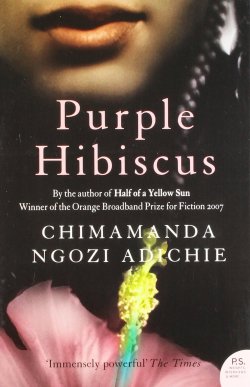
81gXf0Y5lsLI bought this one on a “used bookstore” weekend and finally got around to reading it when my library holds dried up. (I’m number 185 on 98 copies, so it’ll be awhile before I read Hillbilly Elegy.) I loved Americanah, so I had high hopes for this one. One thing I thought would have been really helpful was a glossary of all the Nigerian words. Having to google sometimes two or three times per page interrupted the flow of the narrative. I’m sure there are many  English readers out there who would agree with me that a glossary would enhance our enjoyment of the book.

There was a quietness to the prose that I immediately keyed in on. It wasn’t until I progressed farther into the book that I realized that what I had mistaken as quiet, was actually oppression. That sense of oppression was so palpable that I sometimes felt shortness of breath, as though an elephant was sitting on my chest. There really was a metaphorical elephant in the book that was hinted at early on. The story is about a well-to-do Nigerian family consisting of Eugene and Beatrice Achike and their children Jaja and Kambili, brother and sister, respectively. The family’s life is well-ordered by Papa, and their devout Catholicism is so present as to be another character in the story. Kambili is an outsider: quiet, shy, unable to express herself. Those characteristics should have tipped me off a lot sooner than they did about what was really going on here. In the end, this was a tale about a child’s need for love and validation from a parent, and also how important it is for parents to help their children cultivate a sense of self as someone independent from both the parent and the family. I love the way Adichie writes. It makes for effortless reading. The words and ideas flow easily, as though she were telling me the story herself, to me, in her own speaking voice.

THE BEAUTY:

When Kambili and Jaja visit Aunty Ifeoma and Amaka, Obiora and Chima (Aunty’s 3 children in Nnukwu where they lived), Jaja becomes interested in her garden, particularly the purple hibiscuses. When he returns home, he brings stalks of purple hibiscus that Aunty Ifeoma gave him, and plants them in the family’s garden. The plant had taken on a unique meaning for Jaja, perhaps representing a different way of living from what he was used to. It also became a symbol of his independence, and th eperfect title for the book.

hibiscushawaii5jpg-e3021c005650021c

THE FOOD:

There’s a lot of food mentioned in Purple Hibiscus, probably because the Achikes are well-to-do. Here is a list of just of few of the foods mentioned: fufu (a dumpling made of pounded cassava, yams, plantains or other grains that is served in soup); onugbu (a traditional Nigerian soup made with bitter leaves); ofe nsala (a rich fresh fish soup); okpa (made with Bambara nut flour, like peanuts, and boiled in a wrapper to form a ball, that can then be eaten as a snack); akara (also known as bean cakes, served for breakfast); and moi moi (steamed bean pudding). When Jaja and Kambili visit Aunty Ifeoma for the first time, her children teasingly say that they wish Jaja and Kambili would visit more often if it meant they would have jolloff rice and chicken. This is something that I will make often. It is delicious.

Chicken and Jolloff Rice
serves 4

8 chicken thighs
1 tsp ground coriander
1 tsp ground white pepper
Vegetable oil
1¼ lbs. cherry tomatoes
4 onions, finely chopped
6 garlic cloves, sliced
½ –1 scotch bonnet chili, deseeded and chopped
A bunch of flat leaf parsley, leaves and stalks (finey( chopped separately
¼ c tomato purée
1 lb. vine-ripe tomatoes, chopped
3 C chicken stock
1½ C long grain rice
1 lemon, cut into wedges, to serve

Preheat the oven to 350ºF. In a bowl, toss the chicken thighs with the ground coriander, white pepper and a pinch of salt. Add a splash of oil to a large saucepan and fry the chicken over a medium heat for 7–8 minutes, until browned all over. Transfer the chicken to a medium-sized roasting pan and cook in the oven for 30–40 minutes, until golden, adding the cherry tomatoes to the pan halfway through.

Meanwhile, using the same pan you browned the chicken in, add a splash of oil and sauté the onions, garlic, chili and parsley stalks over a low heat for 10 minutes. Stir in the tomato purée and chopped tomatoes, then pour in the chicken stock. Bring it to a boil, then reduce the heat to low and let it simmer for 5 minutes. Stir in the rice, cover and let cook for 20 minutes, stirring occasionally, adding water if it gets too dry. Finally, stir in the parsley leaves followed by the cooking juices and cherry tomatoes from the roasting pan. Mix well, squashing the tomatoes into the rice.

Serve the rice with the chicken pieces on top and lemon wedges on the side for squeezing over.

Do Not Say We Have Nothing

THE BOOK:

Cover_for_Do_Not_Say_We_Have_Nothing                    Do+Not+Say+We+Have+Nothing

I’ve been thinking about coincidences lately- those random things that happen that are in some way connected. A few days ago I was listening to a podcast about books where the topic was pet peeves about reading, and one of the hosts immediately said, “family sagas.” I thought, “I couldn’t disagree more,” having just read a few averaging a little over 500 pages each. Then I started reading this book. I was hooked from the first sentence, “In a single year, my father left us twice.” As I read on, there was more to love. The story is about three musicians who lived in Shanghai during Mao’s Cultural Revolution, so there are abundant musical references, starting (and ending) with Bach’s Sonata for Piano and Violin #4. There was a reference to David Copperfield which is on my list of books to read this year because of Will Schwalbe’s book Books for Living. There were even a couple of jokes, like this one: “What did the Buddhist say to the pizza maker? Make me one with everything.” And then the narrative slowed down a bit, and I had trouble keeping all of the characters straight in my mind, although the family tree at the front of the book was very helpful. There was so much violence and suffering, with people being publicly shamed and beaten, I began to think maybe I had read one too many family sagas. Ultimately, however, I got back into the story and enjoyed it all the way through to the end. As I was reflecting on the toll that the repressive Chinese society took on the musician’s lives, another coincidence occurred to me from last year’s reading of The Noise of Time by Julian Barnes about Dmitri Shostakovich, a musician who suffered in another repressive society. The similarities between the two books are striking. A musician thinks in sound, and music constantly plays in his head. For a composer to be denied writing the kind of music that is his interpretation of his environment is literally taking away his voice. The mother of Sparrow, the composer in this book, reflects upon her son’s circumstances:
“Party cadres withheld his rations, demanded self-criticisms, scorned the way he held his head, his pencil, his hands, his silence. And her son had no choice but to accept it all. He let them pour all their words into him as if the life inside him had been burned away, as if his own two hands had knotted the rope around Zhuli. Yet Big Mother thought she understood. In this country, rage had no place to exist except deep inside turned against oneself. This is what had become of her son, he had used his anger to tear himself  apart.”

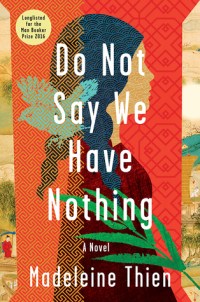
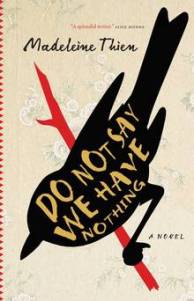
A final note about the two covers above. I much prefer the one on the right, although I read the edition sporting the cover on the left. “Do not say we have nothing” is a line from the Chinese version of the left wing anthem “Internationale.” Sparrow, the composer, truly, had nothing, not even a shred of dignity. The graphic with the words inside the bird is a perfect expression of him, and this book.

THE BEAUTY:

When Marie, Kai’s daughter, passed a store selling DVD’s in Vancouver’s Chinatown, she recognized the music coming from inside as Bach’s Sonata for Piano and Violin No. 4. A memory came to her of she and her father in the car, in the rain. She remembered the joy with which her father hummed to this piece of music, played by Glenn Gould, a Canadian pianist whom Kai admired, and American violinist, Yehudi Menuhin. At the end of the book, when Marie is in Shanghai in 2016, Professor Liu and Mrs. Wang and other musicians have gathered to play Sparrow’s Sonata for Piano and Violin for the first time. Before the concert began, Professor Liu’s sound engineer daughter called for a sound check. The musicians played the opening of Bach’s Sonata No. 4.  I toyed with including Liang Liang’s interpretation instead of the Gould, but to be true to the story, it had to be this version, because Kai loved Glenn Gould.

THE FOOD:

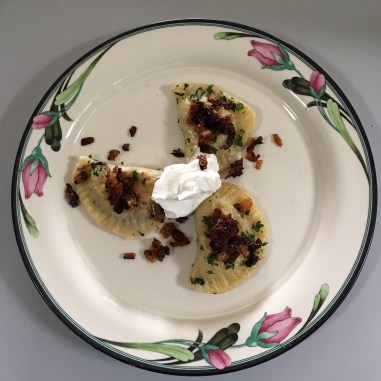
Eleven year old Marie used her Chinese New Year’s money to take Ai-ming, Sparrow’s daughter to dinner at her father’s favorite restaurant in Vancouver, Mazurka, where they dined on pierogies and cabbage rolls. This was an opportunity for me to make pierogies again. They were delicious with carmelized onions and sour cream.

Mushroom Pierogies
Makes: About 20

For the dough:
1 large egg
¼ C sour cream
¼ C plus 2 tablespoons water
2 tsp olive oil
1/2 tsp kosher salt
2 C all-purpose flour

To make the dough:

In a bowl, whisk together the egg, sour cream, water, olive oil, and salt. Add the flour and stir to combine.

Dump the dough onto a floured work surface and gently knead just until the dough comes together. Do not overwork the dough. Transfer the dough to a bowl, cover with plastic wrap, and let rest for 30 minutes.
For the filling:
10 oz cremini mushrooms, halved
½ large yellow onion, cut into chunks
2 large garlic clove, chopped
2 T unsalted butter
3 T dry sherry
1 T chopped parsley
1 tsp kosher salt

To make the filling:

Put the mushrooms, onion, and garlic into a food processor and pulse until finely chopped. In a large frying pan over medium heat, melt the butter. Add the mushroom mixture and cook, stirring, until the mixture is dry, about 4 minutes.

Add the sherry and cook until the mixture is thick, tender, and dry, about 4 minutes longer. Stir in parsley and salt and pepper to taste. Set aside to cool.

For onion topping:
1 lb. onion, chopped
½ stick of unsalted butter

To make the onion topping:

Cook onions in butter in a large heavy skillet over moderately low heat, stirring frequently, until golden brown, about 30 minutes. Season with salt and pepper and keep warm.
For assembling and browning:
2 T unsalted butter
2 T olive oil
1 T parsley
sour cream

Line 2 baking sheets with parchment and dust with flour. On a floured work surface, roll out the dough to -⅛ inch thick. (I used our pasta maker set at 1 and 2 to roll the dough.) Using a 3-inch biscuit or round cookie cutter, cut out as many rounds as possible. Press the scraps together, roll out the dough again, and repeat. You should get about 20 rounds.

Fill each pierogi with a scant 1 tablespoon of filling. Brush the edge of half the round lightly with water. Fold the round in half, pressing the edges together and crimping them with the tines of a fork to seal. Transfer to the flour-dusted baking sheet. Repeat with the remaining rounds.

Bring a large pot of salted water to a boil. Add the pierogi in batches, and cook until tender and they float to the top, 12 to 15 minutes. Using a slotted spoon, transfer to paper towels to drain.

To serve, warm half the butter and half the olive oil together in a large frying pan over medium heat. Fry the pierogi in batches until golden brown on both sides, adding more butter and olive oil as needed. Garnish with parsley, carmelized onions and sour cream. Serve at once.

Filling can be made 2 days ahead and chilled, covered. Filled pierogies can be frozen up to 1 month. Freeze on a tray until firm, about 2 hours, then place in sealable plastic bags. Thaw before cooking.

img_3561.jpg


An Invisible Thread

THE BOOK:

9781452675879Laura Schroff was a successful advertising executive for the start-up national newspaper, USA Today, in Manhattan when Maurice, an eleven year-old panhandler, approached her for money on 56th St. and Broadway one Sunday afternoon. Initially she ignored him, walking right past. But then, for some reason, unknown even to her, she turned around and offered to buy him lunch at McDonald’s. That encounter was the start of an unlikely friendship that lasted for more than thirty years and is still going strong. Maurice’s  is a story of survival. His father was abusive at first, then mostly absent from Maurice’s life later. His mother was an addict who was never a caregiver, but someone who needed to be looked after herself. There were his sisters who were older and wrapped up in their own lives,  and a string of uncles with colorful nicknames who were all physically present in Maurice’s life, but there was no one to provide for his basic needs. So Maurice spent most of his time on the streets, finding ways to feed himself. Laura and Maurice soon fell into a routine where they met every Monday. As they spent more time together, Laura tried not to interrogate Maurice too much about his home life, so she never really knew just how tenuous Maurice’s domestic situation was. For his part, Maurice was curious about what Laura did all day. When she explained her job to him, he was amazed that she did nearly the same thing every single work day. Not only did his mother not work, no one in his family had a conventional job. Growing up in an environment like that, there was so much that Maurice didn’t know that Laura took for granted. Take for example, the first time Maurice came to dinner at Laura’s tiny apartment she asked him to set the table. When she noticed his hesitation, she showed him where the knives, forks, spoons and napkins, etc. were placed on the table.  Laura worried about crossing a line with Maurice. She wanted to be his friend, and to be there for him, but she also recognized that she was not his family, and most of all, she did not want to give him expectations about his future that were unattainable. So, while she dispensed wisdom about living life in the way that a teacher or parent might do, she also tried not to preach, and took her cues, instead, from Maurice.

This was a heart-warming story about two people of vastly different ages and backgrounds forging a lifelong friendship that enriched both of their lives. I loved the pictures of Maurice and his family, and I loved this book.

The Beauty:

maurice-and-family
Maurice’s extended family

THE FOOD:

The first meal Laura and Maurice shared was at McDonald’s, and was probably the most important meal, but I’m not going to make a copycat recipe of a McDonald’s burger with fries. So another important meal was their fourth together, when Laura invited Maurice to her apartment for a home cooked dinner. Before she started cooking, she initiated an important conversation with Maurice. She said that she considered Maurice a friend, and that friendship is based on trust. After making sure that he knew what she meant, she promised never to betray that trust and said that if he betrayed her trust, their friendship would have to end. Maurice was amazed that all Laura wanted was to be his friend. In his experience, adults usually wanted something from him. He was so relieved! So on this important evening, Laura made broiled chicken and pasta with vegetables. Not much to go on, so I had a lot of leeway. This meal took place in 1986. Since Laura was a busy working girl, I’m guessing she would have taken advantage of some corner-cutting these days by purchasing a pre-cooked “trustworthy” rotisserie chicken. Here is my version of that trust-enhancing meal.

Rotisserie Chicken with Roasted Vegetables, Linguine and Aglio e Olio Sauce
Serves 6

4 C small broccoli florets (about 6 ounces)
4 carrots, halved lengthwise and cut into ½-inch pieces
1 large onion, large chop
2 T extra-virgin olive oil
½ teaspoon fine sea salt
8 ounces linguini (break linguine in half)
8 cloves of garlic, sliced into large chunks
¼ C olive oil
3T flour
½ C dry white wine
1½ C chicken stock
1 rotisserie chicken, meat cut into small chunks
½ C grated Parmigiano Reggiano cheese

Preheat the oven to 425°F. Place broccoli, carrots and onion in a small bowl. Drizzle with 2 tablespoons of the oil and sprinkle with salt. Toss to coat vegetables evenly. Arrange in a single layer on a foil-lined baking sheet. Roast until browned and soft, about 20 minutes.

Meanwhile, cook pasta according to the package directions.

Saute garlic in ¼ cup olive oil until soft, 2-3 minutes. Stir in the flour and cook for 2- 3 minutes until the roux begins to turn golden. Add the white wine and chicken stock, stirring until smooth and simmer to reduce by half, about 10 minutes.

Drain pasta, reserving 1 cup cooking water. Return pasta to the pot. Add chicken, the vegetables, sauce, and cheese. Reheat over low heat if necessary, adding some reserved pasta water if it seems dry.


Exit West

THE BOOK:

30688435._UY1200_SS1200_This is the love story of two young people living in an unnamed oppressive, volatile, and unstable city. In spite of the various restrictions on their lives, the two are relatively light-hearted and hopeful, just as any other young couple falling in love might be. Nadia is estranged from her family, having chosen to live alone in a culture where unmarried young women just don’t do that, but Saeed is close to his parents. When his mother is randomly killed in her own yard by militant gunfire, Saeed brings Nadia to live at his father’s house. They become like father and daughter quickly in those dangerous and uncertain times. When war breaks out, Saeed and Nadia have to decide whether to stay, or try to find access to the “doors” that are rumored to provide access to unknown locations, possibly thousands of miles away in another country. There were so many uncertainties when the couple made the decision to leave: can the person they’ve paid be trusted; where will they end up and will it be safer than where they are; will they make it to the designated door location without being apprehended by the police or the militants or the army; what will happen to them during the actual passage through the door? So many questions. Losing his mother, and leaving his father changed Saeed. He began to pray more, laugh less and lost his playful optimism. The rest of the story is about their literal journey, through the doors to new locations, and the journey of their relationship as their love grows and changes.
What made reading this book so enjoyable was the beauty of the writing. Hamid’s prose is meticulous and precise and I was left feeling that each word was carefully chosen in constructing sentences that sometimes felt like poetry. In his writing, Hamid managed to convey joyfulness when Saeed and Nadia first met; grief when Saeed lost his parents; and tension in the uncertainties that the couple faced as they migrated through space and time. Suspension of belief about the doors was easy, I simply accepted that something as mundane as a door in an ordinary house could be the route to another geographical location, like “beam me up, Scotty,” in Star Trek.

THE BEAUTY:

The doors, if one was lucky enough to find one and be able to afford passage, provided an opportunity to escape from one reality into another, so there was a  lot of uncertainty and risk involved, but also a lot of hope. You didn’t know where you would end up. It could be wonderful, but it also could be more dangerous and hostile than the place you left. The doors are metaphors for the choices we make in response to how good a fit exists between where we are and what we want in life. When the circumstances of your daily existence are so difficult that choosing to move on to an uncertain future is the only avenue that allows you to pursue the life you want to live, then you make that choice and hope for the best. That is the basic story of refugees all over the world, making difficult choices to pursue a better life. But as the old woman in Palo Alto thinks near the end of the book:
“…and when she went out it seemed to her that she too had migrated, that everyone migrates, even if we stay in the same houses our whole lives, because we can’t help it. We are all migrants through time.”

A complex book about love, family, refugees,

THE FOOD:

While there were plenty of scenes that took place in restaurants or cafes and other more domestic settings, food was mentioned in a generic way. When Saeed and Nadia went to a Chinese restaurant early in their relationship, the only details given were that they had water and tea to drink, and used forks instead of chopsticks. In one location various groups were giving out free bread and soup. In another, there is a gifted cook who is using local whole foods to create a taster’s paradise because the world’s foods were coming together and being re-formed into something new and wonderful. In that spirit, having just made and tasted kimchi for the first time in my life, I found this Michael Symon recipe from the TV show “The Chew,” while searching for recipes using kimchi. You can use supermarket kimchi if you don’t want to make your own. The best part about this was the pickled hot dogs! I love, love, love hot dogs. My favorite day of the month at school was the day the cafeteria served hot dogs, and all the children knew it. It was also the day I had to say “yes” repeatedly to the question, “Are you having a hot dog today?” I pickled my own, because they’re ready overnight and I had them in the freezer, but a short cut is to add 3 tablespoons of pickle juice to the food processor before pulsing all the ingredients.

Kimchi Potstickers

½ C kimchi, drained and excess liquid squeezed out, finely chopped
1 C pickled hot dogs, sliced
¼ C scallions, finely sliced
1 T soy sauce
1 T sesame oil
1 T cornstarch
1 package potsticker wrappers
3-4 T peanut oil (for pan frying)
(3 T pickle juice if your dogs aren’t pickled)

for the dipping sauce
2 T chinese hot mustard
2 T water
1 T soy sauce
1 T honey
1 T rice vinegar

In a bowl of a food processor, add the kimchi, hot dogs, scallions, soy sauce, sesame oil and cornstarch and pulse until coarsely chopped. Refrigerate until ready to use. Prepare a baking sheet with parchment paper.

Keeping your potsticker wrappers covered with a damp towel, work with one or two at a time and add about one tablespoon of filling to the center. Brush the perimeter with water, then fold in half, crimping and sealing the edges. Place on the parchment-lined baking sheet and keep covered with a damp towel until all of the wrappers and filing have been used.

Place a large saute pan over medium-high heat. Add peanut oil and half of the potstickers. Cook, without moving, until golden brown on the bottom, about 2 minutes. After 2 minutes, add 1/3 cup water to the pan and cover. Continue to cook for another 2-3 minutes. Remove to a platter, wipe out the pan and place back over the heat with more oil. Repeat with remaining potstickers. Serve with the dipping sauce.

For the Dipping Sauce: In a medium bowl add the mustard, water, soy sauce, honey and rice vinegar and whisk to combine.

If you can’t find pickled hot dogs use regular hot dogs and add 3 tablespoons of pickle juice to the kimchi mixture.

NOTE: We absolutely LOVED this recipe. The dipping sauce is fabulous and we’ll use it in place of the other one we’ve been using for Asian-style dishes. This was like nothing I’ve ever tasted. The only dilemma now, is I have leftover pickled hot dogs, and I promised myself that I would never eat more than one hot dog per month. Can’t freeze, as they were previously frozen. Dilemma!


Pachinko

THE BOOK:

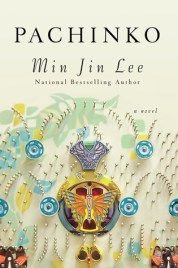
29983711This is the saga of a Korean family who over time, ended up in Japan where they faced serious prejudice and discrimination. The family’s story begins in Busan, Korea, with Hoonie, born with a cleft palate and a twisted foot; and his parents, an aging fisherman and his wife. When Japan annexed Korea in 1910, things became economically dire for many Koreans. Hoonie’s family fared better than most because they had taken in boarders to supplement their meager income. These were the unlikely circumstances that brought Hoonie a wife. Ordinarily, a family would not arrange a marriage with someone like Hoonie for fear of passing along his abnormalities  to his offspring. But when the colonial authority’s land surveys cost a tenant farmer the lease on his farm, and there was nothing left for his four daughters, it became expedient to reduce the number of mouths to feed in the family. No one was more surprised to see the matchmaker at her door than Hoonie’s mother. The matchmaker had come with an offer of the youngest farmer’s daughter, Yangjin, who was reportedly well-mannered and obedient, and the easiest of the four to get rid of. Yangjin and Hoonie met on their wedding day, and their relationship grew into a loving one over the years. The one sour note was that Yangjin miscarried three times before finally giving birth to a  daughter, a survivor named Sunja. We follow Sunja’s family forward into 1989.

Since it is a story of a family, love and how it is expressed is certainly one of the themes of the book. When Sunja was very young, her first love blew her away, as only first loves can. When Min Jin Lee describes those early encounters, I was transported back to my own teenaged first love: how all-consuming it was, how nothing else I had ever experienced felt like it. How the feeling lit me up and warmed me from inside out. After seeing him again years later, Sunja, too was reminded of those feelings. “Yet here was the same face-the one she had loved so much. She had loved his face the way she had loved the brightness of the moon and the cold blue water of the sea.”

THE BEAUTY: 

The goodness of two characters in the book embody the beauty. The first, Hoonie, Sunja’s father, was a truly good man who was respected by everyone in his village. He was so revered that no one took notice of his limp or his lip. He doted on his daughter as if she had hung the moon, and Sunja thrived in that loving environment for the first 13 years of her life, until his death from tuberculosis, a scourge  in Korea and Japan in the early twentieth century. The other, Kyunghee was married to Yoseb who was Sunja’s husband’s brother. They all lived together in Osaka, Japan. Kyunghee and Yoseb were childless, which was a major heartbreak to them both, but they were devoted to their nephews, Sunja’s children. Kyunghee is the embodiment of goodness. She exudes goodwill, and because of her optimistic personality, people were drawn to her. Her loyalty to her family during dark times was inspirational, and I marveled at the author’s ability to create a sympathetic and interesting character that was anything but insipid, in spite of her seemingly boring goodness. Perhaps that was due, in part, to the reader being privvy to Kyunghee’s internal struggles as she forged her way to an ethical, principled and loving life.

THE FOOD:

Sunja and her sister-in-law, Kyunghee, at one point, make kimchi for Sunja to peddle at the local  open market while Kyunghee looks after Sunja’s youngest child at home.  Sunja makes a success of the venture, and is able to support her extended family when her husband is unable to work. I had never had kimchi, although it seemed like something I would like with my affinity for pickles and salty, savory dishes. With probiotics being much in the news and the subject of many recent books, it seemed like the perfect opportunity to try a new, exotic dish. The only off-putting thing was the infamous smell. I delayed making it until after we hosted for dinner friends with sensitive noses. In reality, the sealed jars of the fermenting kimchee in the refrigerator did not exude a powerful smell at all.

Easy  Kimchi

1 head (1.5 to 2 pounds) napa cabbage or green cabbage, cut into 2 by 1-inch pieces (reserve 2-3 large leaves, uncut). You can also substitute bok choy in place of cabbage.
4 T kosher salt
2-3 large cloves garlic, minced
1 tsp fresh ginger, peeled and finely grated
1 tsp sugar (alternatively, use 1 apple or pear, thinly sliced)
3 tablespoons Korean chile pepper flakes or paste (gochugaru). If you don’t live near a        Korean market and can’t find this at your regular grocery store, 1 tablespoon of Sriracha, in a pinch. Do not substitute red pepper flakes; they are much spicier than gochugaru.
4 green onions, green parts only, cut into 1-inch pieces (optional)
1 medium yellow onion, thinly sliced (about ¼ cup) (optional)
Optional: a few large carrots, thinly sliced
For extra hotness: add 1 chili pepper (doesn’t need to be gochugaru) I used serrano.

Yield:  I used carrots, onions, and a chili pepper and got 1¾ quart jars.

Wash all vegetables and pre-measure all of your ingredients.

Place the cabbage in a large bowl and sprinkle with 4 tablespoons of kosher salt. Massage the cabbage for a couple of minutes to start the wilting. Cover the large bowl and allow its contents to sit at room temperature for about an hour until the cabbage has wilted  As it wilts, the cabbage will release around a ¼ cup of liquid.

While the cabbage is wilting, combine the garlic, ginger, chili pepper, carrots, if using them, and sugar (or the apple or pear) in the food processor.

Process the mixture until it forms a rough paste, around 30 seconds. Scrape down the sides of the bowl to incorporate all ingredients.

Once the cabbage has wilted, drain it, set the liquid aside to pour over the cabbage in the jars, and pat the leaves dry. Thoroughly mix the cabbage with the paste. This is your basic kimchi mixture.

Pack the kimchi tightly into the mason jars. Slide a knife down the inside of the jars to remove air pockets. Add equal amounts of the liquid to each jar, making sure that each has at least an inch of headspace (If needed, add some water to the jars to make sure the kimchi is completely covered by liquid. Use filtered water as chlorine will affect the fermentation. Press the mixture down firmly using the wooden spoon, so that the brine covers the top. Cover the kimchi in each jar with one of the reserved large cabbage leaves.

Seal the jars. Use metal lids because plastic will retain the smell of the cabbage. Let them sit at room temperature (65 to 75 degrees Fahrenheit) for three to five days. Taste the kimchi every few days; it will be ready when it has developed a sour, spicy taste and a texture resembling that of sauerkraut.

When the kimchi is ready, remove the big cabbage leaves from the top of each jar and store the jars (tightly sealed) in the fridge. The kimchi should keep for several months.

When I made the soup, I finally broke down and ordered the Korean chili paste (gochujang) and Korean chili powder (gochugaru) online. So, while my kimchi isn’t as authentic as it could be, the soup that I made with it was.

Korean Kimchi Stew (Kimchi Jjigae)
Servings 3-4

¼ lb. skinless pork belly, cut into bite size pieces
1 T rice wine (mirin)
3 sprinkles ground black pepper
¾ cup aged Kimchi (at least 2 to 3 weeks old), cut into bite size pieces if not already
¼ small onion, thinly sliced
½ stalk small green onion, thinly sliced
4 small shiitake mushrooms, stems removed, thinly sliced
5 oz tofu sliced into 1 inch rectangles, or other shapes you may prefer
1 C vegetable stock

Jjigae base (mix these in a bowl)
1 T Korean chili flakes (gochugaru)
1 T soy sauce
1 tsp Korean chili paste (gochujang)
¼ tsp minced garlic
3 sprinkles ground black pepper

Marinate the pork belly with the rice wine and the ground black pepper for about 15 mins.
Heat a pan. Saute the marinated pork belly until lightly browned, about five minutes. Add the onion and saute until it is transparent. Add mushrooms, the jjigae base and stir to incorporate the ingredients and bloom the spices, about 30 seconds. Add the kimchi  and vegetable stock.

Boil on medium high heat initially then reduce the heat to a simmer once it starts boiling, and cook 15 to 20 minutes Make sure the sauce is well blended into the rest of the ingredients.  Turn the heat off, add the green onion. Serve with rice.


The Nest

THE BOOK:

the-nestThe book begins with a prologue that introduces Leo at a  family wedding in July. Fast forward to October of the same year where the Plumb siblings are gathering for a family meeting at their go-to lunch spot in the Grand Central Oyster Bar. Each one has chosen to brace themselves for the occasion somewhere on the periphery of the Oyster Bar. Melody is at the Grand Hyatt Hotel on 42nd Street, secure in the knowledge that she wouldn’t run into the others there, they having rejected her suggestion to meet there instead. Jack is having a hissy fit at the Campbell Apartment, a little known upscale bar in Grand Central, also secure in the knowledge that he won’t be seeing his siblings before the appointed hour. The Campbell is too expensive, too staid – with a dress code, even. Jack, convinced that the mint in his drink had not been properly muddled, was sending it back. Beatrice was happily ensconced at Murphy’s on 43rd St. where she was something of a regular, as her husband, Tuck, had been friends with Garrie, the owner, back in Ireland. The first two are real places, although the Campbell Bar, closed now,  is set to open again in May 2017 after a change in management. The Grand Hyatt is alive and well on 42nd St. A Murphy’s, however, is on 2nd Ave. at 52nd St., and it is an Irish Pub, so even though the genre of bar matches, the geography in the book is suspect. While all this is going on with three siblings, Leo, the eldest, is in Central Park for a “meeting,” when he realizes he’ll have to scramble to get a cab so as not to be late for lunch. Opening the book in this way gives the reader a quick, anecdotal sense of who the characters are, and an intimation of how they relate to one another. I was hooked from the first: Manhattan as the backdrop for a dysfunctional family showdown among four distinctively different personalities. Gold!

THE BEAUTY:

grand-central-oyster-bar-620x300
Grand Central Oyster Bar

Nuff said.

THE FOOD:

The food had to be oysters, but because it also has to appeal to my palate, they had to be cooked, so I researched and found the cookbook from the Oyster Bar with their signature “Oysters Rockefeller.” This may seem like an awful lot of work, and it was, but for me, the hardest part was finding raw oysters, which surprised me, seeing as how I live in NEW ENGLAND, and we have oysters aplenty here. I found a seafood market in Beverly just before the Salem bridge that I had forgotten about and they had some pretty ugly oysters that tasted very good. Next time, I hope to secure oysters with flat shells so they’ll broil more evenly. It was delicious and festive and we ended up having just them for dinner bcause we were full. Definitely worth the effort. However, I would make the Vin Blanc Sauce a day ahead of time. The Hollandaise recipe included here is one that works for me. I was not successful with the more complicated Oyster Bar recipe.

Oysters Rockefeller

12 oysters on the halfshell
Creamed Spinach
Hollandaise Sauce

Position an oven rack in the top position and heat the broiler. Remove the oysters from their shells. Place the shells on a rimmed baking sheet and spread 1 heaping tablespoon of the creamed spinach into each shell. Set the oysters on top of the spinach. Broil until the edges of the oysters are just starting to ruffle, about 1 minute. Remove the pan from the broiler, top the oyster with about one tablespoon of hollandaise sauce, and return the pan to the oven. Broil until the sauce is brown 1 to 1½ minutes. Using tongs, divide the oysters among 2 plates and serve.

Creamed Spinach

1 lb. frozen chopped spinach
1½ C vin blanc sauce
pinch of ground nutmeg
Pinch of kosher salt
Pinch of ground white pepper

Place the spinach in a clean towel and squeeze out excess water. (I used frozen spniach and just squeezed out the excess water wth my hands.) Transfer the spinach to a large skillet over medium heat and cook, stirring often until spinach is warm. Stir in the vin blanc sauce, then season with nutmeg, salt and pepper and stir again. Keep spinach warm until serving it.

Vin Blanc Sauce
Makes about 1½ cups

1 C dry white wind preferably Sauvignon Blanc
2 T minced shallots
1¼ C water
¼ C heavy cream
2 tsp fish base or granulated fish bouillon
3T salted butter
3T all-purpose flour

Combine the wine and shallot in a saucepan and bring to a full boil. Reduce by half. Add the water, cream and fish base and return to a boil. Meanwhile melt the butter in a medium saucepan over medium heat. Add the flour and cook, stirring until it smells toasty, about 1 minute. Don’t let the roux brown.

Add about one half of the boiling liquid and stir well to dissolve the roux. Stir in the rest of the liquid and bring to a simmer. Reduce the heat and simmer gently for 5 minutes. Strain the sauce through a fine sieve and keep warm until serving.

Hollandaise Sauce
Makes about 1¼ cups

1 C unsalted butter, melted
4 large egg yolks
½ tsp Dijon mustard
2 T lemon juice
¼ tsp Tabasco sauce or to taste
½  tsp kosher salt

Melt the butter. In the container of a blender put the egg yolks, mustard, lemon juice, Tabasco and salt. Set the blender on high speed and pour the butter into the egg mixture in a thin stream. It should thicken almost immediately. Keep the sauce warm (about 120º) until serving by placing the blender container in a pan of hot tap water.

IMG_3494                                                  My ugly shells with delcious oysters!