THE BOOK:
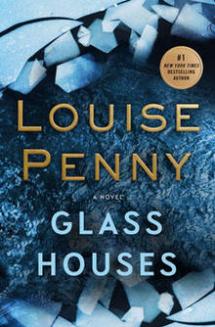 Louise Penny has taken the mystery to a higher level in this, her latest Three Pines novel. I was totally drawn into the story from the beginning, only putting the book down to eat and sleep during the twenty-four hour period that it took to reach the satisfying conclusion. The book begins with Armand Gamache, the Chief Superintendent of the Surete de Quebec (a post he had previously turned down twice) testifying in court as a witness for the prosecution in a murder case. The story is told back and forth in time, between the trial and the events that led to the defendant’s arrest. The case against the defendant in the courtroom scenes slowly reveal the evidence indicating culpability and gives the reader a perspective similar to that of the jury. The scenes describing the events prior to the trial lead the reader eventually to the conclusion that there is something else at play here, that elements of the two vantage points don’t mesh to form a clear picture. More information is needed. More than other mysteries I’ve read, I felt empowered here, to solve the mystery myself. Penny seemlessly revealed the facts, and the feelings of the characters, leading me to questions that I felt needed answering in order to figure the whole thing out.
One thing I love about Penny’s writing is how she illuminates themes, or character traits with excerpts from literature, or history. One of those quotes was from Shakespeare’s Henry VIII, “I feel within me a peace above all earthly dignities, a still and quiet conscience.” Gamache illustrates a point he wants to make to his team at one point, by talking of Churchill and the German bombing of Coventry in World War II. I love when there are literary and historical allusions that I recognize, but I also love identifying those that I’m not sure about by googling to get more information.
When Gamache needs to think through something important, he frequently takes long walks around Three Pines, and usually ends up at a bench on a hill above the village. The bench is inscribed with the words, “Surprised by joy,” which I loved without knowing a context for the quote, but I figured there must be meaning in it, so a quick Google search revealed that Surprised by Joy is the title of C.S. Lewis’s (Clive Staples) autobiography that describes his journey through life as a Christian in his youth, an atheist in his middle years, and his return to Christianity as he tries to find joy later in his life. I’m not sure what that means relative to this particular story, or to the village of Three Pines in general, but I’ve added the book to my WTR (want to read) list.
Finally, the ending of the book was perfect: heartwarming and thoughtful, and produced such a warm feeling of well-being in me, that I forgot for a moment that our current state of affairs has an imminent launch of an ICBM missile by North Korea.
THE BEAUTY:
“But the tiny, achingly beautiful Magdalen Islands were the sweet spot.” This location was an important one in the ongoing investigation of the drug cartels by Gamache’s team. The photo below is the red cliffs made of red sandstone, a sedimentary rock made of quartz which is covered with iron oxide. Wind, waves, tides and thaw join forces to erode the extremely crumbly rock faces sculpting them into spectacular shapes.

image by lucyneatby.com/image/madeline.jpg
THE FOOD:
I’ve been thinking about trying my hand at a baguette for quite a while. My husband’s attempt years ago yielded what he refers to as “dough baseball bats.” So when the baguette played such an important role in this book, I had to give it a try.
Dan Leader’s 4-Hour Baguette
Makes 3 baguettes
Author Notes: This recipe is the aggressive, no-more-excuses shove that you need to start baking your own bread. It will only take you 4 hours of intermittent attention, and won’t require a starter nor any equipment you don’t already own — and it will rival your favorite bakery’s.
1½ C (12 ounces) tap water, heated to 115° F
1 tsp (⅛ ounce) active dry yeast
3¼ C (14⅔ ounces) all-purpose flour
3 tsp (⅜ounces) Diamond Crystal kosher salt (note: if using a fine-grained salt like table salt, fine sea salt or other brands of kosher salt, you will need to use a smaller volume)
Canola oil, for greasing bowl
½ C ice cubes
Whisk together water and yeast in a large bowl; let sit until yeast is foamy, about 10 minutes. Add flour, and stir with a fork until dough forms and all flour is absorbed; let dough sit to allow flour to hydrate, about 20 minutes. Add salt, then transfer dough to a lightly floured work surface, and knead until smooth and elastic, about 10 minutes. Transfer dough ball to a lightly greased bowl, cover bowl with plastic wrap, and place bowl in a cold oven or microwave. Let dough rest until doubled in size, about 45 minutes.
Transfer dough to a lightly floured work surface, and shape into an 8-inch x 6-inch rectangle. Fold the 8-inch sides toward the middle, then fold the shorter sides toward the center, like a T-shirt. Return dough, seam side down, to the bowl. Cover with plastic again, and return to oven. Let sit until doubled in size, about 1 hour.
Remove bowl with dough from oven, and place a cast–iron skillet on the bottom rack of oven; position another rack above skillet, and place a baking stone or upside down or rimless sheet pan on it.
Heat oven to 475° F. Transfer dough to a lightly floured work surface, and cut into three equal pieces; shape each piece into a 14-inch rope. Flour a sheet of parchment paper on a rimless baking sheet; place ropes, evenly spaced, on paper. Lift paper between ropes to form pleats; place two tightly rolled kitchen towels under long edges of paper, creating supports for the loaves. Cover loosely with plastic wrap; let sit until it doubles in size, about 50 minutes.
Uncover; remove towels, and flatten paper to space out loaves. Using a sharp razor, knife, bread lame, or scissors, slash the top of each baguette at a 30–degree angle in four spots; each slash should be about 4 inches long. Pull out the oven rack with the stone or baking sheet on it and, using the corner of the parchment paper as a guide, slide the loaves, still on the parchment paper, onto the baking stone or pan. Place ice cubes in skillet (this produces steam that lets the loaves rise fully before a crust forms). Bake the baguettes until darkly browned and crisp, 20 to 30 minutes; cool before serving.

I am happy to report my baguettes were a raging success!
 I ordered this book prior to publication in the US because my trusted literary advisor, Simon Savidge, gave it 5 stars on Goodreads, (also, it was shortlisted for the Bailey’s Prize, now known as the Women’s Prize for Fiction). Simon’s recommendation was more of a selling point for me because I usually like the books he recommends, and have a history of not liking the books nominated for major prizes. It turned out to be well worth my time and effort. Since the book was primarily about how culture affects personal lives and choices, I learned a bit about Nigerian culture, particularly as it relates to marriage and parenthood. The names in the book were Yoruban, so I assumed that was the basis for the cultural circumstances presented in the book. The main character, Yejide, is happily married to Akin, who adores her. They attempt, unsuccessfully, to have children. After a couple of years, Akin’s mother starts to pressure him to take a second wife in the hope that she will provide the much-revered grandchild. This presents problems for the couple, as one might imagine, and the book proceeds to explore how Yejide and Akin and their family navigate their way through this difficult situation. There was a point where I was having trouble buying in to some of the plot directions and had to remind myself that I was not familiar with Nigerian culture. I did a little online research and found that in the context of that culture, the things that I had difficulty with were perfectly plausible.
 As a former teacher of ancient history, albeit the sixth grade version, I was intrigued by a retelling of the story of Clytemnestra, in Oresteia by Aeschylus. I wondered why a literary talent like Colm Toibin would go there: what did he hope to add to or illuminate in the story? What I found was a kindred spirit, someone who, like me, found this connection to the ancients endlessly fascinating and relevant to our modern lives. The first chapter, Clytemenestra’s story, is chilling. “I have been acquainted with the smell of death. The sickly, sugary smell that wafted in the wind towards the rooms in the palace.” Prior to reading, I had no expectations, only excited anticipation, but reading those words left me goose-fleshed, and curiously, understanding of the wave of emotion that preceded those words. I don’t think I’ve ever had a murderous thought in my life, yet I completely understood what Clytemnestra was feeling at that moment, when her only focus was to eliminate the husband who shattered her existence by his betrayal. The one who, by lying to her, made her complicit in the death of their daughter, Iphigenia, who was sacrificed to appease the gods, to win their favor, and win a war. In what universe are those acts noble?
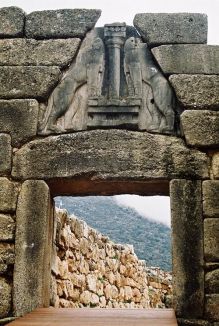 The Lion Gate is the main entrance to the citadel, named for the relief sculpture of the two lions or lionesses above the door (their heads are missing). It is the only surviving example of Mycenaen sculpture. It was so well-described in the writings of antiquity that it was known among archaeologists in modern times.
 The remains of the ancient city of Mycenae were found by a native Greek and professional archaeologist, Kyriakos Pittakis, in 1841. Pittakis discovered the Lion Gate, but the real excavations would come 35 years later by a complete amateur, Heinrich Schliemann. Schliemann had already made his mark in the field of archaeology by discovering the remains of Troy in what is today Hisarlik,Turkey. In excavating Mycenae, he wanted to prove that world of Homer was based on archaeological remains.
 This is an engaging book about one of my favorite subjects. Shapiro begins with a well-worn Brillat Savarin quote, “Tell me what you eat, and I shall tell you who you are.” Laura Shapiro found her way into this book through insomnia. Hoping that a visit to the Lake District in a biography of Dorothy Wordsworth would lull her to sleep, she had an “aha” moment when she read that their cook was feeding them black pudding for dinner. Here was a woman that Shapiro thought she knew, one devoted to her brother, William, leaving him the time and space to create his poetry. As she researched what the Wordsworths ate and how Dorothy cooked, she began to find someone different from the portrait that had become conventional wisdom about Dorthy Wordsworth, and that was the seed of an idea that grew into this book.
 I’ve wanted to read this book for a long time, as it comes up frequently when podcasters talk about books with twisty plots, so I was prepared to really like it, which I did- it was definitely a page-turner. The story is told in a series of letters from Eva to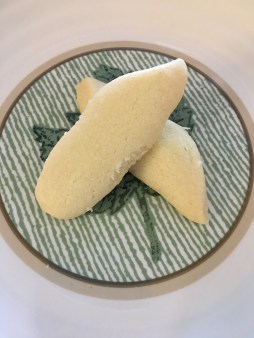
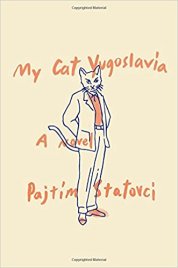 I had seen this book on a list of anticipated debut novels for 2017, and remembered it because of the cat in the title and the cover drawing. I’ve talked so much about book covers recently, that I’m pretty sure this is a banner year for them, at least among the books I’ve read. That cat has more style than me! When I picked up a hold at the library the other day, I went to the shelves of new books conveniently situated near the exit, where this book was displayed with the front cover facing out, so of course I had to go back and check it out. After reading the second chapter, where Bekim purchases a boa constrictor and all of its accoutrement, I didn’t know if I wanted to continue with the book. I have an intense loathing of snakes, and don’t even like saying the word. But I persisted (I need an emoji for irony) because I hadn’t yet met the other protagonist who had been introduced in the blurb. I was immediately rewarded and drawn completely in to the story as I read on.
 One holiday, thirty year-old Ruth Young spent Christmas with her parents and decided at the end of the visit that she wanted to come back to live with them for a year. So she does. During this time, she keeps a diary, recording things that happen, her memories and reflections of her childhood, and of her family’s history. She learned that her father, Howard, had begun a journal himself, starting when she was small. Initially, the reader sees only a few snippets of what Howard wrote, but as more and more are revealed, the reader is treated to a precious view of a father’s love for his funny, quirky, intelligent daughter, reflected in his observations of her. Here is the first entry:

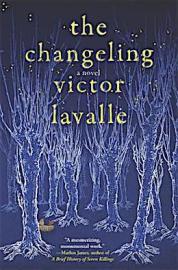 The epigraph in
 This was a disturbing read. It follows Alexandra, a captive in the sex trade industry, from her kidnapping as a young teenager in Armenia to her arrival in Bronxville, New York as a stripper at a bachelor party in a private home. It is a heartbreaking story, but also a testament to the human spirit’s ability to survive. While fiction, it is based on actual stories researched by the author. In an interview he suggests that there is much nonfiction in the world to better address the issue of sex trafficking. He hopes that his book shines a light on human trafficking in a way that nonfiction might not be able to by prompting an emotional response as the reader connects to these very real, very human, very flawed characters. He also wants the reader to be invested in the two remarkable female characters in the story and the breakdown of a marriage.

 Ann Kingman recommended this one on a podcast, not her own, of course, she was a guest on Episode 15 of Book Cougars. She said it was like nothing she’d ever read before. I was pretty sure I was going to love it, from Ann’s brief summary, and I was not disappointed. It actually did remind me of another book I loved, about a deteriorating marriage, Jenny Offill’s
 bbfbooksbeautyfood