THE BOOK:
 In Leon’s latest Brunetti installment, Guido takes on an investigation for his father-in-law, Count Falier, once again walking a fine line between family interests and pursuit of crime someone is murdered. As in all Commisario Brunetti books, the reader watches as Guido attempts to serve justice in an astoundingly corrupt environment. We may not always agree with his tactics, but have to concede that his motivation is pure, ethical and just, if not always legal, or “by the books.” In this volume, Brunetti is rereading “The Trojan Women” by Euripedes. Thinking about the spoils of war that created the plight of the Trojan women, he sees a contemporary parallel in the thousands of women from eastern Europe flooding into the west: living spoils of war, forced into prostitution. Reflecting on the motivations for war in modern times, Guido contrasts the ancients. The Trojans and Achaeans were seeking glory, fame, and honor for their name in perpetuity, unlike today’s wars, motivated by greed in the form of land and spoils. Whatever the motivation, there is one clear group in both ancient and modern times that suffers, powerless to control their own destiny.
I marvel at how Leon has crafted the relationship between Guido and his wife, Paola. They are equals, best friends, and really know and understand one another. The children, Chiara and Raffi, older now and more involved with their friends, do not play as large a role as they have in past books, except at mealtimes. Everyone comes home for mama’s cooking. Although, with Chiara declaring vegetarianism, now Paola has had to provide meat-free options for her daughter alongside Guido’s penchant for vitello. Reading a Leon book is like spending an evening with old friends, taking comfort in the constancy of their character that provides a respite of the familiar in an often hostile world.
THE BEAUTY:
Henry James, Paola’s beloved author, wrote his novella, The Aspern Papers while visiting friends in Venice. The action in the novel was modeled on the Palazzo Soranzo Capello and Gardens on Rio Marin.

The photo is from a website called Pictures from Italy (Est. 2001) by David Lown
THE FOOD:
When Guido misses a meal, you know there’s a compelling reason. His motivation for getting through his days at the Questura is sometimes as simple as looking forward to whatever Paola is preparing for lunch or the evening meal, and the pleasure of her and the children’s company during it. On the day that Brunettie discovered who killed Berta, best friend of Count Falier’s best friend, Gonzalo, Paola was serving peperonata with polenta. In a timely coincidence, my husband and I had just watched an episode on the Food Channel, where Lidia Bastianich prepared peperonata with her granddaughter, serving it on crostini. This is her recipe, except for the polenta.
Peperonata (Stewed Savory Peppers) with Creamy Polenta
¼ C extra-virgin olive oil
4 anchovy fillets, chopped
2 medium onions, sliced to 1/2 inch thick
6 small (or 4 large) bell peppers (red, yellow, and orange), cut into 1-inch strips
1 tsp kosher salt
½ C pitted oil-cured black olives
¼ C drained capers in brine
¼ tsp crushed red pepper flakes
One 28-ounce can whole San Marzano tomatoes, crushed by hand
Heat the olive oil in a large straight-sided skillet over medium heat. When the oil is hot, add the anchovies. Cook and stir until they dissolve into the oil, about 1 to 2 minutes. Add the onions, and cook until they begin to wilt, about 4 minutes. Add the peppers, and season with the salt. Add the olives, capers, and red pepper flakes, and get everything sizzling; then add the tomatoes, slosh out the can with 1 cup water, and add that to the pan. Cover, and cook until the peppers begin to droop, about 10 minutes.
Uncover, and cook until the peppers and onions are tender and sauce is thick and flavorful, about 10 to 15 minutes more.
Creamy Polenta
1 C cornmeal ½ C Parm or ricotta, or both (opt.)
1 to 2 T butter
4 C water
1 tsp kosher salt, plus more to taste
Salt and pepper
Bring 4 cups water to boil in a medium sauce pan. When the water boils, whisk in the 1 cup corn meal in a slow steady stream, whisking constantly to prevent lumps. Continue whisking until the polenta begins to thicken (around 1 to 2 minutes). Add 1 teaspoon kosher salt.
Reduce the heat so that the polenta bubbles slowly. Continue to cook, stirring occasionally, for about 20 minutes until the cornmeal loses its raw flavor (taste every so often to check).
When the polenta is complete, turn off the heat and add 1 to 2 tablespoons butter, and more kosher salt and pepper to taste. You can cover it to keep it warm before serving. If the polenta becomes too thick, you can stir in a bit of milk or water to loosen it up.
For even more flavor, you can stir in some cheese with the butter in Step 3.
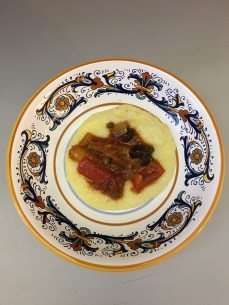
A delicious dish, but for a meat-eating audience, include a protein
 I fell in love with this book early on in my reading. It was rich in history, (a time period I know little about) cultural references, cultural differences, and exquisite writing. Midhat Kamal was the son of a wealthy textile merchant in Nablus, a town in Ottoman Palestine. He was educated at a boarding school in Constantinople and went off to France to study medicine in 1914. It truly was culture shock for him, in spite of his having taken French in school, he knew nothing of French culture, save for the somewhat jaded perceptions shared by Faruq, a fellow passenger on the ship to Marseilles. In Montpellier, he boarded in the home of Doctor Molineau, a member of the medical school faculty, and his daughter, Jeannette. Predictably, Midhat fell in love with Jeannette. The two concealed the nature of their relationship until a shocking turn of events opened Midhat’s eyes to the inherent French prejudice towards Arabs in general, and Midhat specifically. As the story unfolds, it’s sad that so frequently in fiction and real life, people’s destinies are changed irrevocably by what is not said. The book sort of fell apart for me in the third part, with some plot points that didn’t make sense to me, but it didn’t spoil my overall enjoyment of the book. It was an ambitious undertaking for a debut novelist and the beginning of a wonderful literary career.
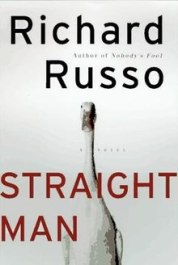 I heard a trusted reviewer say that this book was laugh-out-loud funny, and though I had unsuccessfully tried a Russo book before with a similar claim, I decided to give this a try. In fairness, rare is the occasion that I, (and I believe most readers out there) truly emit audible sounds of mirth in response to reading a book. This was no exception. But while I may not have made noise, I made note to myself many times of the cleverness of a thought, or a turn of phrase, with the overall effect being: this is a very amusing, witty, dare I say ironic, if irony also incorporates good-natured sarcasm, book. In his life, the main character, William Henry Devereaux, Jr., plays the straight man. His friends know that he is never serious, and can be a real jerk in service of his humor at their expense. And yet, they are loyal to him, all the while telling him what an ass he is. He’s blessed with a beautiful wife who understands and loves him, even though she recognizes the many ways that he is not present in their shared life. The action takes place in rural Pennsylvania where “Hank” is an English professor, serving as interim head of the department during a serious fiscal threat to the livelihood of his colleagues and himself. Did he cut a deal with administration? Did he make a list ranking his fellow academics according to their usefulness in the department? These are the questions that everyone buzzed about. In the end, Devereaux is true to himself, and despite rampant departmental gossip and speculation, his friends and colleagues finally recognize what they should have known all along about him. A very satisfying read!
 bbfbooksbeautyfood