THE BOOK:
 I came to The River having loved Celine, also by Heller. Then there was the Kirkus starred review, Book Cougars and Book Riot recommendations, and 4.08 star rating on Goodreads. I was pretty confident that I would enjoy this adventure story, and I did. What I did not enjoy was the extensive descriptions of the day-to-day routine of trekking in the wilderness, so I admit to having skipped long passages in an effort to get back to the plot. What did I expect! It was clearly stated in the summary what this was about… so I recognize that this was not a flaw of the book, simply a point where my interests and the book’s narrative did not intersect. The story itself was a page-turner. Two friends with a love of the outdoors and the challenges of hiking in the wilderness, Wynn and Jack, were on their dream canoe trip in northern Canada, when multiple circumstances added up to disaster. When disaster struck, their almost polar opposite views about the situation, began to drive a wedge between them. Some of the calamity might have been avoided, had they opted for simple things, like bringing a GPS device along. Other challenges could not have been anticipated, and their skills at orienteering and survival served them well. It was hard for me to believe that anyone could have survived what they endured, but I trust that Heller knows what he’s talking about. Pretty much devoured this thing in one sitting.
THE BEAUTY:
One cold night, Jack was standing watch at the campsite, on his back, looking up at the sky when he saw: “…a pale cloud that drifted and elongated and accordioned into a high curtain of softest light, and as he watched, it spread silently across the northern sky. It pulsed with inner radiance as if alive and then poured itself like a cascade to the horizon and shimmered with green… It was like a portent– more: a preview–and it was as if every cantlet and breath of the night was filled with song– and silent. It was terrifying and unutterably beautiful.”
Aurora borealis.
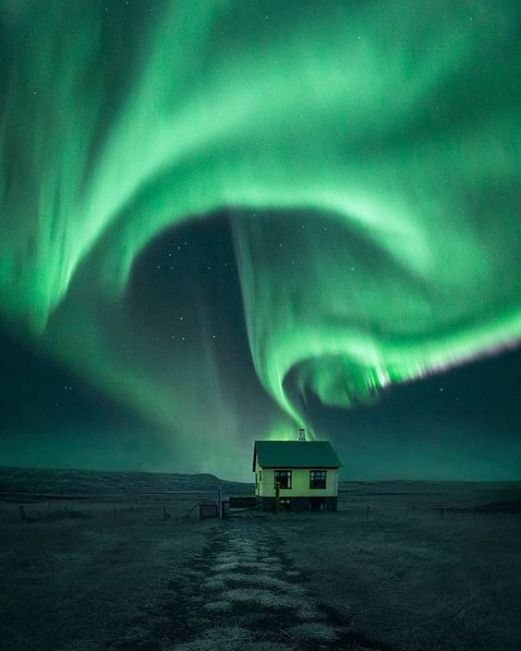
The photo was taken in Iceland, credit arnakristjans_photograph
THE FOOD:
The first part of the trip was going well, and when they found blueberries in great abundance, they supplemented their diet with massive quantities of them. While they lacked the resources to make delicious blueberry muffins with theirs, I do not, and have the blueberries I picked last summer in the freezer, so at the very least, I can share this little bit of adventure with them.
Jordan Marsh Blueberry Muffins
Makes 12 regular or 24 mini muffins
Baker Nick Malgieri came up with this formula for Boston’s beloved blueberry muffins, sold at a bakery in the now defunct department store Jordan Marsh. Many recipes have circulated over the years, but none that capture the true taste. This does.
2 C flour
2 tsp baking powder
½ tsp salt
8 T (1 stick) unsalted butter
1¼ C sugar
2 eggs
½ tsp vanilla extract
½ C buttermilk
2 C fresh or frozen blueberries
flour to coat the frozen berries
extra sugar for muffin tops
Slide a rack in the middle of the oven. Set the oven at 375°. Line a regular muffin pan or two minis with paper liners.
In a bowl, whisk flour, baking powder and salt.
In an electric mixer fitted with the paddle attachment, cream the butter and sugar until light. Beat in the eggs one at a time until the batter is smooth. Blend in the vanilla. Add the flour mixture to the batter alternately with the buttermilk, beginning and ending with flour, mixing only until incorporated. Do not overmix or the muffins will be tough.
Remove the bowl from the stand. Fold in the blueberries.
Spoon the batter into the liners. A regular sized ice cream scoop makes a perfect size regular muffin. Sprinkle a bit of sugar on top of each muffin.
Bake regular muffins for 40 minutes, turning the pan halfway through baking, until well risen and golden. Bake minis for 15 minutes checking after 10, or until golden. Keep muffins loosely covered at room temperature on the day they are baked.
 The Book Cougars recommended this one, so it went to the top of my library holds list. I suggest that editors refrain from making comparisons to books like
 One of the book podcasters I follow recommended Bronsky’s latest book,
  It’s been a couple of weeks since I finished this book, and I haven’t been able to get it out of my mind. Although it had all the elements that I love: taking place in a foreign country with a culture that was unfamiliar to me, I had trouble warming to the characters, particularly Clyde, the father of twins Peter and Paul. Paul, the second born, had the umbilical cord wrapped around his neck at birth and suffered oxygen loss, making him “retarded” in his father’s eyes. Clyde was hard on Paul, who was not an easy child, throwing tantrums or acting in the extreme to unexpected stimuli. He also had trouble in school, and consequently hated it. So, guess who the golden one was. Peter was an exceptional student and athlete, and his entire extended family had great plans for him in the form of a college education. I finally really got into the book in Part 3, which was told from Paul’s point of view. Paul’s life was so joyless that he literally folded into himself in most situations, to make himself smaller, invisible. One teacher, Mr. Kavanaugh, saw something more in Paul, and became an ally, but without his father’s support, Paul couldn’t find a reason to value himself . As a teacher, I wondered how Paul’s life would have been if his school had been equipped to handle a student with disabilities. I also was reminded of the tremendous power educators have in making a difference in the lives of their students. While sad, the novel provided a powerful reading experience. The author, Claire Adams was born and raised in Trinidad where the novel was set. Having set foot on Trinidad on a Caribbean cruise, I was struck by how little I got to know about that island. Reading expands my world and takes me to places that, even having been there, I can’t truly know.

 bbfbooksbeautyfood