THE BOOK:
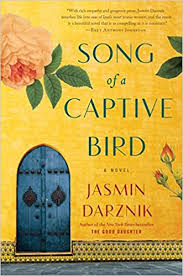 This book was also in the Random House email of books to look for in 2019, although it, too, was published in 2018. Though fiction, it is based on the life of Forugh Farrokhzad, the Iranian poet, who revolutionized Iranian poetry in both form and subject. She wrote about her personal life which, was anything but traditional. She didn’t wear a head scarf, dressed in western-style clothing including tight skirts and heels, married her husband under “scandalous” circumstances, and ultimately left her young son and husband for several days to travel hundreds of miles to Tehran to try and get her poetry published. Her story is fascinating- like nothing I’ve ever read. She lived life on her own terms in a very restrictive patriarchal society, that sometimes was very punitive. She sacrificed a lot for the life she chose, yet, still was able to find moments of beauty that nourished her poetry.
THE BEAUTY: Losing her son, Kami, to her husband in their divorce was devastating to Forugh- a pain that she carried with her every day of her life. (In Iran, apparently, the father gets custody of the children.) This poem to him, in its simplicity, is achingly beautiful to me.
A Poem for You
I am composing this poem for you
on a parched summer dusk
halfway down this road of ominous beginning
In the old grave of this endless sorrow.
this is the final lullaby
at the foot of the cradle where you sleep.
may the wild sounds of my screaming
echo in the sky of your youth.
let the shadow of me the wanderer
be separate and far from your shadow.
when one day we reach one another,
standing between us will be none other than God.
against a dark door I have rested
my forehead tight with pain;
I rub my thin, cold fingers
against this door in hope.
that person branded with shame who used to laugh
at foolish taunts was I.
I said I would be the cry of my own existence;
but O, alas that I was a “woman”.
when your innocent eyes glance
at this confused, beginningless book,
you will see a deep-rooted, lasting rebellion
blooming in the heart of every song.
here the stars are all dim,
the angels here all weep.
the blooms of the tuberose here
have less value than desert thorns.
here, seated along every road
Is the demon of duplicity, disgrace and deceit.
In the dark sky I do not see
a light from the bright morning of wakefulness.
wait until once again my eyes
overflow with drops of dew.
I have taken it upon myself to unveil
the “pure” faces of the holy Marys.
I have cast away from the shore of good name;
In my heart lies a storm star.
the place of my anger’s flame,
alas, is the prison’s dark space.
against a dark door I have rested
my forehead tight with pain.
I rub my thin, cold fingers
against this door in hope.
against these ascetic hypocrites
I know this fight is not easy.
my city and yours, my sweet child,
has long been Satan’s nest.
a day will come when your eyes
will sadly quiver at this painful song.
you will search for me in my words
and tell yourself: My mother, that is who she was.
THE FOOD:
After Leila arranged for Forugh’s release from the Rezayan Clinic and brought her home to her mansion in Tehran, Forugh started writing poetry again. She was eating saffron pudding when she told Leila about having sent out some new poems for a book called, “The Wall.”
Saffron Rice Pudding
Serves : 8
1 C jasmine rice
6 C boiling water
¼ tsp crushed saffron threads
6 T boiling water
1½ C sugar
2 C boiling water
3 green cardamom pods, lightly cracked
2 T pure rosewater, preferably Sadaf brand (see Note)
Ground cinnamon and slivered almonds, for garnish
Rinse the rice in cold water several times until the water runs clear. Drain completely. In a Dutch oven, combine the rice with 6 cups of boiling water and bring up to a boil. Simmer over low heat until the rice is softened, about 30 minutes, stirring occasionally so the rice doesn’t stick.
Using a mortar and pestle, grind the saffron threads into a fine powder. Add the boiling 6 tablespooons of water to the saffron and let cool.
Stir the sugar, 2 cups of boiling water and cardamom pods into the mixture and continue cooking on medium-low stirring frequently so the rice mixture doesn’t stick to the bottom of the pan, until the rice breaks down and the pudding thickens, 20-30 more minutes. Add the brewed saffron and rosewater*, stir to mix.
Discard the cardamom pods. Spoon the pudding into 8 glasses and let cool slightly. Cover the glasses with plastic and refrigerate until thickened, about 1 hour.
Decorate the puddings with cinnamon, rose petals and slivered almonds. If refrigerated, let stand at room temperature for 25 minutes before serving.
*Using a high-quality, pure rosewater is essential here. Look for Sadaf brand.
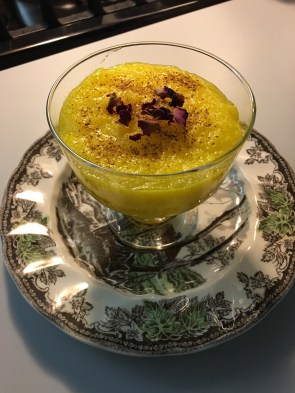 As it turned out, what I thought were almonds in my freezer were actually pecans- not a flavor that I thought would complement the pudding. So I dusted them with cinnamon, sprinkled on a few rose petals, and called it dessert. Over the course of two days, my husband has developed a taste for this. I however, could not get into the rosewater, even though I bought “the good stuff.” The Sadaf rosewater tastes so much better than the supermarket brand I bought a while ago for another recipe, but, sadly, it was not a flavor I enjoyed.
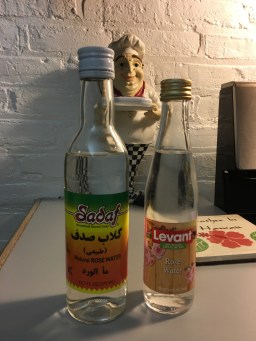
Sadaf rosewater on the left, Market Basket on the right.
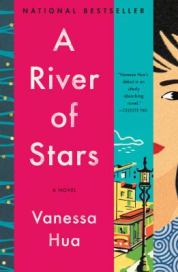 I learned about this book from an email Random House sent regarding books to look for in early 2019. It must be coming out in paperback, because the library book I read was published in 2018. I love books that plop me right down in a culture that is foreign to me, and this one delivered on that count in spades. Scarlett’s confinement during her pregnancy brought her to Las Vegas, about as far from her native China as she could get. Never one to fit in, even in China, Scarlett was an iconoclast among the other wealthy Chinese women at Perfume Bay, the resort for pregnant women who want their child to have American citizenship. When things took an unexpected turn, Scarlett had to think fast to forge a way forward for herself, and to keep her baby safe. She was joined in her adventures by Daisy, another outcast from Perfume Bay, and a very young one at that. The two wound up in San Francisco, where Scarlett discovered that she could make a living selling Chinese pork sliders on the street. Another entertaining immigrant story, I’m struck by how many women subsist by selling street food.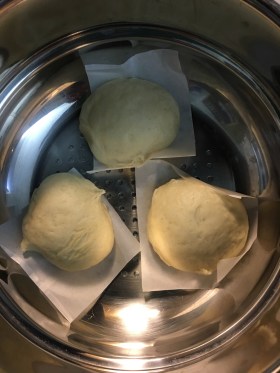

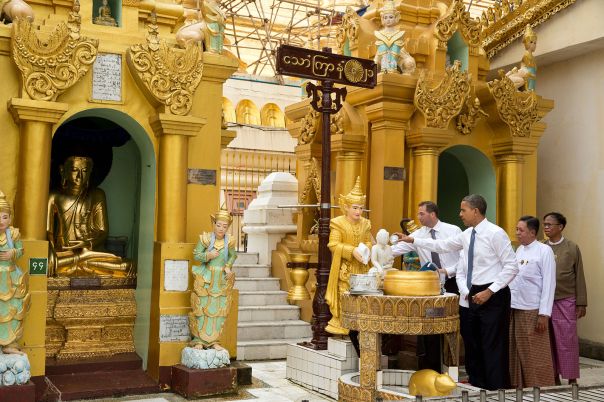
 Beck Dorey-Stein’s path to the White House was pretty arbitrary. She answered an ad for a stenographer on Craigslist, never dreaming that she’d actually get a return call. When she did, she blew off her interview, because after so much rejection, she figured, what the heck. Finally, Bernice, the interviewer, emailed her to say that the job was at the White House. Well, that changed things! As a stenographer, Beck’s job was to follow the president around the country recording all of his public comments, and later transcribing them for the historic record. While this sounds pretty exciting, there was a lot of tedium involved and Beck kept focusing on the fact that she was essentially, just a typist, not anyone important. This is representative of her view of herself at that time in her life. In her mid-twenties, she had had a series of jobs, but not a career. In fact, what she really wanted to do was write, but she lacked confidence. The book gives a snapshot of what the president’s schedule was like, the hierarchy of staff, and a bit of insider gossip. Beck was so in awe of Obama that she became mute whenever he spoke directly to her. But during all her travels, she continued to record her thoughts and impressions, because that’s what she’d done all her life.
 bbfbooksbeautyfood