THE BOOK:
 This was an important book to me, because it clearly articulated questions I’ve had about race in America. Eddo-Lodge is British, born and bred, but in contemporary Britain, marginalized as an outsider. “What history had I inherited that left me an alien in my place of birth?” There is no summary I can write that would do justice to her narrative about race in Britain. What I can say is how convincing her writing is in supporting her assertions, mainly, that racism is structurally embedded in British society. “I choose to use the word structural rather than institutional because I think it is built into spaces much broader than our more traditional institutions… Structural is often the only way to capture what goes unnoticed- the silently raised eyebrows, the implicit biases, snap judgements made on perceptions of competency.” Reni Eddo-Lodge stopped talking to white people about race, because, even when she found like-minded white people in the context of feminism, for example, she always hit a wall when the white person tried to change the course of the narrative to black people’s failure to assimilate, or black people’s inability to demonstrate equal capabilities to their white peers competing for the same capital. In short, even sympathetic white people could not see that white privilege had afforded them a leg up that was not available to people of color. Simple. And profound. I urge you to read this book with the caveat that if you are white, prepare to be uncomfortable.
THE BEAUTY:
In “The Feminism Question” chapter, Eddo-Lodge recounts an interview with Naomi Campbell in 2013, where she was using her voice to get more models of color on the runways of Fashion Week. At that time in 2013, 82% of the models were white. She was confronted by a Channel 4 news reporter who told her, “you have a reputation, rightly or wrongly, for being quite an angry person.” The phrase “angry black woman” resonated with me, in part because I remember something like it from Americanah. I had written a note when I read that book that said the best parts were in the blogs, where Ifemelu mused about being an African black woman in America. She said, “strong-minded black women are scary.” At the time it made me laugh, but in the context of this book, I realize its power. So here’s to “angry black women.” Keep on being angry. May you use your power to effect change.
THE FOOD:
There was no food in this book, but plenty of food for thought. I hope that these thoughts out of context don’t mislead or lose their power. I wrote them down as I was reading because they seemed relevant or important to me. You’ll have to form your own opinions when you read the book yourself.
The author began researching the history of black people in Britain when she was nineteen, in an attempt to uncover the historical context of Blacks in Britain, and found a history of slave trading. Most of the slaves were in colonial West Indies where they were put to work on sugar and cotton plantations, for no pay, of course. With the intimation of political reform on the islands in return for their service, thousands of West Indian slaves signed up to fight for Britain in WWI and WII. When many of these soldiers chose to settle in England after the wars, racial unrest reached explosive levels, revealing a tradition of suspicion of black people in England. The author was surprised that she had never heard about this in her history classes.
Some random statements:
“Prejudice needs power to be effective.”
70% of the professors in Britain are white men.
We don’t live in a meritocracy, and to pretend that simple hard work will elevate all to success is an exercise in willful ignorance.
Seeing race is essential to changing the system.
 This is the story of a Pakistani family living in London. They try to fly under the radar because their father was a terrorist, even though they never really knew him because he was not a part of their lives. When their mother died, the eldest daughter, Isma, put her education on hold to support her two younger siblings by working at a dry-cleaner’s shop. The book begins with Isma, detained for questioning at Heathrow and consequently missing her flight to Boston, where she would then travel west to Amherst to begin a PhD program, now that the twins were grown and going off to pursue their own careers. In Amherst, Isma met Eamonn, son of Karamat Lone, a Muslim MP recently elevated to Home Secretary. Isma concealed the fact that their lives were loosely connected until just before Eamonn returned to London, where their lives became inextricably connected. One of the themes of the book is “like father, like son,” relating to both Eamonn and his father, and Isma’s younger brother, Parvaiz and their father. Aneeka, Isma’s younger sister and Parvaiz’s twin, completes the cast of main characters. The more I think about this book, the more I love it. This one is so different from




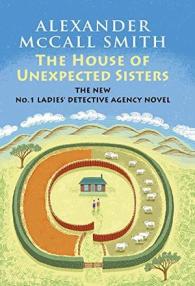 One of the things I love about this series is the reflections that Precious Ramotswe makes about life in Botswana, its traditions, and the way that people around her choose to live their lives. Frequently, in conversation, Precious’s thoughts will stray, based on something that was said, and she will completely lose herself in that train of thought until someone brings her back into the conversation by saying her name. The best digressions are the ones where something has amused her, and everyone wonders why she’s smiling, since what they had been talking about was rather serious. These are quiet books about everyday life, but infused with so much warmth and wisdom, that they function, for me, anyway, as a trip to a spa (although I’ve never actually done that!) for my soul. AMS’s books bring me to a place of peace and comfort, humor and compassion, in the company of like-minded friends.
 bbfbooksbeautyfood