THE BOOK:
 This is the story of an unlikely alliance among three people whose lives merge in a snowstorm in Brooklyn in 2016. Lucia is a visiting professor from Santiago, Chile who signed a one-year contract to teach at NYU’s Center for Latin American and Caribbean Studies. Her landlord and upstairs neighbor, Richard, is also her boss. Evelyn Ortega meets Richard when his car crashes into her Lexus at a snowy intersection during a particularly bad winter storm. Through the course of the book, the reader gets to know the characters’ backstory as they get to know one another. The circumstances they find themselves in are somewhat bizarre and scary, but the relationships that develop over a short period of time- just a couple of days, really- are life-affirming. When Evelyn shares the story of her escape from Guatemala and the horrific event that forced her to leave in the first place, she tells of a visit to a healer with her grandmother. The shaman, Felicita, a famous guardian of the traditions of the Maya, explained her power- that she channeled the earth’s healing energy. As she prepared for the healing, she lit some herbs in a painted pot, blowing the smoke into Evelyn’s face. Then she made Evelyn drink a disgusting ayahuascan tea that she could barely swallow. That was the beginning of Evelyn’s solo, frightening journey. Hours later when it was done, Evelyn emerged from the magic world and did not know where she was. What came next is the beauty of this post.
THE BEAUTY:
Maybe it was because all that had been in the news for the last week was allegation after allegation of sexual abuse by powerful men in Washington, Hollywood, and beyond, and the predictable victim-shaming that followed. Whatever the reason, when I read the following passage, I wept, (embarassingly) uncontrollably, on the couch next to my bewildered husband:
“Tell me what you saw,” the shaman instructed her.
Evelyn made a supreme effort to speak and to pronounce words, but she was very tired and could only stammer “brothers,” and “jaguar.”
“Was it female?” asked the healer.
The girl nodded.
“Mine is the feminine power,” Felicita said. “That’s the power of life that the ancients had, both men and women. Now it is asleep in men, which is why there is war, but that power is going to reawaken, and then good will spread over the earth, the Great Spirit will reign, there will be peace, and evil deeds will cease. I am not alone in saying this. It’s prophesied by all the wise ancient women and men among the native peoples I have visited. You also have the feminine power. That’s why the mother jaguar came to you. Remember that. And don’t forget that your brothers are with the spirits and are not suffering.”
I wept, because I was hopeful.
THE FOOD:
When a state of emergency was declared in New York, Lucia made the most of her day off from work by preparing a “life-restoring” cazuela, a Chilean soup that “lifts down-hearted spirits and sick bodies.” Her ingredients were a well-seasoned stock, fried onion and meat, cooked vegetables and potatoes, pumpkin and rice.
Cazuela (Chilean Stew)
Yield: 4 servings
1 lb beef brisket (or lamb, pork or chicken)
2 T olive oil
1 onion, peeled and cut vertically into quarters
1 tsp oregano
1 tsp ground cumin
salt, to taste
freshly ground black pepper, to taste
8 small red or white new potatoes
2 carrots, peeled and cut across into four pieces
1 red or green bell pepper, seeded and cut into quarters
1 stalk celery, chopped
4 2-inch chunks pumpkin meat
1 cup rice
5-6 cups boiling water
2 ears corn, each cut into four rounds
1 cup green peas or green beans
2 Tbsp cilantro, chopped
Cut the brisket into eight roughly equal portions. Heat oil in a large pot, add meat and brown well. Add the onion, oregano, cumin, salt and pepper; stir, and continue cooking over medium heat for five minutes.
Add the potatoes, carrots, bell pepper, celery, pumpkin and rice to the pot. Add enough boiling water to cover the contents completely and simmer for 10 minutes, stirring occasionally.
Add the corn and peas or green beans and cook for 10 minutes more. Adjust seasonings to taste and serve hot in warm bowls. Take care to plate with at least two pieces of meat, two potatoes, one piece of pumpkin and two pieces of corn in each bowl. Garnish with a bit of chopped cilantro.
*Note* I eliminated the meat, added vegetable bouillon to the boiling water (about 6 cups) and substituted butternut squash for pumpkin. It was the perfect antidote to Thanksgiving’s indulgences!
 This was an extraordinary book. The way that the main characters, Mamah Borthwick Cheney and Frank Lloyd Wright lived their lives defied the social mores of the time, and had me questioning the wisdom of staying in a failing relationship when one has met her true life’s mate. Mamah left her husband, her home and her children in order to be with Frank. But was he Mr. Right? The way he’s depicted in this book shows him to be an epic narcissist with the temperament of a spoiled child. He seemed to believe that creative geniuses were not bound by the morality of the masses. In order to nourish that genius, his behavior might occasionally fall outside the confines of what was expected of mere mortal men. After all that Mamaw gave up to be with him, I wonder if she ever experienced true happiness, and in the end, was it all worth it?
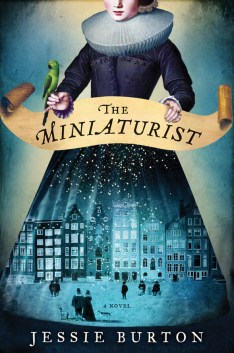 Seventeen year-old Petronella Oortman stood at the door of the Amsterdam home of her new husband, Johannes Brandt, and knocked. And knocked. No one came. This was not an auspicious beginning to married life. Even though she was expected, Brandt was not even in town to greet her when she arrived. Nella was shown to her room by Marin, Brandt’s sister, who in the early pages of the novel reminded me of Mrs. Danvers, with her curt comments and mysterious actions. Needless to say, I was hooked, even though I suspected that things would not end well for Nella. Marin was a real doozy. After sniffing Nella’s perfume (lily, a gift from her mother), Marin says, “You know what they say about lilies. Early to ripe, early to rot.” As Johannes traveled extensively for the VOC, the Dutch East India Company, Nella was subjected to Marin’s disdain on a daily basis. Seventeenth century Amsterdam afforded limited latitude about the proper occupation of women, so Nella was essentially a prisoner in her own home, which was more like a boarding house, since Marin took over the duties of wife that should have been Nella’s responsibilities under different circumstances. As distant as Johannes was, I liked him. I especially liked him when he said, “I find much of myself in food.” This was at a banquet, the first time he and Petronella appeared in public as man and wife, and their first real conversation. He went on to talk about how memory is connected to food and how food is a language in itself. It reminds me of the famous Brillat-Saverin quip, “Tell me what you eat, and I will tell you what you are.” That currently makes me leftover pizza from Santarpio’s.
 Dunbar is the latest addition to the Penguin Random House Hogarth Shakespeare Series. A retelling of King Lear, it is quite a gloomy little book, although, how could it not be. “Acclaimed” authors were asked to select a Shakespeare play upon which to base their own retelling. This one begins in a sanatorium in in Cumbria, England, near Manchester. Henry Dunbar, 80 year-old media mogul, was deposited here by his two oldest daughters, Abigail and Megan (Goneril and Regan). Comic relief is provided by Dunbar’s alcoholic comedian friend, Peter Walker, in the form of impressions of various celebrities and a lot of clever – silly sometimes- banter. It is a morality tale about what people who have dedicated their lives to the accumulation of wealth and power can expect when they’ve neglected a moral compass that would have tied them more closely, more sympathetically, to their fellow humans. The siblings, intending to take over the company after having elaborately staged their father’s incoherent demise, garnered the support of the apppropriate board members, and performed any number of other equally despicable business dealings that would secure their fortune. Being only cursorily familiar with King Lear, I don’t recognize how closely the book parallels the play, but even I recognized the most obvious nods. Aubyn’s writing is very smart, but the overall effect of this sad story is to make one want to take stock of one’s life before it’s too late. Before a lifetime of selfish choices leaves you old and alone.
 bbfbooksbeautyfood