THE BOOK:
 I was so excited when I heard that there was going to be a new Celeste Ng book in 2017, so when I finally got it, I devoured it. Thank goodness for lousy weather so I don’t have to feel guilty about spending all my waking hours indoors reading. This book is similar to Everything I Never Told You in that it explores relationships among family members, friends, and the larger community. People present themselves to their world in different ways. We can be charming and delightful to the rest of the world, while at the same time being angry and resentful to our family. And then, there’s the notion of what we think we show to other people about ourselves in contrast to how they interpret what they see. So everyone’s reality is very fluid and unpredictable, begging the questions, do we every really know another person, let alone do we ever really know ourselves?
Shaker Heights outside of Chicago is a planned community that was originally the North Union Community of the United Society of Believers in Christ’s Second Appearing, commonly known as Shakers. The colony eventually faded away and closed in 1889. Shakers, after all, were celibates, with no steady stream of potential acolytes to increase their numbers. When the Van Sweringen brothers bought the land in 1905, their vision was the first garden style suburb in Ohio. Strict building codes and zoning laws have helped maintain the community’s identity over the years. The author mentions rules that the color of the exterior of different styles of homes are allowed to be painted; there are fines for not mowing your lawn in a timely fashion (good thing we don’t live there); the driveways are designed so that garbage is never in the front of the house. Order and rules rule! We are introduced to the Richardson family: Elena and Bill, and their children, Lexie, Trip and Moody. Things start to get interesting in the community when Mia, an artist, and her teen-aged daughter, Pearl, rent a duplex owned by the Richardsons. Essentially, a contest ensues between order (Richardsons) and free-spirited living where the rules that govern behavior are more gray than black and white (Mia and Pearl). It is very telling that the Richardson’s matriarch, Elena, is referred to as “Mrs. Richardson” throughout the narrative.
When I finished the book, I still wasn’t finished with the book. It stayed with me and I found myself wondering about Izzie (youngest Richardson), and how her relationship with her mother set her on a dangerous, perhaps lonely path. Bottom line, I love that this book made me think about my own relationships after experiencing the conflicts in this book. Again, I can’t wait for the next Ng book. Keep them coming, please!
THE BEAUTY:
This was a tough one. I thought about Shaker Heights being beautiful, but the thought of it oppresses me and makes me feel claustrophobic and short of breath. But when I thought about the origin of the place and how “Simple Gifts” was taught in their schools so that students would make the connection to those who had founded the community, I thought I might be onto something. When I typed in “Simple Gifts” one of the first links to come up was to the video below. I love Yoyo Ma, and the Silk Road, and Alison Krauss’s voice is delicately, simply, beautiful .
This video was put together on April 29, 2014 by Vicki Burns. It features photography of Oregon.
‘Tis the gift to be simple, ’tis the gift to be free
‘Tis the gift to come down where we ought to be,
And when we find ourselves in the place just right,
‘Twill be in the valley of love and delight.
When true simplicity is gained,
To bow and to bend we shan’t be ashamed,
To turn, turn will be our delight,
Till by turning, turning we come ’round right.
THE FOOD:
Mia worked at the Lucky Palace Chinese restaurant. She was able to make ends meet to feed Pearl and herself with the leftovers that the restaurant would have discarded at the end of each day. The recipe below for repurposed lo mein is not Mia’s. She added Ragu spaghetti sauce and who knows what else, and THAT did not appeal to me. This is actually pretty good, and I started with leftovers from our local favorite Chinese restaurant. (Finally, a simple recipe! See what I’ve done there, referencing the song above?)
Repurposed Lo Mein
Leftover lo mein
Frozen broccoli, peas and carrots, or whatever vegetables you choose
Garlic
Olive oil
Crushed red pepper flakes
Chop up garlic, and defrost some broccoli in the microwave. Drain the water from the broccoli. Saute garlic and red pepper flakes in olive oil in a frying pan for a couple of minutes until the garlic is fragrant and softened. Then, add the defrosted broccoli to the pan.
Once your broccoli is sautéed through, add the lo mein and continue to sauté until the lo mein is warmed all the way through. Serve with condiments of your choice, like soy sauce or sriracha.
 I wanted to love this book. Last fall, when I was sorting through some boxes that I had taken from my mother’s house, I found a list of the books she had read from 1986 to 1990. This was the first on the list. I hadn’t read but a few pages when I realized how much I was loving the size and shape of the book. Even though it’s a hardcover, it fit perfectly in my hand and I could put my left thumb in the binding between the two pages and steady the whole thing with my right hand! (FYI: the book’s dimensions are 6″ wide by 8½ ” high.) That was an auspicious beginning to my read. Phyllis A Whitney wrote more than 70 books for children and adults, characterizing her adult books as “romantic suspense novels.” This one certainly falls into that category. Karen Hallam has been called to Gatlinburg, Tennessee for her husband’s funeral. Although they were estranged, divorce proceedings had just begun when David took an assignment in Tennessee. Letters to Karen from him revealed his anger about the split, and also a request if something untowardshould happen to him. Karen was staying with David’s brother, Trevor, a celebrated architect whose work Karen had photographed in the past for her magazine, although Trevor didn’t know that. There is an interesting array of characters including Lori Caton, Trevor’s wife, and their 10 year-old son Chris. Nona Andrews, Trevor’s wheelchair-bound aunt, who lived with him and his family in the gorgeous house he designed, much in the style of Frank Lloyd Wright where the structure blends beautifully into the natural landscape. Add in neighbors Eric (Lori’s uncle) and Maggie Caton and their grown son, Gifford, and other assorted characters, and the reader ends up with many possibilities as to who is responsible for David’s death. I didn’t figure it out, but that’s part of the fun for me, the surprise at all I missed or misinterpreted. Phyllis Whitney skillfully transported me to another place and time, and left me feeling a part of the suspense. An enjoyable read. Well done, Mom!
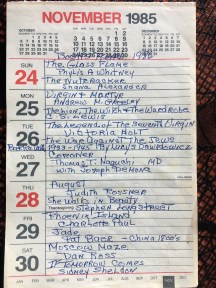 Yup. My mother’s list. I don’t know how far along I’ll get, but I’m glad to have begun. Looking forward to the Shana Alexander book next.
 The photo above is from
  I had wanted to read this book for a long time, although I’m not sure where the recommendation came from. I kept looking for it in used bookstores, until finally, at the September library book sale, I found it. This is the story of an enigmatic, aristocratic and aloof elderly woman, Alma Belasco, whose relationship with Irina Bazili, a young Moldovan caretaker at the unconventional senior residence Lark House, began when Alma asked her to be her assistant. Irina had her own lion’s share of tragedy and shame in her life, but in spite of that, through caring for Alma, she learns to forgive and accept herself. This is also the story of the shameful period of America history during WWII that saw 127,000 Japanese Americans relocated and incarcerated for the duration of the war. Ichimei Fukuda’s family were among them. The patriarch of the family, Takao, worked as a gardener on the estate of Alma’s uncle, Isaac Belasco. The family lost everything- their home, their property, their business- when they were moved first to Tanforan, a racetrack in San Bruno, south of San Francisco, and then, six monthes later, to Topaz Relocation Center in the desert of Utah. Finally, this book is also about multiple love stories, some of which are so intense, so magical, so full of raw emotion that the reader has to pause, for a sigh and to take a deep breath. It is beautifully written. Allende is known for her magical realism, which made its appearance so subtly, that I was not only charmed, but taken aback as well. Full disclosure, I’m one who has no problem with fantasy or magic or the supernatural as long as the story has initially drawn me in and engaged me.
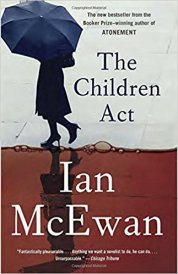 What strikes me about this one in particular and McEwan’s books in general is how concise they are, but also, how complex. As I read the protagonist, Fiona Maye’s thoughts about the cases she was working on as a Family Court Judge, juxtaposed with her thoughts about her marriage, I marvelled at how on the one hand, she could be objective, logical and confident, but in the very next moment, vulnerable, emotional, and insecure. McEwan’s ability to convey a lot of content in a short space leads me to believe he’d be a wonderful poet. (I checked, but could find no poetry by Ian McEwan.) This is a book about a marriage, and a career. Fiona and her husband, Jack, have grown apart. When the book opens, Fiona is still reeling from a conversation she just had with Jack, about how to fix their foundering marriage. At the same time, she was pondering the cases she would address on behalf of the children caught up in their parents’ divorce, at work the following day. While her work was challenging, and often grim, she felt that she brought reasonableness to otherwise hopeless situations. Reading Fiona’s thoughts about her work made me realize how difficult and important the work of a Family Court judge is. And then there’s the key “decision” that Fiona makes that nearly unravels her professionally and personally. I do love McEwan.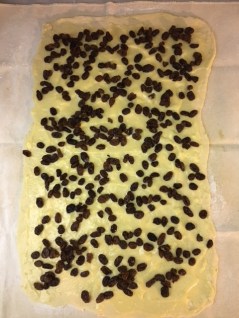
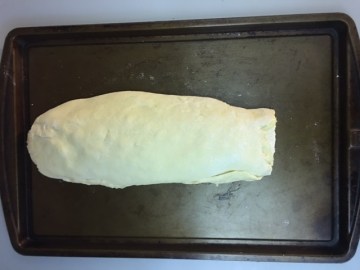
 The finished product, and yes, I am very proud of this. It tasted like it came from a bakery. It was a lot of work, and while I’ll save the recipe, I’m not sure when I’ll be in a hurry to make it again. Unless Jim begs. Or requests. Also, I planned my time so poorly that the second batch came out of the oven at 11 PM. Bakers need to schedule carefully so they’re not up all night.
 I had
I had 
 Thandi grew up middle class, with a South African mother, and a father from New York city. Her parents met on a volunteer trip to Botswana, and later settled in Pennsylvania where her father was a mathematics teacher for many years before being promoted to head of the department of the college. The story that unfolds is Thandi’s journey through her mother’s cancer diagnosis, and the subsequent caretaking that it eventually entails. As Thandi becomes further and further unmoored by her mother’s decline, she seeks refuge in boyfriends, looking for an anchor to tether her to the world of the living, and distract her from her mother’s inevitable demise. There are many musings- some about South Africa after apartheid, and American Blacks, who were the epitome of cool to teenaged Thandi and her best friend, Aminah. When Aminah and her high school boyfriend, Frank’s relationship grew stronger in college, even though they were separated by hundreds of miles, “… I (Thandi) realized that the divergence between our love lives- which had begun in high school- would be permanent.” There is one heartbreaking passage when Thandi awoke in the middle of the night at her parents’ house to find her bald mother hovering over her. “I want to go home,” she said. As Thandi reassured her that she already was home, it suddenly occurred to her what was really going on, and she once again felt helpless, small and worthless, because of that one thing she could never do for her mother. So much of this story rings true to me about losing a loved one, particularly your mother. I could also relate to the young adult woman trying to find her own way, her own voice, in the shadow of the mother she loved so very much.
 A friend told me that she saw an interview with Hillary Clinton who revealed that her favorite mystery writers are Donna Leon, Louise Penny and Charles Todd. I loved the first two, and didn’t know about the third, so I quickly put this book on hold at the library. Charles Todd is actually a pen name for the writing duo of mother and son, Caroline and Charles. This book is first in the Bess Crawford mystery series.
 The book was inspired by the life of Margaret Mead, author of the unsettling (for the time, 1928) book
 Here’s yet another book I pre-ordered well in advance of its US release, based on Simon Savidge’s recommendation, calling it a perfect book. It is the story of three friends. As I think back on the story from the distance of several days since finishing it, the word that comes to mind about their friendship is “sacred.” Because of what they shared, and who they were, individually and collectively, they connected on the very deepest level. It was as though they were never really apart, even when they were, because each person had a little bit of the other two in their heart.
 bbfbooksbeautyfood