THE BOOK:
 I began this book by loving the title, then the cover. As I started reading, I became more and more excited, culminating in this comment after I had read the first chapter: “Wonderful first chapter! Tight. Satisfying.” I started making a list that I maintained throughout my reading, of British things, including: the hob; “he was a comforting constant like Radio 4;” Big Ben; the bin; arsehole; Henry Vacuum; King Edward potato and jammy dodger, to name a very, very few. I listened to a recording of Al Bowlly singing “The Very Thought of You.” I looked up the meaning of “salmagundi,” (precursor to a chef salad or; on a pirate ship, a stew made of whatever the cook had on hand; or a hodge podge of disparate things.) In short, I was learning new things, and googling, and responding to what I read: I was in biblio-paradise.
The book tells the story of Laura, and how she came to be the owner of lost things, charged with the responsibility of returning those things to their rightful owners. In addition to Laura’s story, the reader meets some of the people who owned the objects in Laura’s care. The writing is sometimes playful, as in the following passage: “Eulalia shuffled through to her kitchen, sliding in her slippers and gripping her sticks like a geriatric cross-country skier.” Another passage: “The magpie appeared at her feet as soon as the door was opened. He looked as though he was having a bad feather day; a near miss with next door’s cat perhaps.” The magpie, by the way, is called Rossini, a reference to Rossini’s “The Thieving Magpie,” or “La Gazza Lada” in Italian. Finally, an irreverent observation about scattering the ashes of a loved being somewhat akin to dumping the vacuum bag!
An enjoyable read that kept my interest until the end.

Magpies are pretty!
THE BEAUTY:
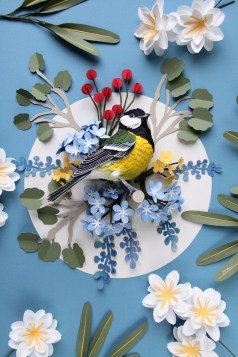
The cover! Although the book cover is beautiful, it doesn’t show the three-dimensionality of the original work. Since you can’t really tell how the cover was constructed, I included the image below from Barbara Beltran Herrera’s (the artist who works in paper sculpture) website to show how the objects extend out from the background. How cool would it have been if the cover had been three-dimensional like this, with plastic cover over it! How much would that have cost? But what a treasured artifact it would have been.
THE FOOD:
At Christmas, Mrs. Doyle at the shop where Eunice buys their daily doughnuts, was bagging up some slices of Tottenham Cake for the customer just before Eunice. It was so casually mentioned, as though everyone knew what Tottenham cake is. Well, now I, too, know. Tottenham is a district north of London in the borough of Haringey. The cake was originally sold by a baker called Henry Chalkley, a Friend, or Quaker. It was a sponge cake covered in pink icing or jam that sold for one pence. If the piece was irregular or broken up, it was half that. The pink coloring was derived from mulberries growing at the Tottenham Friends Burial Ground. It was originally intended for children, I read, but I’m not sure why.
TOTTENHAM CAKE
Serves: 12
Cake
1½ sticks softened unsalted butter
¾ C sugar
1½ C all purpose flour
2¼ tsp baking soda
¾ tsp salt
3 eggs
½ tsp vanilla extract
Icing
1 heaping cup confectioners sugar
5 tsp water/black currant juice
pink food coloring (only needed if you use water instead of juice)
Pre-heat oven to 350º
Line an 8″x 8″ square tin with parchment paper, then grease the pan and parchment with butter or Crisco.
In a large bowl, using an electric mixer on high, cream together the butter and sugar until it becomes a light and fluffy. This takes about 2 minutes, but you may need to clear the beaters intermittently to make sure everything gets mixed.
Add the vanilla extract to the butter mixture. Mix until combined. Turn the mixer to low or medium-low and beat in the eggs, one at a time. Once the eggs are mixed, turn the mixer to low and add in the flour all at once. Mix until just combined.
Pour the batter into the prepared pan. Bake in the middle of the oven for 25-30 minutes. The cake is done when a toothpick inserted in the center comes out clean. Let the cake cool.
While the cake is cooling prepare the icing. In a medium bowl, add the confectioners sugar. One teaspoon at a time add the blackcurrant juice or water and just a bit of food coloring. Mix in between each teaspoon. Keep adding liquid until the icing looks like proper frosting and is thick enough to spread but not so thick it would rip up the cake when you spread it on. (Note: you may not need all the liquid or you may need more, just mix until it feels right to you. If it gets too drippy, then add more sugar) Let the icing sit for a minute it will harden and get shiny. Spread the icing all over the top of the cake.
Cut the cake into squares and serve.
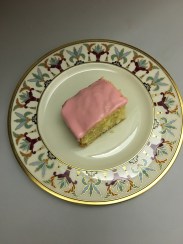
I liked the sponge cake, but the icing was too sweet for me. I would use my homemade raspberry jam next time, and maybe some whipped cream.
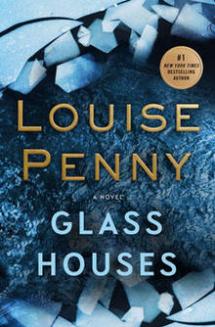 Louise Penny has taken the mystery to a higher level in this, her latest Three Pines novel. I was totally drawn into the story from the beginning, only putting the book down to eat and sleep during the twenty-four hour period that it took to reach the satisfying conclusion. The book begins with Armand Gamache, the Chief Superintendent of the Surete de Quebec (a post he had previously turned down twice) testifying in court as a witness for the prosecution in a murder case. The story is told back and forth in time, between the trial and the events that led to the defendant’s arrest. The case against the defendant in the courtroom scenes slowly reveal the evidence indicating culpability and gives the reader a perspective similar to that of the jury. The scenes describing the events prior to the trial lead the reader eventually to the conclusion that there is something else at play here, that elements of the two vantage points don’t mesh to form a clear picture. More information is needed. More than other mysteries I’ve read, I felt empowered here, to solve the mystery myself. Penny seemlessly revealed the facts, and the feelings of the characters, leading me to questions that I felt needed answering in order to figure the whole thing out.

 I ordered this book prior to publication in the US because my trusted literary advisor, Simon Savidge, gave it 5 stars on Goodreads, (also, it was shortlisted for the Bailey’s Prize, now known as the Women’s Prize for Fiction). Simon’s recommendation was more of a selling point for me because I usually like the books he recommends, and have a history of not liking the books nominated for major prizes. It turned out to be well worth my time and effort. Since the book was primarily about how culture affects personal lives and choices, I learned a bit about Nigerian culture, particularly as it relates to marriage and parenthood. The names in the book were Yoruban, so I assumed that was the basis for the cultural circumstances presented in the book. The main character, Yejide, is happily married to Akin, who adores her. They attempt, unsuccessfully, to have children. After a couple of years, Akin’s mother starts to pressure him to take a second wife in the hope that she will provide the much-revered grandchild. This presents problems for the couple, as one might imagine, and the book proceeds to explore how Yejide and Akin and their family navigate their way through this difficult situation. There was a point where I was having trouble buying in to some of the plot directions and had to remind myself that I was not familiar with Nigerian culture. I did a little online research and found that in the context of that culture, the things that I had difficulty with were perfectly plausible.
 As a former teacher of ancient history, albeit the sixth grade version, I was intrigued by a retelling of the story of Clytemnestra, in Oresteia by Aeschylus. I wondered why a literary talent like Colm Toibin would go there: what did he hope to add to or illuminate in the story? What I found was a kindred spirit, someone who, like me, found this connection to the ancients endlessly fascinating and relevant to our modern lives. The first chapter, Clytemenestra’s story, is chilling. “I have been acquainted with the smell of death. The sickly, sugary smell that wafted in the wind towards the rooms in the palace.” Prior to reading, I had no expectations, only excited anticipation, but reading those words left me goose-fleshed, and curiously, understanding of the wave of emotion that preceded those words. I don’t think I’ve ever had a murderous thought in my life, yet I completely understood what Clytemnestra was feeling at that moment, when her only focus was to eliminate the husband who shattered her existence by his betrayal. The one who, by lying to her, made her complicit in the death of their daughter, Iphigenia, who was sacrificed to appease the gods, to win their favor, and win a war. In what universe are those acts noble?
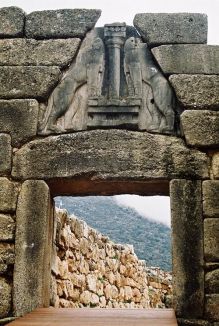 The Lion Gate is the main entrance to the citadel, named for the relief sculpture of the two lions or lionesses above the door (their heads are missing). It is the only surviving example of Mycenaen sculpture. It was so well-described in the writings of antiquity that it was known among archaeologists in modern times.
 The remains of the ancient city of Mycenae were found by a native Greek and professional archaeologist, Kyriakos Pittakis, in 1841. Pittakis discovered the Lion Gate, but the real excavations would come 35 years later by a complete amateur, Heinrich Schliemann. Schliemann had already made his mark in the field of archaeology by discovering the remains of Troy in what is today Hisarlik,Turkey. In excavating Mycenae, he wanted to prove that world of Homer was based on archaeological remains.
 This is an engaging book about one of my favorite subjects. Shapiro begins with a well-worn Brillat Savarin quote, “Tell me what you eat, and I shall tell you who you are.” Laura Shapiro found her way into this book through insomnia. Hoping that a visit to the Lake District in a biography of Dorothy Wordsworth would lull her to sleep, she had an “aha” moment when she read that their cook was feeding them black pudding for dinner. Here was a woman that Shapiro thought she knew, one devoted to her brother, William, leaving him the time and space to create his poetry. As she researched what the Wordsworths ate and how Dorothy cooked, she began to find someone different from the portrait that had become conventional wisdom about Dorthy Wordsworth, and that was the seed of an idea that grew into this book.
 bbfbooksbeautyfood