THE BOOK:
 I’ve wanted to read this book for a long time, as it comes up frequently when podcasters talk about books with twisty plots, so I was prepared to really like it, which I did- it was definitely a page-turner. The story is told in a series of letters from Eva to
Franklin, her husband. Franklin and Eva have one son, Kevin, who has committed an atrocity against his schoolmates. (No spoilers here, it’s all on the book jacket.) Through the writing of the letters, Eva reflects on her family in an attempt to understand and process all of the horror, so the reader only gets Eva’s point of view, which is perhaps why I found Franklin so unlikable. His staunch support of Kevin beginning in infancy seemed unrealistic and at times unnatural, begging the question, what is Franklin trying to prove? In order to consider himself a good father, must he view everything Kevin does in a positive light? Or given the opportunity, would Franklin have told a different story? It is questions like these that make the book such a good candidate for discussion. It reminded me of Defending Jacob by William Landay, and The Dinner by Herman Koch. All three books explore nature versus nurture and the lengths to which a parent will go in protecting their children. The reflective nature of the narrative in We Need to Talk About Kevin made it a more ponderous read, but also a deeper, richer examination of lives in turmoil. I highly recommend it.
THE BEAUTY:
When Eva first learns that she is pregnant, she surprises herself when she bursts into song- not showtunes, but Armenian folk songs that her mother used to sing to her and her brother when they were children. Her mother was shocked, but pleased when Eva called to ask her the words to a favorite, “Soode, Soode.” According to the book, the words mean, “It’s a lie, it’s a lie, it’s a lie, everything’s a lie; in this world everything’s a lie.” The irony of these lyrics make this the perfect, double-edged source of beauty and pain in the book.
On a historical note, this song was purported to have been written by Armenians in America. This style of music is referred to as the “kef” style, meant to be enjoyed at parties for dancing and general merriment. With the increase in the Armenian population in the United States after the Armenian genocide, the style continued to be played and also evolve, as it took on influences from other cultures and incorporated new instruments and compositions. Start this video at the beginning. After about the 1 minute mark, after the dancers have cycled through, the melody repeats itself, so you’ll get the flavor of the music in this small portion of the clip.
Published on YouTube June 21, 2015, it was recorded at the St. James Armenian Festival in Watertown, Massachusetts.
THE FOOD:
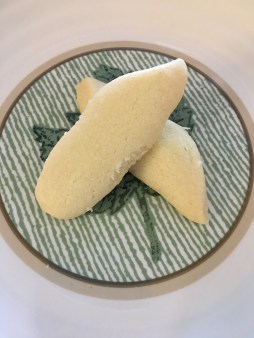
When Kevin was ten, Eva and her mother were in the kitchen making khurabia, Armenian sugar cookies, while Kevin, in another room, was systematically cutting up the custom Christmas cards his grandmother had just finished making for a wealthy client, transforming hours of work into ragged paper snowflakes. Having just posted another Armenian recipe, I find these accidental coincidences of topic curious. I certainly did not set out to explore Armenian culture, but here I am, exploring Armenian culture.
Khurabia (Armenian Sugar Cookies)
Makes: about 3 dozen
1 ½ cups (3 sticks) salted butter (about)
1 cup granulated sugar (process in food processor for about 1 minute to break down granules)
2 cups flour
Clarify butter: Melt butter over low heat in a heavy saucepan without stirring. When the butter is completely melted, skim the foam off the top and discard it. You will see a clear oily layer atop milk solids. You can buy ghee at some grocery stores, but at my local one, it was $12.95 a jar, so I opted to make my own.
Slowly pour the clear liquid into a measuring cup, leaving the milk solids in the saucepan; discard them. Measure 1 cup of the clarified butter and put in refrigerator until it’s hard (solid) enough to beat.
In bowl, whip butter until it’s almost white. Add sugar and whip until mixed. Add flour, mix in with a spoon and then knead it with your hands, like kneading bread dough. This incorporates all of the flour into the mixture. It takes about 3 to 4 minutes. The sugar granules will break down a little bit, and you should be able to roll it out with your hands and the dough will all stick together as one ball. This kneading process allows the sugar crystals to become less grainy, to disintegrate, and in the end the khurabia will be more delicate and melt in your mouth.
Depending on the environment, humidity and weather, you might have to put in an additional spoonful of flour and mix it in. If the dough gets too soft, you also may put it in the refrigerator for a few minutes to make it more workable.
Preheat oven to 325º degrees.
Take a handful of dough and roll with palm of hand on a cutting board into a rope until it is the diameter of a nickel.
Cut into about 2 inch pieces, on the diagonal, and put on an ungreased cookie sheet. Leave room between the cookies as they will expand a little in the oven. If desired, use a fork to make little hatch marks on the top of the dough for decoration. Bake in preheated oven 15 minutes. Remove cookies from oven but leave them on the sheet to cool. Do not remove from cookie sheet until they are cool. Khurabia may be stored in the freezer. They were light, fluffy with a delicate taste to match. Delicious.
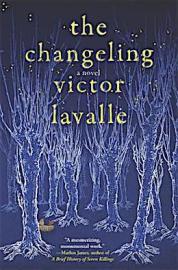
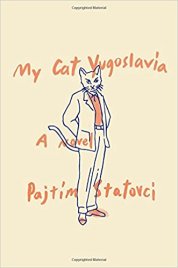 I had seen this book on a list of anticipated debut novels for 2017, and remembered it because of the cat in the title and the cover drawing. I’ve talked so much about book covers recently, that I’m pretty sure this is a banner year for them, at least among the books I’ve read. That cat has more style than me! When I picked up a hold at the library the other day, I went to the shelves of new books conveniently situated near the exit, where this book was displayed with the front cover facing out, so of course I had to go back and check it out. After reading the second chapter, where Bekim purchases a boa constrictor and all of its accoutrement, I didn’t know if I wanted to continue with the book. I have an intense loathing of snakes, and don’t even like saying the word. But I persisted (I need an emoji for irony) because I hadn’t yet met the other protagonist who had been introduced in the blurb. I was immediately rewarded and drawn completely in to the story as I read on.
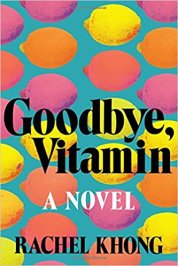 One holiday, thirty year-old Ruth Young spent Christmas with her parents and decided at the end of the visit that she wanted to come back to live with them for a year. So she does. During this time, she keeps a diary, recording things that happen, her memories and reflections of her childhood, and of her family’s history. She learned that her father, Howard, had begun a journal himself, starting when she was small. Initially, the reader sees only a few snippets of what Howard wrote, but as more and more are revealed, the reader is treated to a precious view of a father’s love for his funny, quirky, intelligent daughter, reflected in his observations of her. Here is the first entry:

 The epigraph in
 This was a disturbing read. It follows Alexandra, a captive in the sex trade industry, from her kidnapping as a young teenager in Armenia to her arrival in Bronxville, New York as a stripper at a bachelor party in a private home. It is a heartbreaking story, but also a testament to the human spirit’s ability to survive. While fiction, it is based on actual stories researched by the author. In an interview he suggests that there is much nonfiction in the world to better address the issue of sex trafficking. He hopes that his book shines a light on human trafficking in a way that nonfiction might not be able to by prompting an emotional response as the reader connects to these very real, very human, very flawed characters. He also wants the reader to be invested in the two remarkable female characters in the story and the breakdown of a marriage.

 bbfbooksbeautyfood